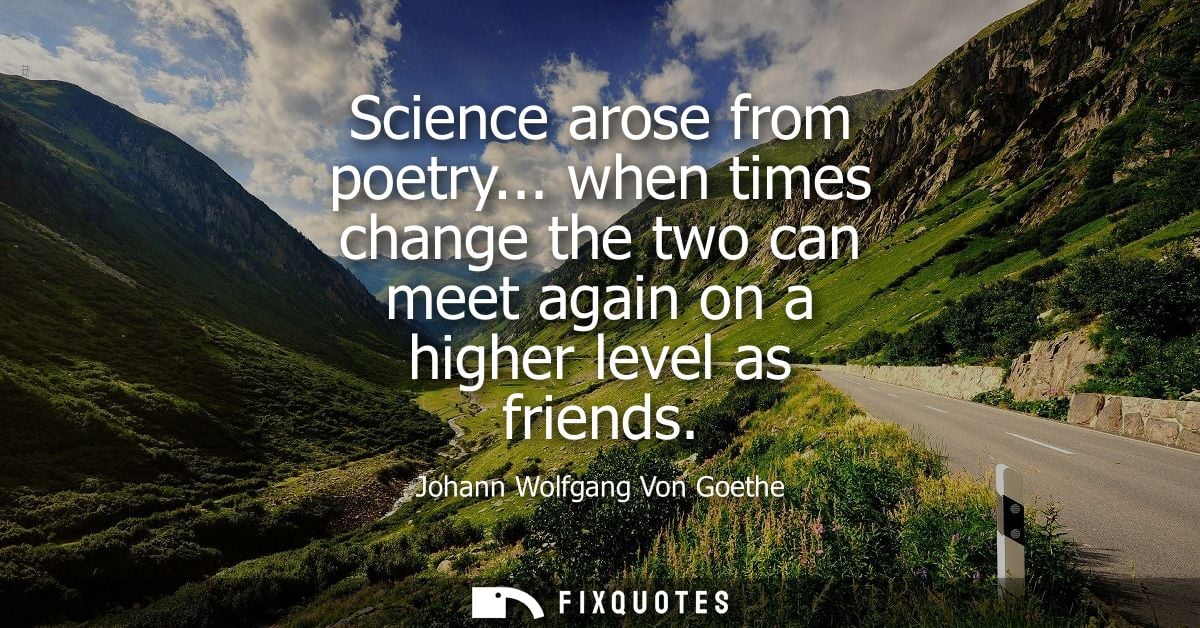
"Science arose from poetry... When times change, the two can meet again on a higher level as friends"
About this Quote
The subtext is Goethe defending his own hybrid mind. He lived at the hinge of Enlightenment rationalism and Romantic revolt, and he refused to surrender nature to pure measurement. In works like his color theory and his botanical studies, he argued that how we perceive matters, that the observer isn’t a removable stain on the data. That put him at odds with the Newtonian story of objective optics, and the quote quietly recruits history to his side: the split is contingent, not inevitable.
“When times change” carries a political and cultural wager. Specialization, bureaucracy, and professional science have made knowledge efficient but narrow; poetry becomes the quarantined “humanities.” Goethe imagines a reconciliation “on a higher level,” not a return to superstition but an upgrade: science with imagination, poetry with rigor, each checking the other’s worst habits. Friends, not rivals - because the real enemy is a culture that mistakes precision for truth and dismisses wonder as childish.
Quote Details
| Topic | Wisdom |
|---|---|
| Source | Help us find the source |
| Cite |
Citation Formats
APA Style (7th ed.)
Goethe, Johann Wolfgang Von. (2026, February 20). Science arose from poetry... When times change, the two can meet again on a higher level as friends. FixQuotes. https://fixquotes.com/quotes/science-arose-from-poetry-when-times-change-the-7943/
Chicago Style
Goethe, Johann Wolfgang Von. "Science arose from poetry... When times change, the two can meet again on a higher level as friends." FixQuotes. February 20, 2026. https://fixquotes.com/quotes/science-arose-from-poetry-when-times-change-the-7943/.
MLA Style (9th ed.)
"Science arose from poetry... When times change, the two can meet again on a higher level as friends." FixQuotes, 20 Feb. 2026, https://fixquotes.com/quotes/science-arose-from-poetry-when-times-change-the-7943/. Accessed 24 Mar. 2026.