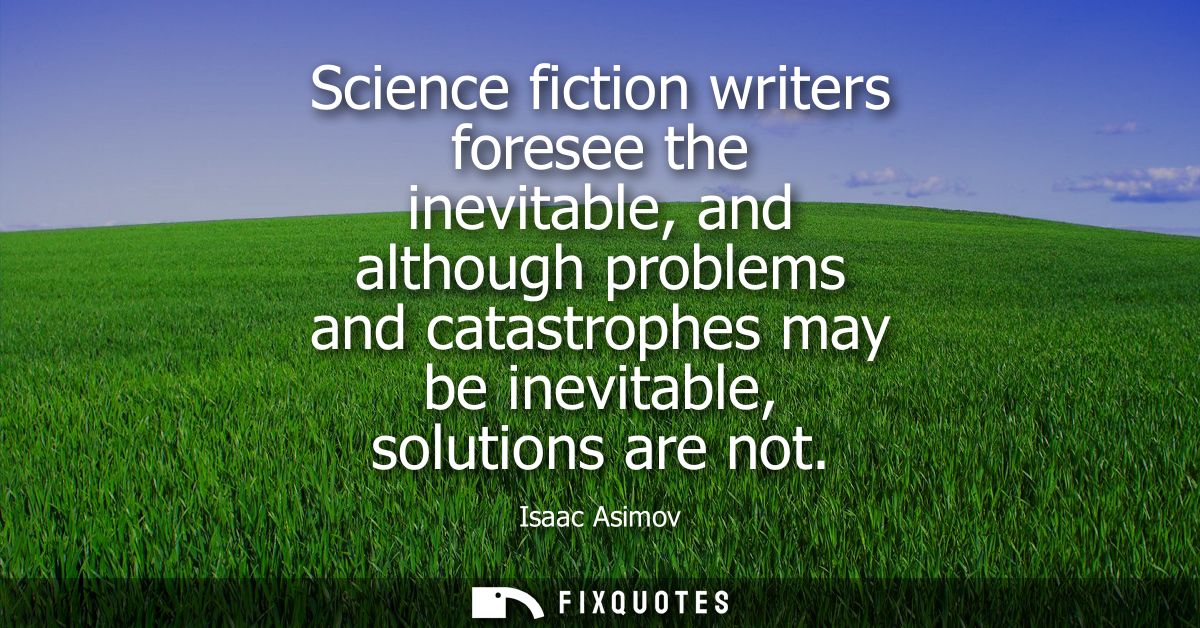
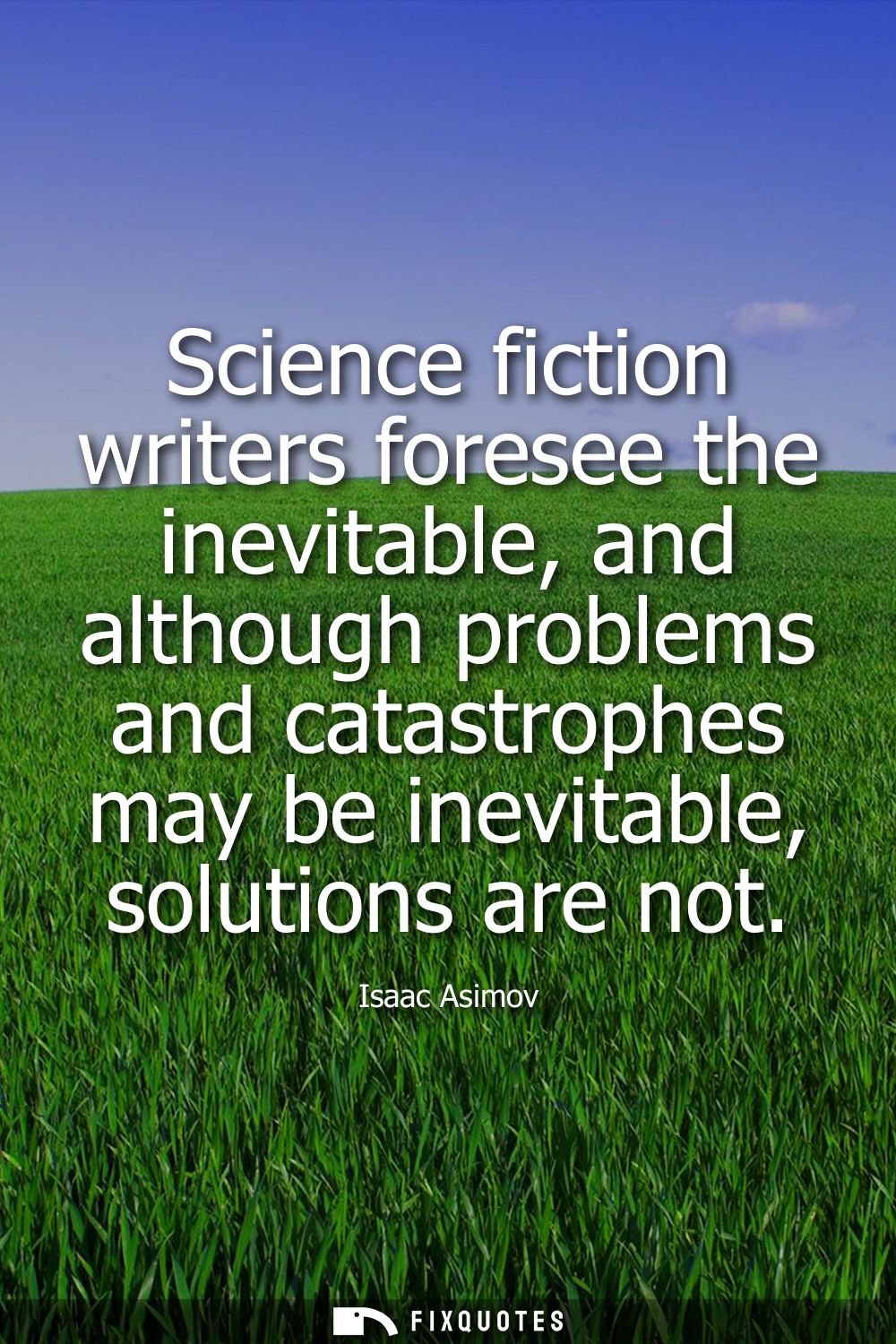
"Science fiction writers foresee the inevitable, and although problems and catastrophes may be inevitable, solutions are not"
About this Quote
The sentence pivots on a crucial asymmetry. Catastrophes can be “inevitable” in the sense that complex systems break, empires overreach, technologies spill into misuse. Solutions, by contrast, are not baked into physics. They require politics, imagination, coordination, and moral courage - the messy human variables that don’t obey tidy laws. That’s why the second clause lands like a cold splash: it punctures the comforting idea that progress automatically arrives to clean up after progress.
Context matters. Asimov wrote in the long shadow of nuclear weapons, Cold War brinkmanship, and the acceleration of industrial and computational power. His era was saturated with apocalyptic foresight, from mushroom clouds to environmental collapse. The quote positions science fiction as a diagnostic tool, not a salvation narrative: it can map the cliff edge, but it can’t guarantee the bridge.
Subtext: if you’re relying on “inevitable solutions,” you’re already rehearsing your excuse.
Quote Details
| Topic | Science |
|---|---|
| Source | Help us find the source |
| Cite |
Citation Formats
APA Style (7th ed.)
Asimov, Isaac. (2026, January 15). Science fiction writers foresee the inevitable, and although problems and catastrophes may be inevitable, solutions are not. FixQuotes. https://fixquotes.com/quotes/science-fiction-writers-foresee-the-inevitable-20044/
Chicago Style
Asimov, Isaac. "Science fiction writers foresee the inevitable, and although problems and catastrophes may be inevitable, solutions are not." FixQuotes. January 15, 2026. https://fixquotes.com/quotes/science-fiction-writers-foresee-the-inevitable-20044/.
MLA Style (9th ed.)
"Science fiction writers foresee the inevitable, and although problems and catastrophes may be inevitable, solutions are not." FixQuotes, 15 Jan. 2026, https://fixquotes.com/quotes/science-fiction-writers-foresee-the-inevitable-20044/. Accessed 27 Mar. 2026.