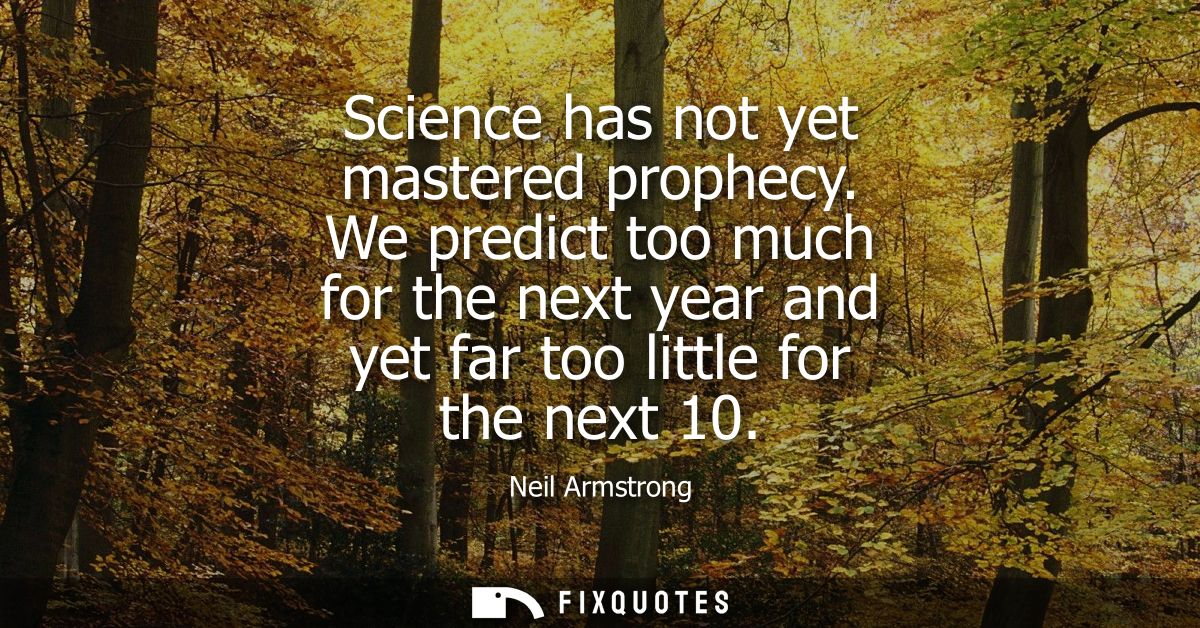
"Science has not yet mastered prophecy. We predict too much for the next year and yet far too little for the next 10"
About this Quote
The punch is in the asymmetry: “too much for the next year” and “far too little for the next 10.” Short-term predictions balloon because they’re incentivized. Media cycles demand novelty; funding cycles reward confident timelines; corporations sell roadmaps; politicians crave deliverables. So we overfit the present, mistaking momentum for destiny. Meanwhile the decade-scale shifts - infrastructure, demographics, climate, computing platforms, geopolitics - accumulate quietly and then rearrange everything. Armstrong’s subtext is that the big changes are rarely the ones we storyboard. They’re systemic, not spectacular.
The context matters: space exploration itself is the ultimate case study in miscalibrated futurism. The 1960s promised moon bases by the year 2000; the next year’s reality was always budgets, setbacks, and incremental engineering. Armstrong, emblem of a gigantic leap, points out that leaps are usually visible only in retrospect. The quote isn’t pessimism; it’s a demand for better time horizons - and less showboating certainty.
Quote Details
| Topic | Science |
|---|---|
| Source | Help us find the source |
| Cite |
Citation Formats
APA Style (7th ed.)
Armstrong, Neil. (2026, January 18). Science has not yet mastered prophecy. We predict too much for the next year and yet far too little for the next 10. FixQuotes. https://fixquotes.com/quotes/science-has-not-yet-mastered-prophecy-we-predict-1013/
Chicago Style
Armstrong, Neil. "Science has not yet mastered prophecy. We predict too much for the next year and yet far too little for the next 10." FixQuotes. January 18, 2026. https://fixquotes.com/quotes/science-has-not-yet-mastered-prophecy-we-predict-1013/.
MLA Style (9th ed.)
"Science has not yet mastered prophecy. We predict too much for the next year and yet far too little for the next 10." FixQuotes, 18 Jan. 2026, https://fixquotes.com/quotes/science-has-not-yet-mastered-prophecy-we-predict-1013/. Accessed 20 Mar. 2026.