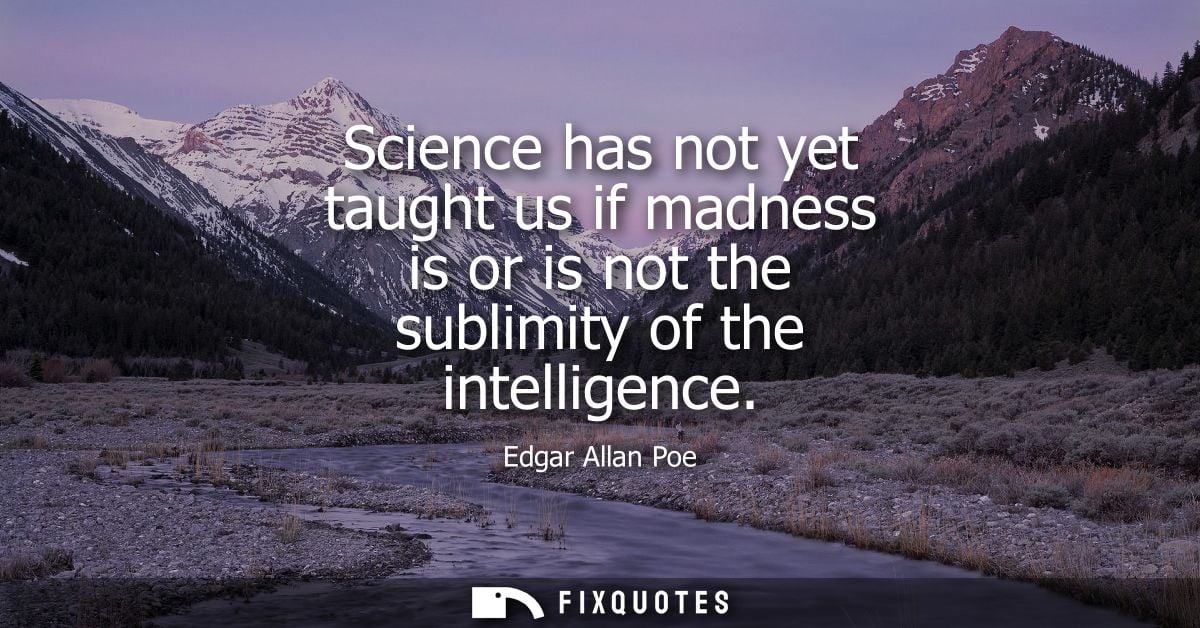
"Science has not yet taught us if madness is or is not the sublimity of the intelligence"
About this Quote
The subtext is both self-defense and provocation. Poe lived in a culture where the asylum was becoming modernized, where phrenology and early psychiatry promised clean explanations for unruly minds. His writing, meanwhile, is packed with narrators whose logic is razor-sharp and catastrophically misapplied. By calling madness “the sublimity of the intelligence,” he turns the Romantic myth of the tormented genius into a paradox: maybe insanity isn’t the absence of reason, but reason driven past the speed limit, a mind so intensely pattern-seeking it starts manufacturing meaning.
That’s why the sentence works: it flatters intelligence while warning about its edge. Poe doesn’t romanticize breakdown as cute eccentricity. He suggests a more unsettling possibility - that lucidity and delusion share a border, and the crossing can look, from the inside, like transcendence.
Quote Details
| Topic | Deep |
|---|---|
| Source | Help us find the source |
| Cite |
Citation Formats
APA Style (7th ed.)
Poe, Edgar Allan. (2026, January 17). Science has not yet taught us if madness is or is not the sublimity of the intelligence. FixQuotes. https://fixquotes.com/quotes/science-has-not-yet-taught-us-if-madness-is-or-is-28942/
Chicago Style
Poe, Edgar Allan. "Science has not yet taught us if madness is or is not the sublimity of the intelligence." FixQuotes. January 17, 2026. https://fixquotes.com/quotes/science-has-not-yet-taught-us-if-madness-is-or-is-28942/.
MLA Style (9th ed.)
"Science has not yet taught us if madness is or is not the sublimity of the intelligence." FixQuotes, 17 Jan. 2026, https://fixquotes.com/quotes/science-has-not-yet-taught-us-if-madness-is-or-is-28942/. Accessed 12 Feb. 2026.