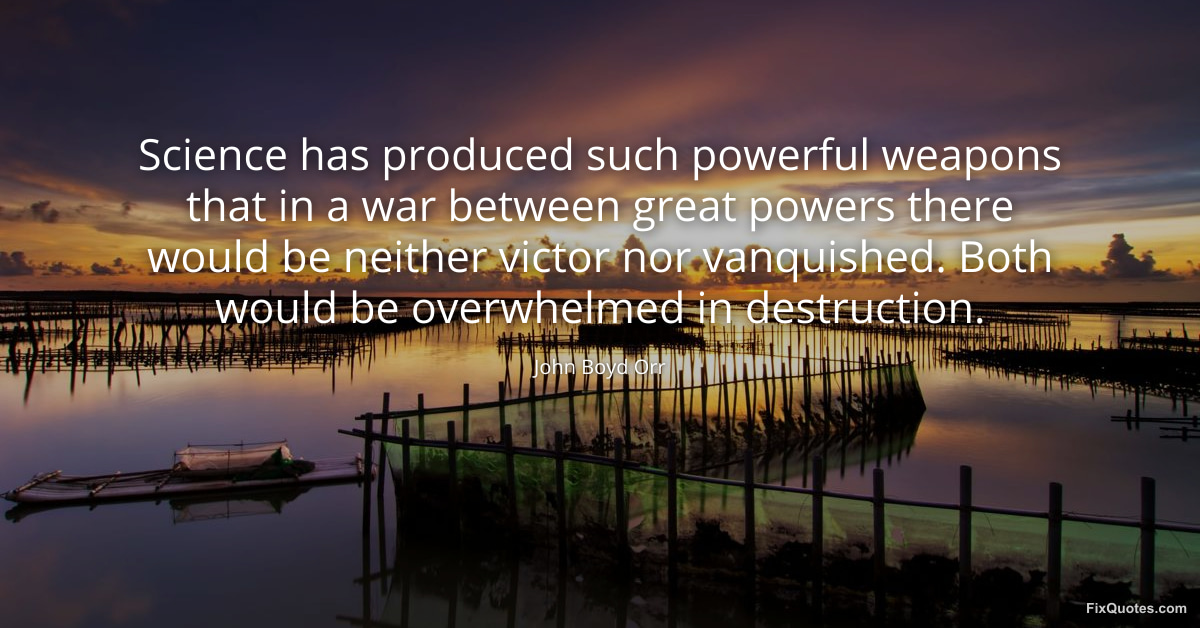
"Science has produced such powerful weapons that in a war between great powers there would be neither victor nor vanquished. Both would be overwhelmed in destruction"
About this Quote
The rhetorical hinge is “neither victor nor vanquished.” Orr borrows the old grammar of war - winners and losers - only to cancel it. That’s a political move as much as a philosophical one: if total war can’t deliver a usable win, then the traditional arguments for deterrence, honor, or strategic necessity start to look like antique props. “Both would be overwhelmed in destruction” finishes the thought with a kind of bureaucratic fatalism. Not “defeated,” not “punished,” but overwhelmed: swamped by consequences too large to manage.
Context sharpens the intent. Orr came of age through World War I, watched the interwar faith in technology metastasize into mechanized slaughter, and then lived into the nuclear era when “great powers” stopped meaning armies and started meaning extinction-level capability. The subtext is a policy plea disguised as a fact: arms races aren’t just dangerous; they’re irrational. If the end state is mutual ruin, restraint becomes the only form of realism left.
Quote Details
| Topic | War |
|---|---|
| Source | Later attribution: The Word Factory (Oscar Whinge, 2016) modern compilationISBN: 9781482860313 · ID: JkpJDAAAQBAJ
Evidence:
... Science has produced such powerful weapons that in a war between great powers there would be neither victor nor vanquished. Both would be overwhelmed in destruction. {John Boyd Orr} War means blind obedience, unthinking stupidity ... |
| Cite |
Citation Formats
APA Style (7th ed.)
Orr, John Boyd. (2026, March 31). Science has produced such powerful weapons that in a war between great powers there would be neither victor nor vanquished. Both would be overwhelmed in destruction. FixQuotes. https://fixquotes.com/quotes/science-has-produced-such-powerful-weapons-that-74933/
Chicago Style
Orr, John Boyd. "Science has produced such powerful weapons that in a war between great powers there would be neither victor nor vanquished. Both would be overwhelmed in destruction." FixQuotes. March 31, 2026. https://fixquotes.com/quotes/science-has-produced-such-powerful-weapons-that-74933/.
MLA Style (9th ed.)
"Science has produced such powerful weapons that in a war between great powers there would be neither victor nor vanquished. Both would be overwhelmed in destruction." FixQuotes, 31 Mar. 2026, https://fixquotes.com/quotes/science-has-produced-such-powerful-weapons-that-74933/. Accessed 4 Apr. 2026.