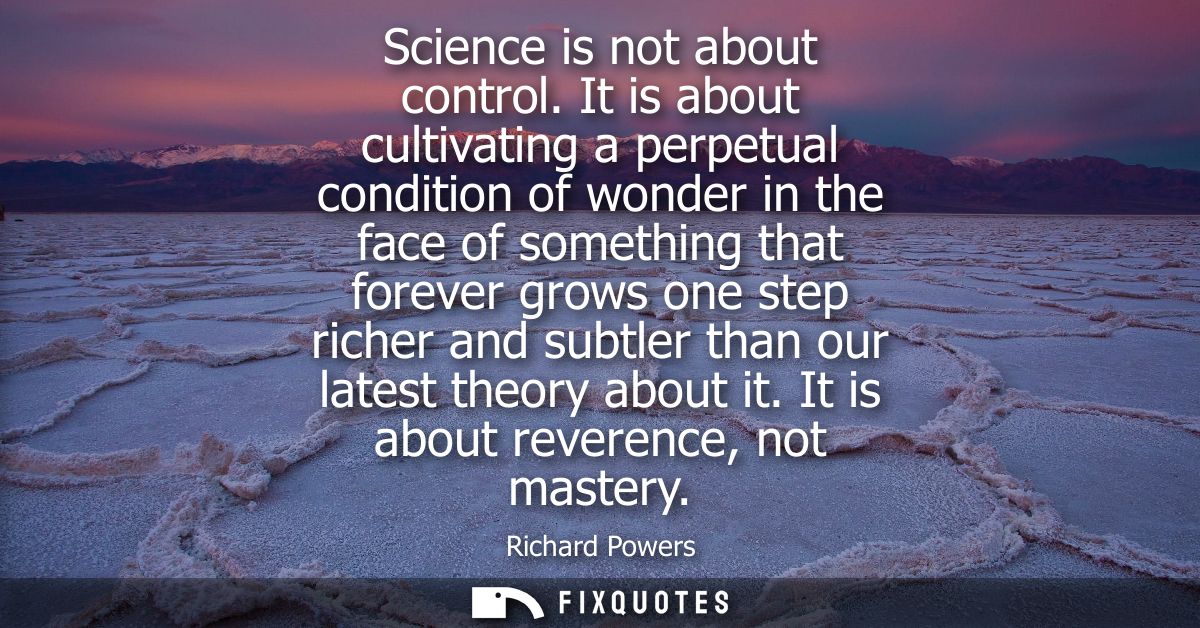
"Science is not about control. It is about cultivating a perpetual condition of wonder in the face of something that forever grows one step richer and subtler than our latest theory about it. It is about reverence, not mastery"
About this Quote
Power slips a knife into the modern tech-era fantasy that science is a remote control for reality. In an age when "innovation" gets sold as domination (optimize the body, hack the brain, engineer the climate, fix the mess), he insists on science as a discipline of humility: not a ladder to stand above the world, but a practice that keeps you close enough to be surprised by it.
The engine of the passage is its refusal of closure. "Perpetual condition of wonder" turns curiosity into an ethic, not a mood; it suggests a stance you maintain even when you could be tempted by certainty. Powers then gives wonder teeth by describing the world as "one step richer and subtler than our latest theory". That "one step" matters: close enough to chase, far enough to never quite capture. It frames knowledge as asymptotic, always improving, never final, and it quietly rebukes the institutional pressures that reward decisive answers, clean narratives, and measurable "impact."
Calling it "reverence, not mastery" borrows spiritual language without preaching, which is exactly the point. Powers, a novelist steeped in ecology and systems thinking, treats scientific inquiry less like conquest and more like relationship. The subtext is political as much as philosophical: when science is tethered to control, it becomes an accomplice to extraction, surveillance, and managerial arrogance. When it is tethered to reverence, it can still be rigorous, but it resists the cultural demand that everything meaningful must also be ownable.
The engine of the passage is its refusal of closure. "Perpetual condition of wonder" turns curiosity into an ethic, not a mood; it suggests a stance you maintain even when you could be tempted by certainty. Powers then gives wonder teeth by describing the world as "one step richer and subtler than our latest theory". That "one step" matters: close enough to chase, far enough to never quite capture. It frames knowledge as asymptotic, always improving, never final, and it quietly rebukes the institutional pressures that reward decisive answers, clean narratives, and measurable "impact."
Calling it "reverence, not mastery" borrows spiritual language without preaching, which is exactly the point. Powers, a novelist steeped in ecology and systems thinking, treats scientific inquiry less like conquest and more like relationship. The subtext is political as much as philosophical: when science is tethered to control, it becomes an accomplice to extraction, surveillance, and managerial arrogance. When it is tethered to reverence, it can still be rigorous, but it resists the cultural demand that everything meaningful must also be ownable.
Quote Details
| Topic | Science |
|---|
More Quotes by Richard
Add to List