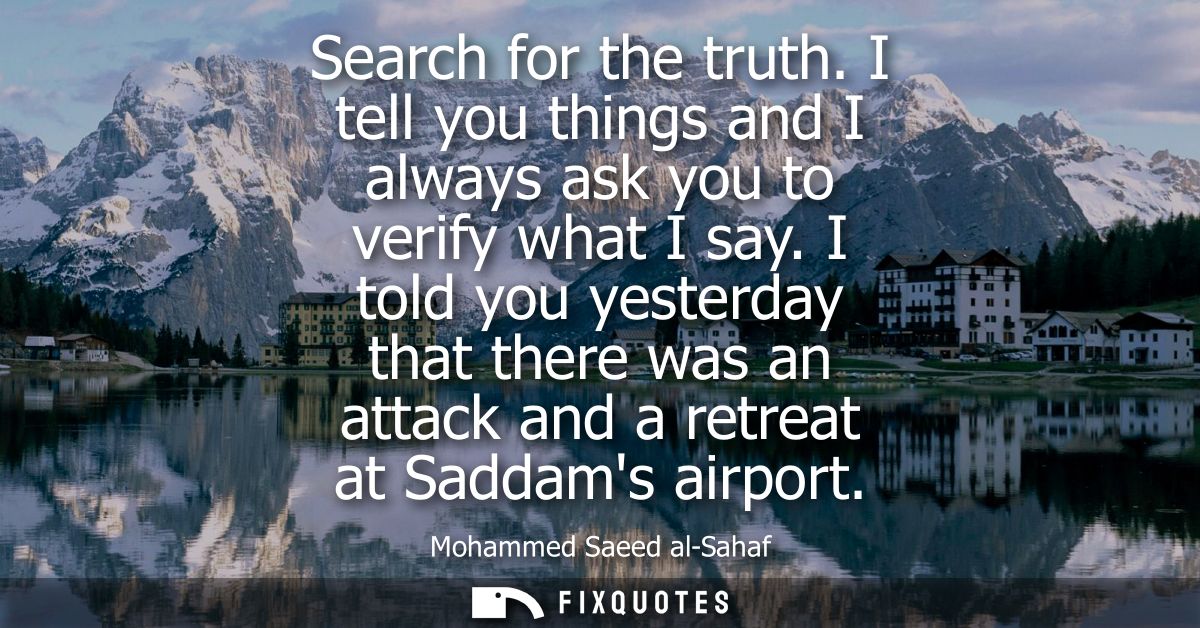
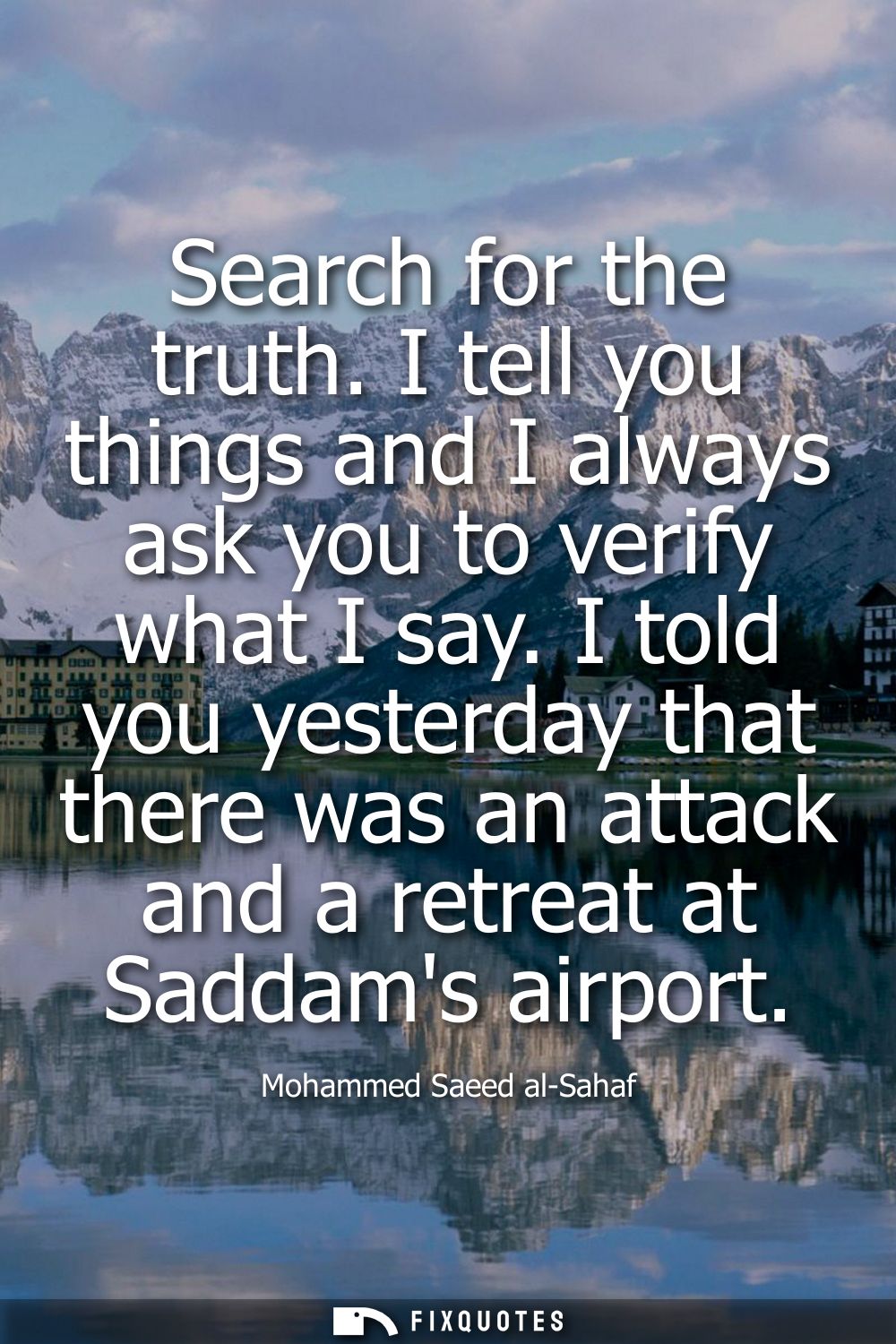
"Search for the truth. I tell you things and I always ask you to verify what I say. I told you yesterday that there was an attack and a retreat at Saddam's airport"
About this Quote
It takes a special kind of nerve to sell certainty while begging to be fact-checked. Mohammed Saeed al-Sahaf, Saddam Hussein's information minister during the 2003 invasion of Iraq, is performing that trick here: he wraps propaganda in the language of skepticism. "Search for the truth" and "verify what I say" sound like an invitation to independent judgment. In practice, they're a rhetorical shield, preemptively laundering his claims through the audience's desire to feel discerning.
The context matters: coalition forces were advancing fast, and al-Sahaf became globally known for issuing confident battlefield updates that often clashed with live footage. Mentioning "an attack and a retreat at Saddam's airport" isn't just a tactical detail. It's a narrative repair kit. Airports are symbols of sovereignty, gateways of control; to concede anything there would be to concede the war's direction. So he offers a carefully balanced micro-drama: yes, something happened (an "attack"), but Iraq reasserted agency (a "retreat"). The symmetry is the point, a made-for-TV arc that turns chaos into competence.
The subtext is less "trust me" than "trust the idea that reality is contested". By framing truth as something you must "search" for, he implies competing versions are natural, even when one side has tanks at the runway. It's a last-ditch attempt to keep the regime's story plausible long enough to function: to steady loyalists, confuse opponents, and project resilience. In that sense, the line is almost accidentally modern, anticipating the rhetorical move of flooding the zone with doubt while sounding pro-truth.
The context matters: coalition forces were advancing fast, and al-Sahaf became globally known for issuing confident battlefield updates that often clashed with live footage. Mentioning "an attack and a retreat at Saddam's airport" isn't just a tactical detail. It's a narrative repair kit. Airports are symbols of sovereignty, gateways of control; to concede anything there would be to concede the war's direction. So he offers a carefully balanced micro-drama: yes, something happened (an "attack"), but Iraq reasserted agency (a "retreat"). The symmetry is the point, a made-for-TV arc that turns chaos into competence.
The subtext is less "trust me" than "trust the idea that reality is contested". By framing truth as something you must "search" for, he implies competing versions are natural, even when one side has tanks at the runway. It's a last-ditch attempt to keep the regime's story plausible long enough to function: to steady loyalists, confuse opponents, and project resilience. In that sense, the line is almost accidentally modern, anticipating the rhetorical move of flooding the zone with doubt while sounding pro-truth.
Quote Details
| Topic | Truth |
|---|---|
| Source | Help us find the source |
More Quotes by Mohammed
Add to List