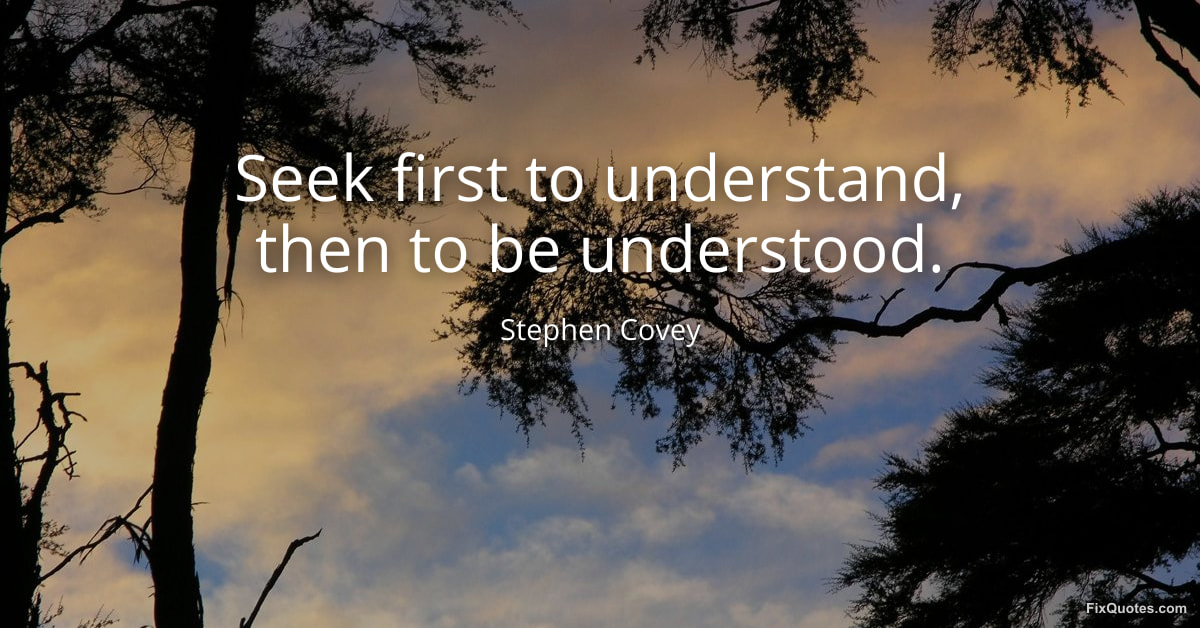
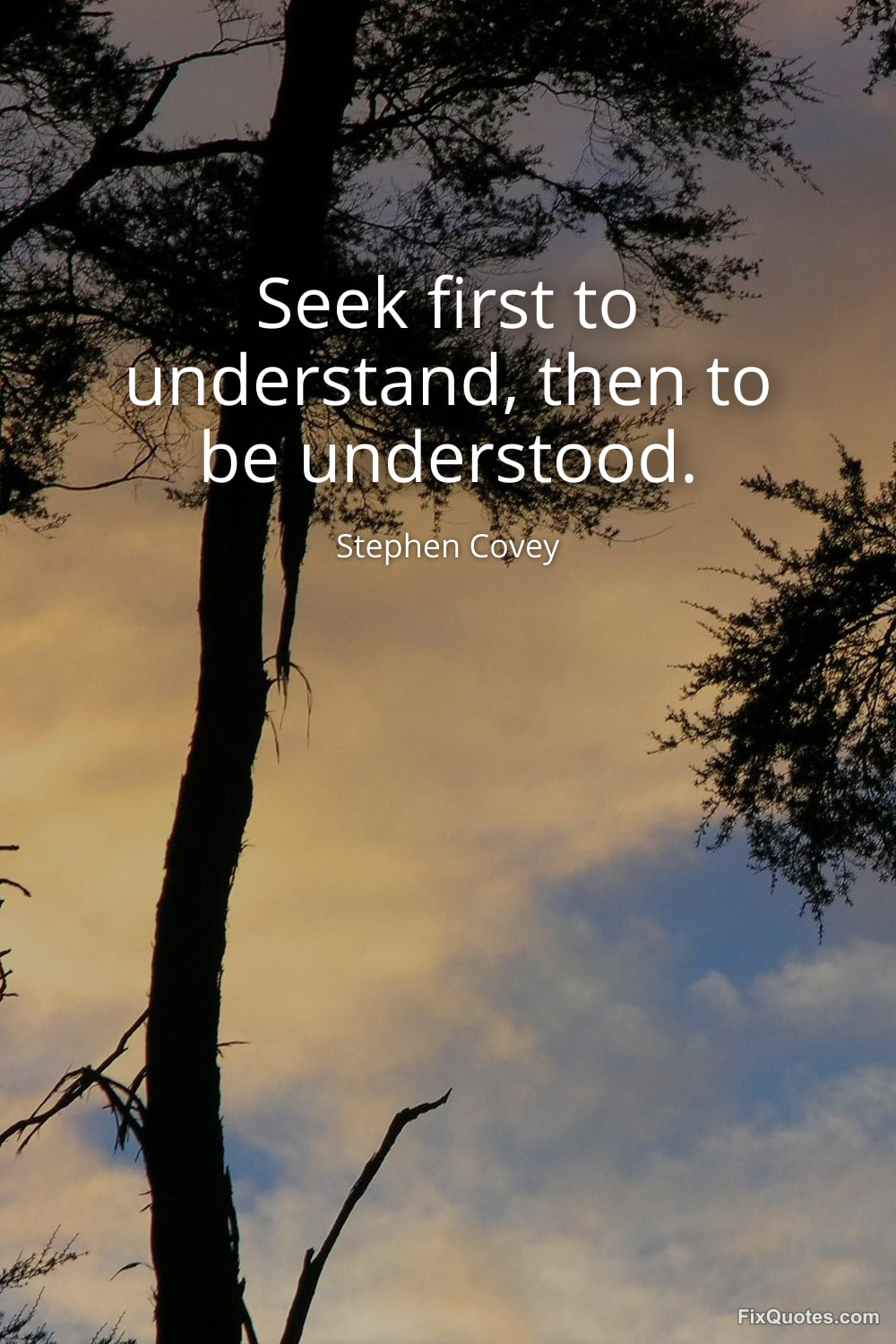
"Seek first to understand, then to be understood"
About this Quote
Covey’s line is a piece of corporate-era moral judo: it flips the default posture of modern communication from performance to reception. In offices, on panels, even at dinner, we’re rewarded for speed, certainty, and the clean articulation of our own position. “Seek first to understand” slows that reflex down and reframes influence as something earned, not seized. The hidden claim is pragmatic, not saintly: understanding is leverage.
The phrase works because it’s staged like a two-step negotiation. Step one isn’t “agree,” it’s “understand” - an important distinction for business culture, where empathy is often treated as a soft luxury rather than an operational tool. Covey isn’t asking you to surrender your agenda; he’s telling you to upgrade it. If you can accurately map what someone fears, values, and needs, your eventual argument lands in the right place. You stop broadcasting and start targeting.
The subtext is also a critique of status games. “Then to be understood” acknowledges the real desire under most conversations: recognition. Covey doesn’t shame that desire; he sequences it. Get the other person’s story right first, and they’re more likely to grant you the dignity you want. It’s etiquette with a backbone.
Context matters: coming out of late-20th-century management thinking, it’s a “principle” dressed as a habit, making emotional intelligence legible to businessmen as a repeatable practice. In a culture addicted to persuasion, Covey sells listening as the most effective way to win.
The phrase works because it’s staged like a two-step negotiation. Step one isn’t “agree,” it’s “understand” - an important distinction for business culture, where empathy is often treated as a soft luxury rather than an operational tool. Covey isn’t asking you to surrender your agenda; he’s telling you to upgrade it. If you can accurately map what someone fears, values, and needs, your eventual argument lands in the right place. You stop broadcasting and start targeting.
The subtext is also a critique of status games. “Then to be understood” acknowledges the real desire under most conversations: recognition. Covey doesn’t shame that desire; he sequences it. Get the other person’s story right first, and they’re more likely to grant you the dignity you want. It’s etiquette with a backbone.
Context matters: coming out of late-20th-century management thinking, it’s a “principle” dressed as a habit, making emotional intelligence legible to businessmen as a repeatable practice. In a culture addicted to persuasion, Covey sells listening as the most effective way to win.
Quote Details
| Topic | Self-Improvement |
|---|---|
| Source | Verified source: The 7 Habits of Highly Effective People (Stephen Covey, 1989)
Evidence: Seek first to understand, then to be understood. (Habit 5 (page number varies by edition; commonly cited as p. 237 or p. 255 in 1990 printings)). Primary-source placement: the phrase is the name/key line of Habit 5 in Covey’s book. The earliest publication of the book is commonly cataloged as 1989 (Simon & Schuster, New York). Many secondary academic/educational PDFs cite the quote to Covey with specific pages, but page numbers differ by edition/printing. For example, one publisher-hosted excerpt cites it as “Covey (1990, p. 255)” and another thesis-style PDF cites “(Covey, 1989, p. 237)”, indicating edition/printing differences rather than different origins. I did not locate (via web search) a verifiable earlier speech/interview/article where Covey used this exact wording prior to the 1989 book publication. Other candidates (1) What I Would Have Said... (Thomas R. Wallin, 2013) compilation95.0% ... STEPHEN. R. COVEY. This is advice to try to understand what the other person is doing and why they are doing it b... |
| Cite |
Citation Formats
APA Style (7th ed.)
Covey, Stephen. (2026, March 4). Seek first to understand, then to be understood. FixQuotes. https://fixquotes.com/quotes/seek-first-to-understand-then-to-be-understood-183985/
Chicago Style
Covey, Stephen. "Seek first to understand, then to be understood." FixQuotes. March 4, 2026. https://fixquotes.com/quotes/seek-first-to-understand-then-to-be-understood-183985/.
MLA Style (9th ed.)
"Seek first to understand, then to be understood." FixQuotes, 4 Mar. 2026, https://fixquotes.com/quotes/seek-first-to-understand-then-to-be-understood-183985/. Accessed 27 Mar. 2026.
More Quotes by Stephen
Add to List