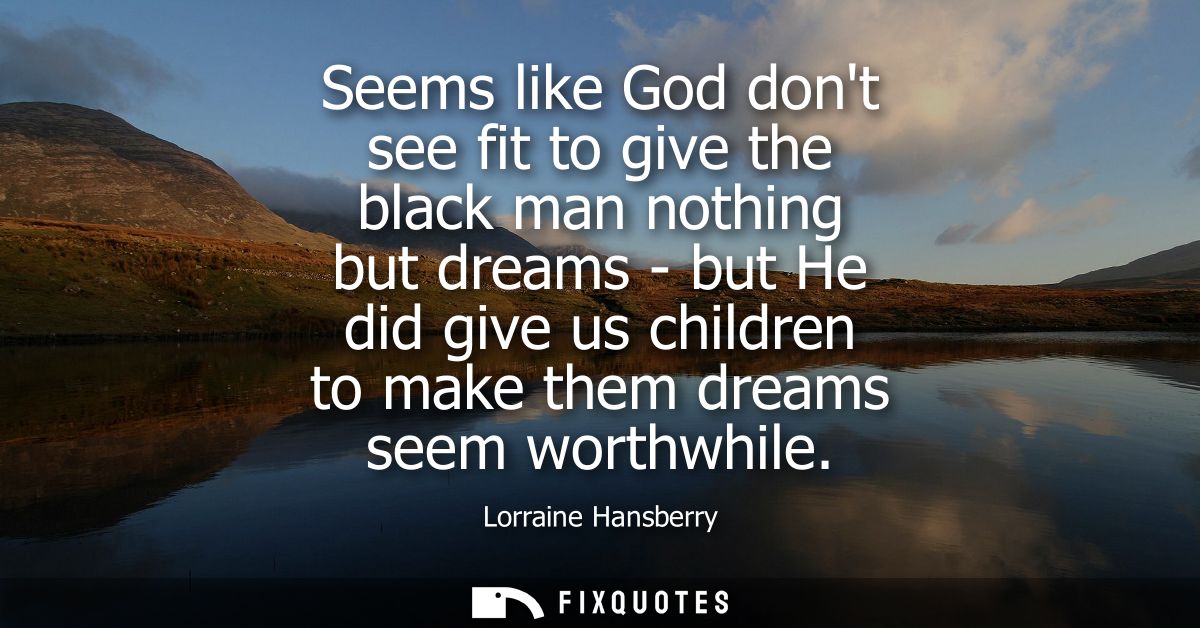
"Seems like God don't see fit to give the black man nothing but dreams - but He did give us children to make them dreams seem worthwhile"
About this Quote
The turn on “but” is the knife. Children arrive as both consolation and complication. They’re proof of life continuing under scarcity, and they’re the reason scarcity can’t be tolerated. Hansberry recognizes a cruel arithmetic: dreams can survive as private fantasies, but children make them public obligations. Once a child exists, “making it” stops being self-improvement and becomes survival, legacy, protection. That’s why the dreams “seem worthwhile” not because parenthood magically erases injustice, but because it supplies stakes that the system can’t wave away.
Context matters: Hansberry, writing in the mid-century crucible that produced A Raisin in the Sun, is dramatizing the gap between American promise and Black access to it. The line doesn’t romanticize suffering; it exposes how hope gets conscripted as a coping mechanism. The subtext is blunt: if God’s gifts are only dreams, then the real theft is happening on earth, by people, enforced by policy, habit, and law.
Quote Details
| Topic | Equality |
|---|---|
| Source | Line from the play A Raisin in the Sun (Lorraine Hansberry, 1959). Frequently quoted line from the published play. |
| Cite |
Citation Formats
APA Style (7th ed.)
Hansberry, Lorraine. (2026, January 15). Seems like God don't see fit to give the black man nothing but dreams - but He did give us children to make them dreams seem worthwhile. FixQuotes. https://fixquotes.com/quotes/seems-like-god-dont-see-fit-to-give-the-black-man-168014/
Chicago Style
Hansberry, Lorraine. "Seems like God don't see fit to give the black man nothing but dreams - but He did give us children to make them dreams seem worthwhile." FixQuotes. January 15, 2026. https://fixquotes.com/quotes/seems-like-god-dont-see-fit-to-give-the-black-man-168014/.
MLA Style (9th ed.)
"Seems like God don't see fit to give the black man nothing but dreams - but He did give us children to make them dreams seem worthwhile." FixQuotes, 15 Jan. 2026, https://fixquotes.com/quotes/seems-like-god-dont-see-fit-to-give-the-black-man-168014/. Accessed 5 Apr. 2026.