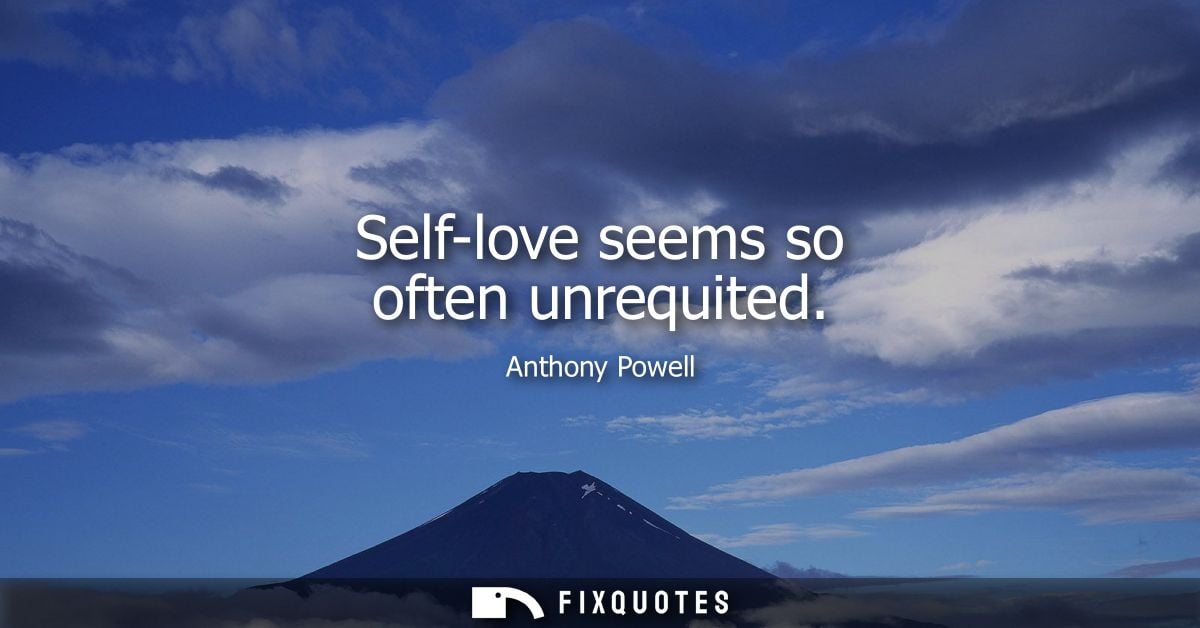
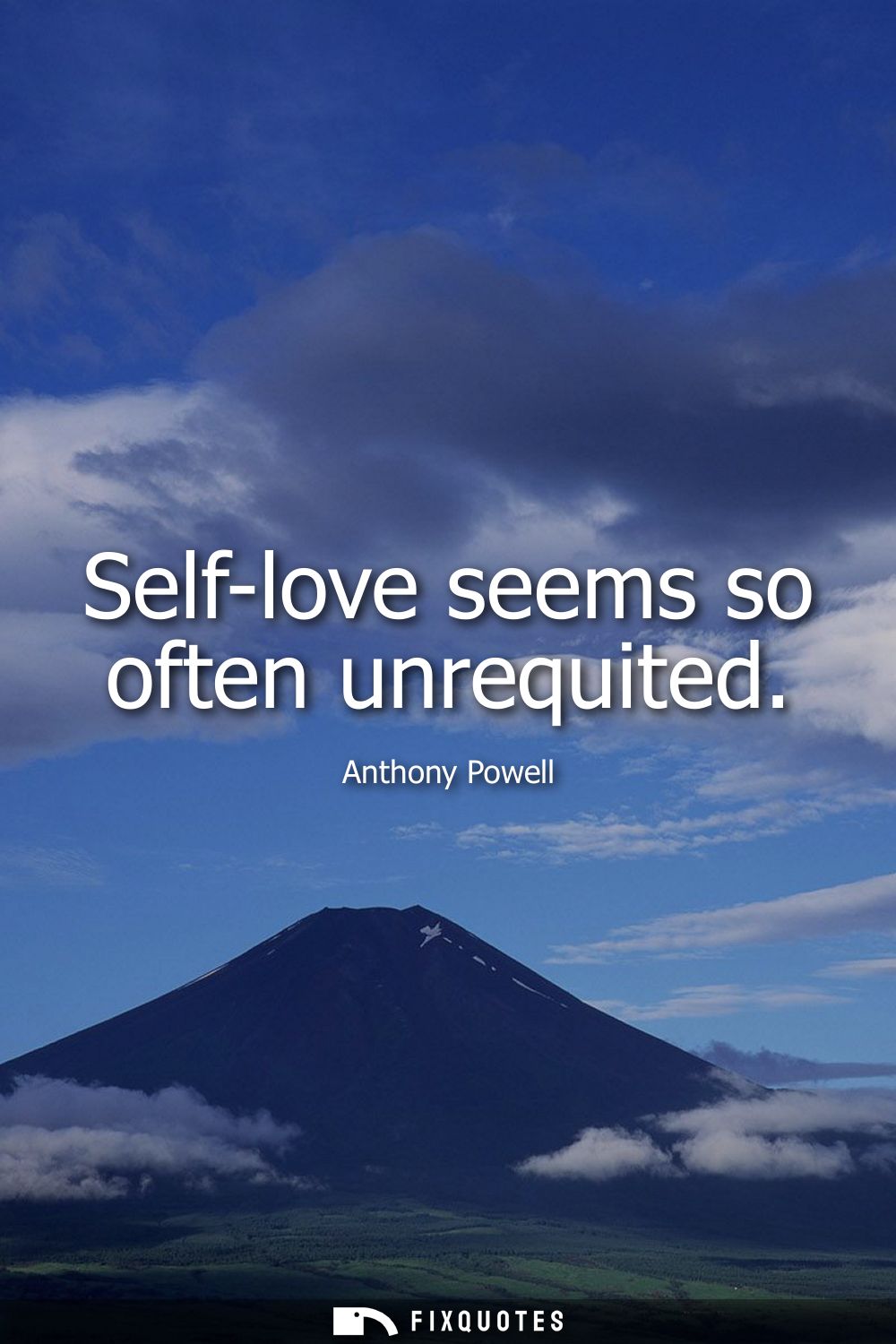
"Self-love seems so often unrequited"
About this Quote
Powell lands the punch in six words by treating “self-love” like an unlucky suitor. The joke is grammatical as much as philosophical: we expect self-love to be the one romance guaranteed a return on investment. By calling it “unrequited,” he smuggles in a bleak recognition that the self isn’t a single, loyal partner but a squabbling cast. One part craves admiration, another keeps receipts, another feels fraudulence; affection ricochets and rarely arrives where it’s sent.
The line also needles the modern piety that self-esteem is a simple moral upgrade. Powell implies it’s an appetite with its own humiliations. People can perform confidence and still feel emotionally stiff-armed by their own interior judge. Narcissism, in this view, isn’t an excess of love but a failed bid for it: the louder the self-applause, the more it betrays the absence of something sturdier underneath.
Context matters because Powell’s fiction (especially the long social choreography of A Dance to the Music of Time) is preoccupied with how identity is made in company: through status, memory, fashion, the small cruelties of class and intimacy. “Self-love” isn’t generated in isolation; it’s shaped by the gaze, and it keeps being revised when the room changes. The subtext is quietly fatalistic: you can chase self-regard as if it were private property, but it remains entangled with recognition, comparison, and time. Even your own affection has conditions, and you’re not always willing to meet them.
The line also needles the modern piety that self-esteem is a simple moral upgrade. Powell implies it’s an appetite with its own humiliations. People can perform confidence and still feel emotionally stiff-armed by their own interior judge. Narcissism, in this view, isn’t an excess of love but a failed bid for it: the louder the self-applause, the more it betrays the absence of something sturdier underneath.
Context matters because Powell’s fiction (especially the long social choreography of A Dance to the Music of Time) is preoccupied with how identity is made in company: through status, memory, fashion, the small cruelties of class and intimacy. “Self-love” isn’t generated in isolation; it’s shaped by the gaze, and it keeps being revised when the room changes. The subtext is quietly fatalistic: you can chase self-regard as if it were private property, but it remains entangled with recognition, comparison, and time. Even your own affection has conditions, and you’re not always willing to meet them.
Quote Details
| Topic | Self-Love |
|---|---|
| Source | Verified source: The Acceptance World (Anthony Powell, 1955)
Evidence: "Self-love seems so often unrequited." (Chapter 1). This line appears as dialogue in Anthony Powell’s novel The Acceptance World (1955), Chapter 1, in the exchange: "He fell in love with himself at first sight and it is a passion to which ha has always remained faithful." "Self-love seems so often unrequited." The Anthony Powell Society page reproduces the passage and attributes it directly to Powell’s novel (a primary work), though it does not provide a page number. Some secondary/tertiary sources variously (and inconsistently) attribute the standalone line to A Buyer's Market (1952) or to The Acceptance World; the Powell Society context supports The Acceptance World, Ch. 1 as the originating appearance of the wording commonly quoted. Other candidates (1) It's A Hard Narc Life (Demetrice Armstrong, 2023) compilation80.0% ... Self - love seems so often unrequited . " Anthony Powell . 38. " You yourself , as much as anybody in the entire ... |
| Cite |
Citation Formats
APA Style (7th ed.)
Powell, Anthony. (2026, February 26). Self-love seems so often unrequited. FixQuotes. https://fixquotes.com/quotes/self-love-seems-so-often-unrequited-35322/
Chicago Style
Powell, Anthony. "Self-love seems so often unrequited." FixQuotes. February 26, 2026. https://fixquotes.com/quotes/self-love-seems-so-often-unrequited-35322/.
MLA Style (9th ed.)
"Self-love seems so often unrequited." FixQuotes, 26 Feb. 2026, https://fixquotes.com/quotes/self-love-seems-so-often-unrequited-35322/. Accessed 25 Mar. 2026.
More Quotes by Anthony
Add to List