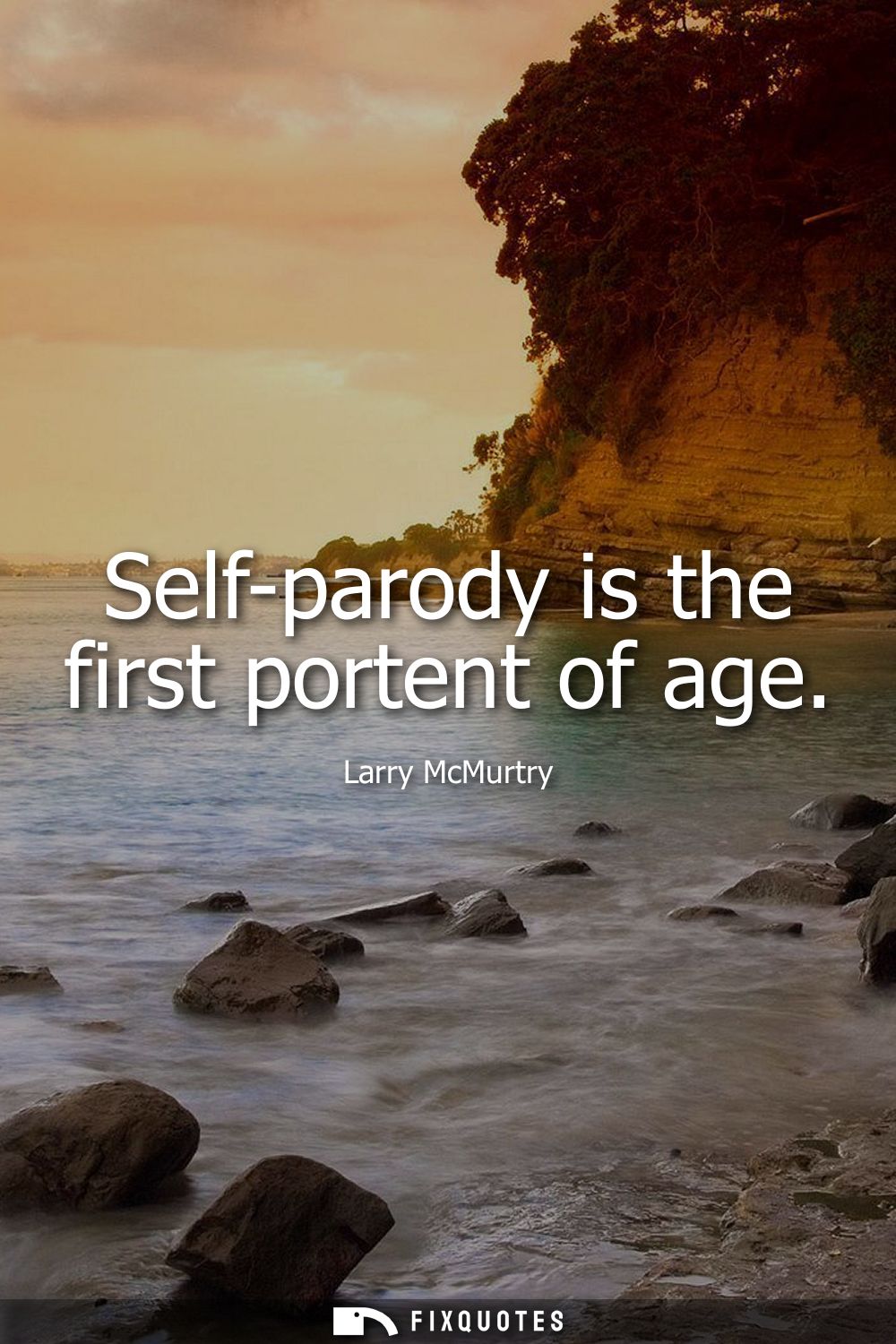
"Self-parody is the first portent of age"
About this Quote
Self-parody is an artist catching themselves on rerun. McMurtry’s line lands because it treats “age” less as a number than as a drift in creative posture: the moment you start performing your own greatest hits with a wink, you’ve ceded the present tense. The “first portent” phrasing is crucial. He’s not talking about wrinkles or decline in stamina; he’s talking about an early warning system, a subtle change in instinct. Before the body announces anything, the voice does.
The subtext is both pragmatic and a little cruel: the culture rewards recognizable brands, and a successful writer is constantly tempted to become a tribute act to their earlier self. Self-parody isn’t merely joking about your habits; it’s a defensive maneuver. By mocking your own trademarks, you preempt critics, dilute risk, and stay “in on the joke” rather than being the joke. That cleverness reads as control, but McMurtry implies it’s also capitulation.
Context matters: McMurtry wrote across eras, from the mythic West of Lonesome Dove to the Hollywood machinery of The Last Picture Show. He watched American storytelling industrialize, watched audiences learn to consume irony as a default flavor. In that world, self-parody becomes the easiest way to keep moving without actually changing: a late-career strategy that feels like honesty but can be artistic surrender.
The line’s sting is that it indicts not just the aging writer, but the aging public. When we clap hardest for the familiar, we train our artists to age on stage, repeating themselves with a grin.
The subtext is both pragmatic and a little cruel: the culture rewards recognizable brands, and a successful writer is constantly tempted to become a tribute act to their earlier self. Self-parody isn’t merely joking about your habits; it’s a defensive maneuver. By mocking your own trademarks, you preempt critics, dilute risk, and stay “in on the joke” rather than being the joke. That cleverness reads as control, but McMurtry implies it’s also capitulation.
Context matters: McMurtry wrote across eras, from the mythic West of Lonesome Dove to the Hollywood machinery of The Last Picture Show. He watched American storytelling industrialize, watched audiences learn to consume irony as a default flavor. In that world, self-parody becomes the easiest way to keep moving without actually changing: a late-career strategy that feels like honesty but can be artistic surrender.
The line’s sting is that it indicts not just the aging writer, but the aging public. When we clap hardest for the familiar, we train our artists to age on stage, repeating themselves with a grin.
Quote Details
| Topic | Aging |
|---|---|
| Source | Help us find the source |
| Cite |
Citation Formats
APA Style (7th ed.)
McMurtry, Larry. (2026, January 16). Self-parody is the first portent of age. FixQuotes. https://fixquotes.com/quotes/self-parody-is-the-first-portent-of-age-136467/
Chicago Style
McMurtry, Larry. "Self-parody is the first portent of age." FixQuotes. January 16, 2026. https://fixquotes.com/quotes/self-parody-is-the-first-portent-of-age-136467/.
MLA Style (9th ed.)
"Self-parody is the first portent of age." FixQuotes, 16 Jan. 2026, https://fixquotes.com/quotes/self-parody-is-the-first-portent-of-age-136467/. Accessed 19 Mar. 2026.
More Quotes by Larry
Add to List