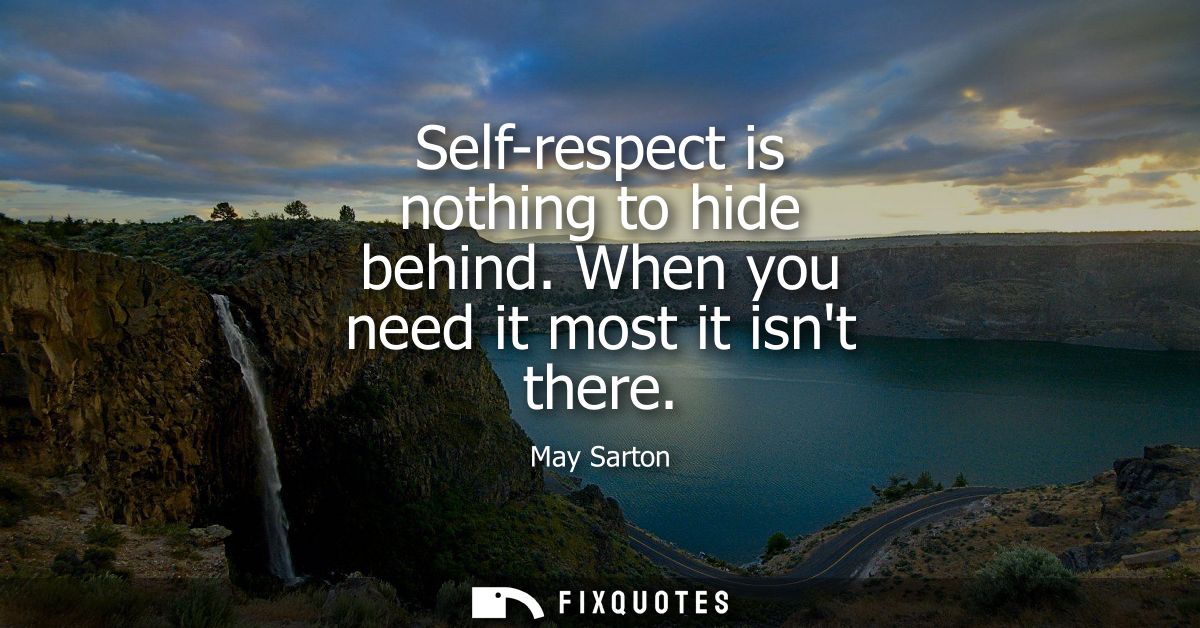
"Self-respect is nothing to hide behind. When you need it most, it isn't there"
About this Quote
Then she twists the knife: “When you need it most it isn’t there.” The line is bleak because it’s psychologically accurate. In moments of crisis - humiliation, abandonment, depression, failure - the very mechanism you’re told to rely on is often the first thing to evaporate. Self-respect becomes conditional, revealed as something that depends on steadier days: routine, health, a sense of being lovable, the ordinary frictionless functioning of life. Under pressure, the “self” you were respecting splinters, and the respect with it.
Context matters: Sarton’s work is steeped in interior weather, solitude, and the labor of living honestly with one’s own mind. This reads like a warning from someone who’s watched moral virtues get romanticized into guarantees. The subtext isn’t nihilism; it’s an argument for sturdier supports than pride - relationships, practices, compassion - things that don’t vanish exactly when you’re at your weakest.
Quote Details
| Topic | Confidence |
|---|---|
| Source | Help us find the source |
| Cite |
Citation Formats
APA Style (7th ed.)
Sarton, May. (2026, February 16). Self-respect is nothing to hide behind. When you need it most, it isn't there. FixQuotes. https://fixquotes.com/quotes/self-respect-is-nothing-to-hide-behind-when-you-158471/
Chicago Style
Sarton, May. "Self-respect is nothing to hide behind. When you need it most, it isn't there." FixQuotes. February 16, 2026. https://fixquotes.com/quotes/self-respect-is-nothing-to-hide-behind-when-you-158471/.
MLA Style (9th ed.)
"Self-respect is nothing to hide behind. When you need it most, it isn't there." FixQuotes, 16 Feb. 2026, https://fixquotes.com/quotes/self-respect-is-nothing-to-hide-behind-when-you-158471/. Accessed 3 Apr. 2026.