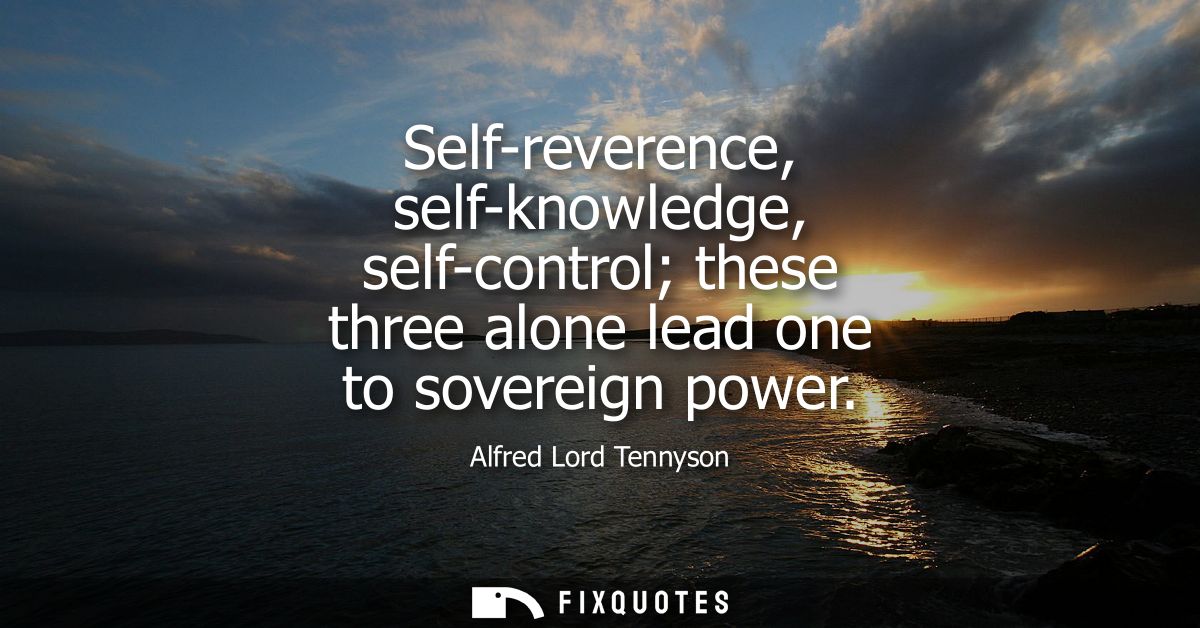
"Self-reverence, self-knowledge, self-control; these three alone lead one to sovereign power"
About this Quote
A Victorian poet promising "sovereign power" sounds like a hymn to empire, but Tennyson slyly relocates the throne inward. The triad hits with the rhythm of scripture: three nouns, each tightening the lens, each prefaced by "self-" like a drumbeat. It reads like moral furniture, yet it’s also a blueprint for authority in an age obsessed with it. Tennyson lived in a Britain that measured greatness in colonies, industry, and public virtue; his move is to argue that real dominion begins before the first flag is planted.
The sequence matters. "Self-reverence" isn’t narcissism; it’s the refusal to treat your own life as disposable. It establishes a baseline dignity that keeps you from begging for validation or outsourcing your values. Then "self-knowledge" introduces the uncomfortable modern note: power without diagnosis becomes self-deception, the Victorian sin that polite society can dress up as character. Finally "self-control" lands as the practical mechanism, the muscle that turns insight into action and prevents reverence from curdling into vanity.
"These three alone" is doing a lot of work. Tennyson is selling a minimalist doctrine that quietly rebukes status, lineage, and applause. The subtext is anti-romantic in the best way: feelings don’t rule; they’re governed. In a culture of stiff collars and public restraint, this isn’t merely prudishness. It’s a claim that the only sustainable power is sovereignty over impulse, narrative, and desire - the kind that can’t be revoked by scandal, politics, or time.
The sequence matters. "Self-reverence" isn’t narcissism; it’s the refusal to treat your own life as disposable. It establishes a baseline dignity that keeps you from begging for validation or outsourcing your values. Then "self-knowledge" introduces the uncomfortable modern note: power without diagnosis becomes self-deception, the Victorian sin that polite society can dress up as character. Finally "self-control" lands as the practical mechanism, the muscle that turns insight into action and prevents reverence from curdling into vanity.
"These three alone" is doing a lot of work. Tennyson is selling a minimalist doctrine that quietly rebukes status, lineage, and applause. The subtext is anti-romantic in the best way: feelings don’t rule; they’re governed. In a culture of stiff collars and public restraint, this isn’t merely prudishness. It’s a claim that the only sustainable power is sovereignty over impulse, narrative, and desire - the kind that can’t be revoked by scandal, politics, or time.
Quote Details
| Topic | Self-Discipline |
|---|
More Quotes by Alfred
Add to List