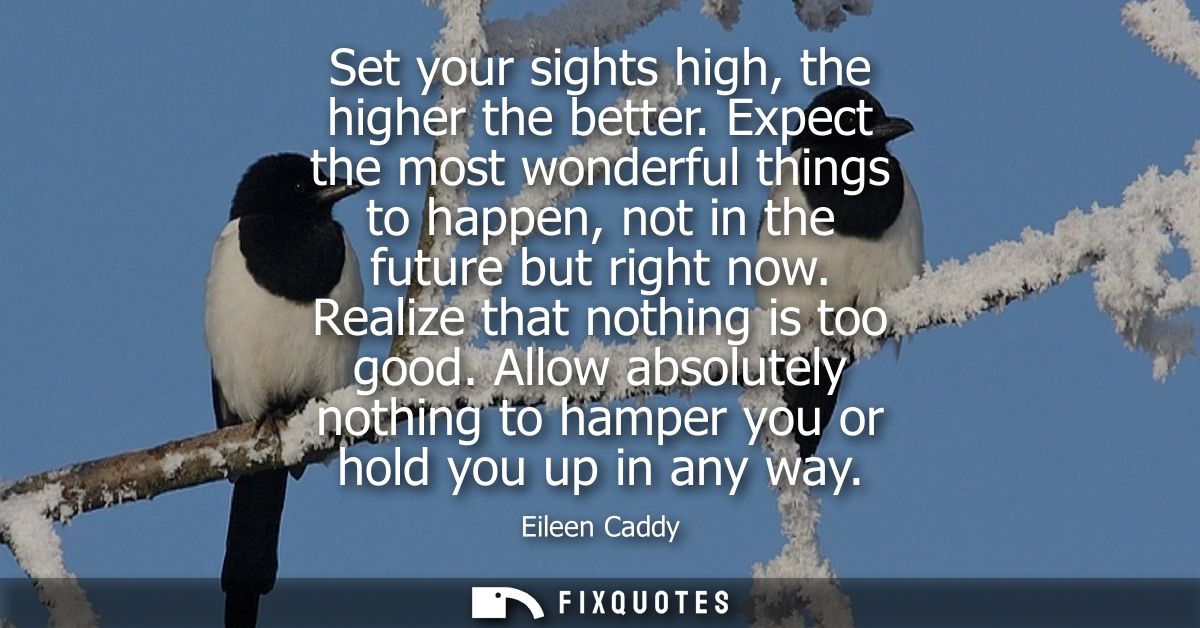
"Set your sights high, the higher the better. Expect the most wonderful things to happen, not in the future but right now. Realize that nothing is too good. Allow absolutely nothing to hamper you or hold you up in any way"
About this Quote
Aspirational language like this works because it refuses to negotiate with doubt. Caddy stacks imperatives - "Set", "Expect", "Realize", "Allow" - so momentum becomes the message. There is no room for maybe. The syntax itself is a kind of spiritual cardio: short commands that push you past hesitation and into the intoxicating idea that your inner posture can reorder the world.
The subtext is classic New Age psychology with a devotional edge: reality is responsive, almost eager, if you meet it with total openness. "Not in the future but right now" is the central trick. It collapses time to make desire feel actionable and to shame postponement. Waiting becomes a moral failure, not a logistical one. And "nothing is too good" quietly rewrites deservingness; it targets the self-sabotage of people trained to preempt disappointment by aiming low.
Context matters. Caddy, associated with the Findhorn community and a broader 20th-century spiritual self-help ecosystem, speaks from a tradition that treats consciousness as both instrument and environment. That lineage emerged alongside postwar prosperity, therapeutic culture, and a growing suspicion of institutional authority: if the old systems can’t guarantee meaning, you build your own meaning engine.
There’s also a cultural politics here: "Allow absolutely nothing to hamper you" flirts with radical agency while sidestepping material constraints. It’s empowering for the stuck and exhausted, but it can also sound like an elegant way to privatize struggle. The quote’s power is its clean, euphoric absolutism - a manifesto for immediacy that dares you to live as if permission isn’t required.
The subtext is classic New Age psychology with a devotional edge: reality is responsive, almost eager, if you meet it with total openness. "Not in the future but right now" is the central trick. It collapses time to make desire feel actionable and to shame postponement. Waiting becomes a moral failure, not a logistical one. And "nothing is too good" quietly rewrites deservingness; it targets the self-sabotage of people trained to preempt disappointment by aiming low.
Context matters. Caddy, associated with the Findhorn community and a broader 20th-century spiritual self-help ecosystem, speaks from a tradition that treats consciousness as both instrument and environment. That lineage emerged alongside postwar prosperity, therapeutic culture, and a growing suspicion of institutional authority: if the old systems can’t guarantee meaning, you build your own meaning engine.
There’s also a cultural politics here: "Allow absolutely nothing to hamper you" flirts with radical agency while sidestepping material constraints. It’s empowering for the stuck and exhausted, but it can also sound like an elegant way to privatize struggle. The quote’s power is its clean, euphoric absolutism - a manifesto for immediacy that dares you to live as if permission isn’t required.
Quote Details
| Topic | Motivational |
|---|
More Quotes by Eileen
Add to List