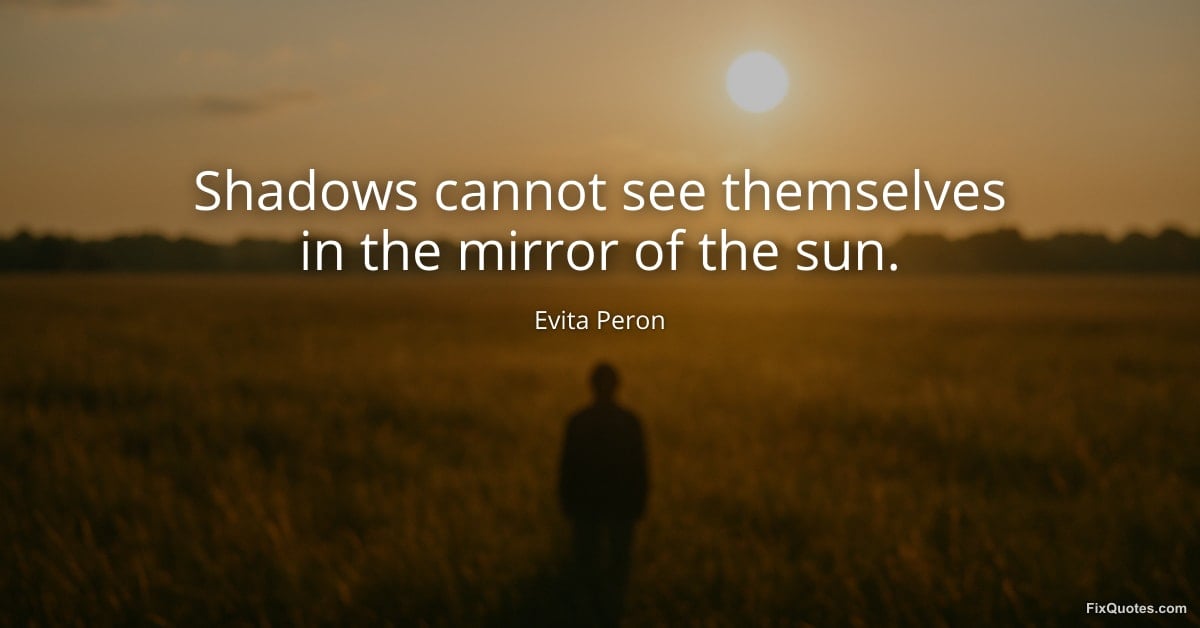
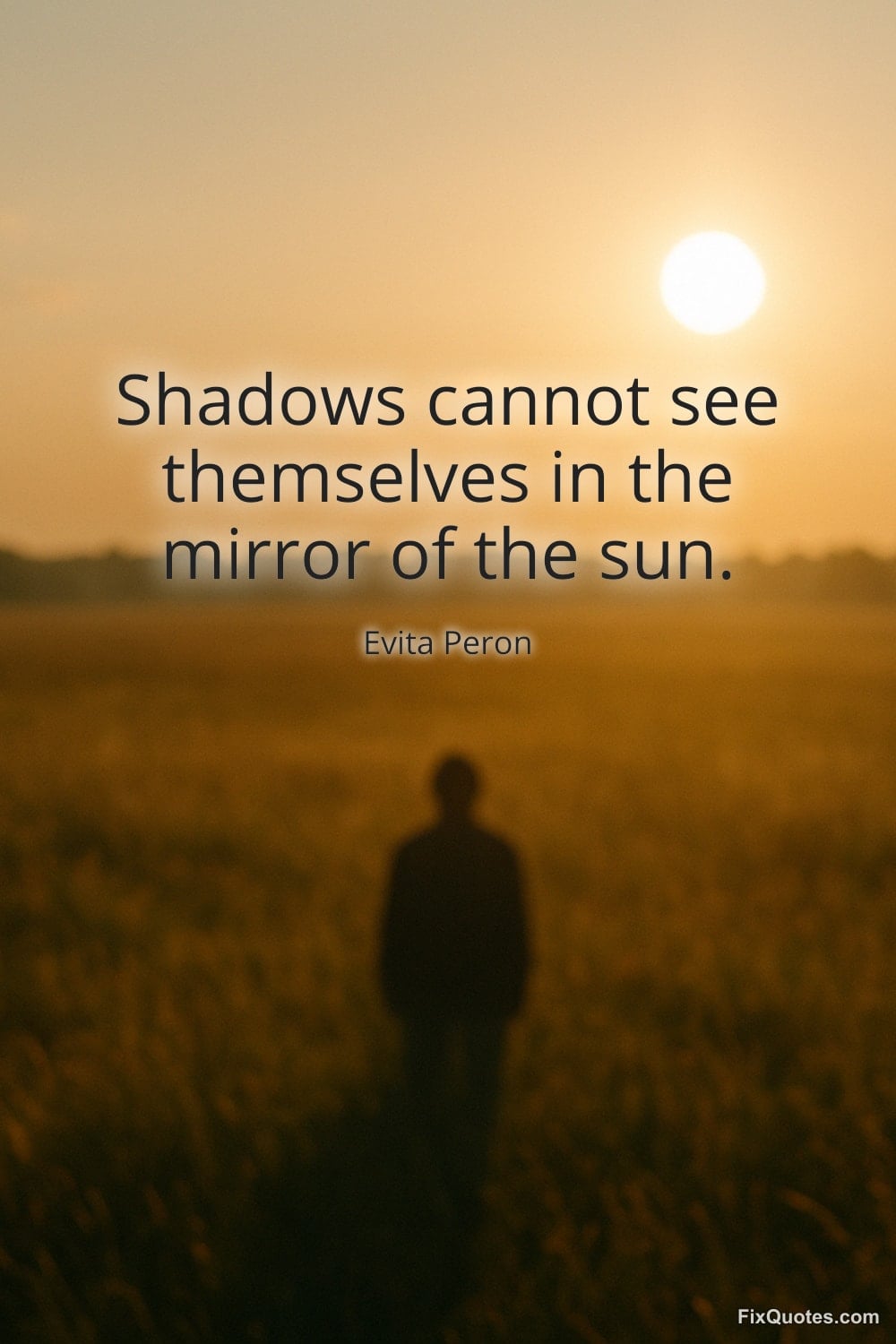
"Shadows cannot see themselves in the mirror of the sun"
About this Quote
Power talks in daylight; its victims are often forced to live as silhouettes.
“Shadows cannot see themselves in the mirror of the sun” lands like a political parable from Evita Peron, a figure who understood spectacle as governance. The line flatters “the sun” as the source of truth, warmth, and national life - a classic rhetorical move in populist statecraft, where the leader (or the movement) is cast as illumination itself. In that glow, “shadows” aren’t just opponents; they’re the sidelined, the discredited, the people deemed too marginal or compromised to claim a clear self-image. The verb choice is crucial: they “cannot see themselves.” It’s not that they won’t, but that the conditions of power deny them self-recognition. Visibility becomes permission.
The subtext is both moral and strategic. Morally, it implies that those who thrive on darkness - corruption, elitism, backroom influence - are incapable of honest reflection when exposed. Strategically, it reframes criticism as a pathology of the unenlightened: if you resist the project, you’re not merely wrong, you’re structurally unable to understand what’s happening. That’s a persuasive inoculation against dissent, especially in a political culture built on rallies, radio, and carefully managed symbolism.
Context matters: Peronism staged itself as a sunrise for “los descamisados,” the newly centered masses. Evita’s charisma depended on converting personal narrative into national destiny. This line performs that conversion elegantly: it turns a power struggle into a natural law, with the movement as sun and its adversaries reduced to the thin, dependent shapes cast by its light.
“Shadows cannot see themselves in the mirror of the sun” lands like a political parable from Evita Peron, a figure who understood spectacle as governance. The line flatters “the sun” as the source of truth, warmth, and national life - a classic rhetorical move in populist statecraft, where the leader (or the movement) is cast as illumination itself. In that glow, “shadows” aren’t just opponents; they’re the sidelined, the discredited, the people deemed too marginal or compromised to claim a clear self-image. The verb choice is crucial: they “cannot see themselves.” It’s not that they won’t, but that the conditions of power deny them self-recognition. Visibility becomes permission.
The subtext is both moral and strategic. Morally, it implies that those who thrive on darkness - corruption, elitism, backroom influence - are incapable of honest reflection when exposed. Strategically, it reframes criticism as a pathology of the unenlightened: if you resist the project, you’re not merely wrong, you’re structurally unable to understand what’s happening. That’s a persuasive inoculation against dissent, especially in a political culture built on rallies, radio, and carefully managed symbolism.
Context matters: Peronism staged itself as a sunrise for “los descamisados,” the newly centered masses. Evita’s charisma depended on converting personal narrative into national destiny. This line performs that conversion elegantly: it turns a power struggle into a natural law, with the movement as sun and its adversaries reduced to the thin, dependent shapes cast by its light.
Quote Details
| Topic | Wisdom |
|---|---|
| Source | Unverified source: Mi mensaje (Evita Peron, 1987)
Evidence: The quote circulates in English as “Shadows cannot see themselves in the mirror of the sun.” The Spanish form most often cited is “Las sombras no pueden mirarse (or verse a sí mismas) en el espejo del sol.” Multiple secondary discussions point to Eva Perón’s text 'Mi mensaje' as the origin, and o... Other candidates (1) Transitions (Jesikah Sundin, 2021) compilation95.0% ... Shadows cannot see themselves in the mirror of the sun . --Evita Peron , First Lady of Argentina , 20th century *... |
| Featured | This quote was our Quote of the Day on January 29, 2026 |
| Cite |
Citation Formats
APA Style (7th ed.)
Peron, Evita. (2026, January 29). Shadows cannot see themselves in the mirror of the sun. FixQuotes. https://fixquotes.com/quotes/shadows-cannot-see-themselves-in-the-mirror-of-148141/
Chicago Style
Peron, Evita. "Shadows cannot see themselves in the mirror of the sun." FixQuotes. January 29, 2026. https://fixquotes.com/quotes/shadows-cannot-see-themselves-in-the-mirror-of-148141/.
MLA Style (9th ed.)
"Shadows cannot see themselves in the mirror of the sun." FixQuotes, 29 Jan. 2026, https://fixquotes.com/quotes/shadows-cannot-see-themselves-in-the-mirror-of-148141/. Accessed 1 Apr. 2026.
More Quotes by Evita
Add to List