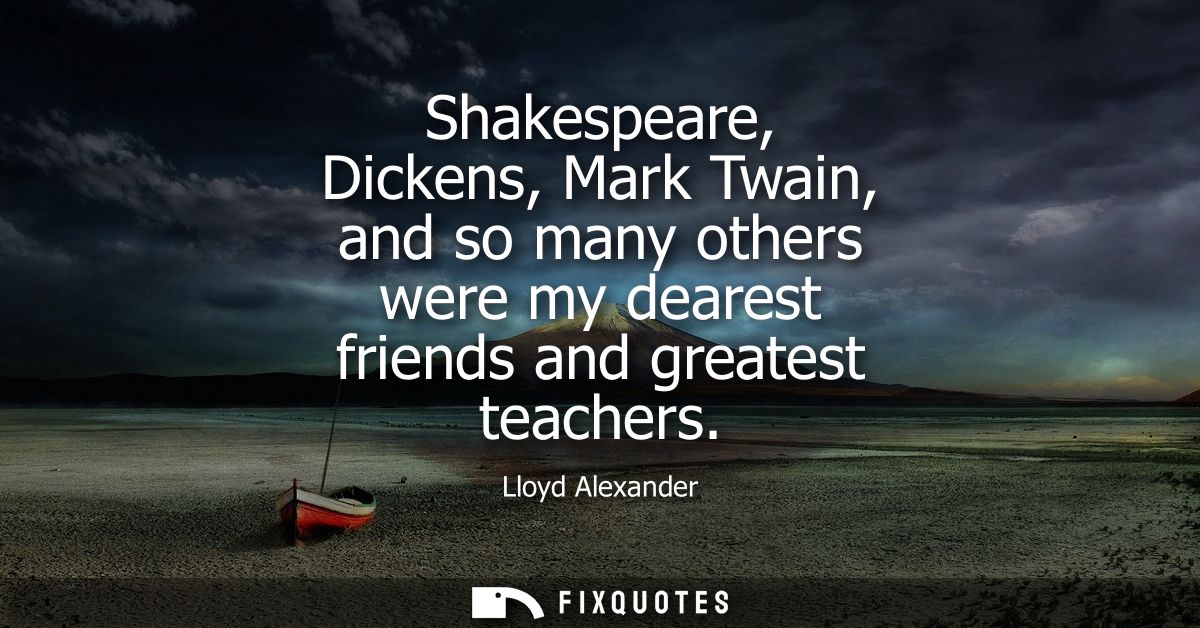
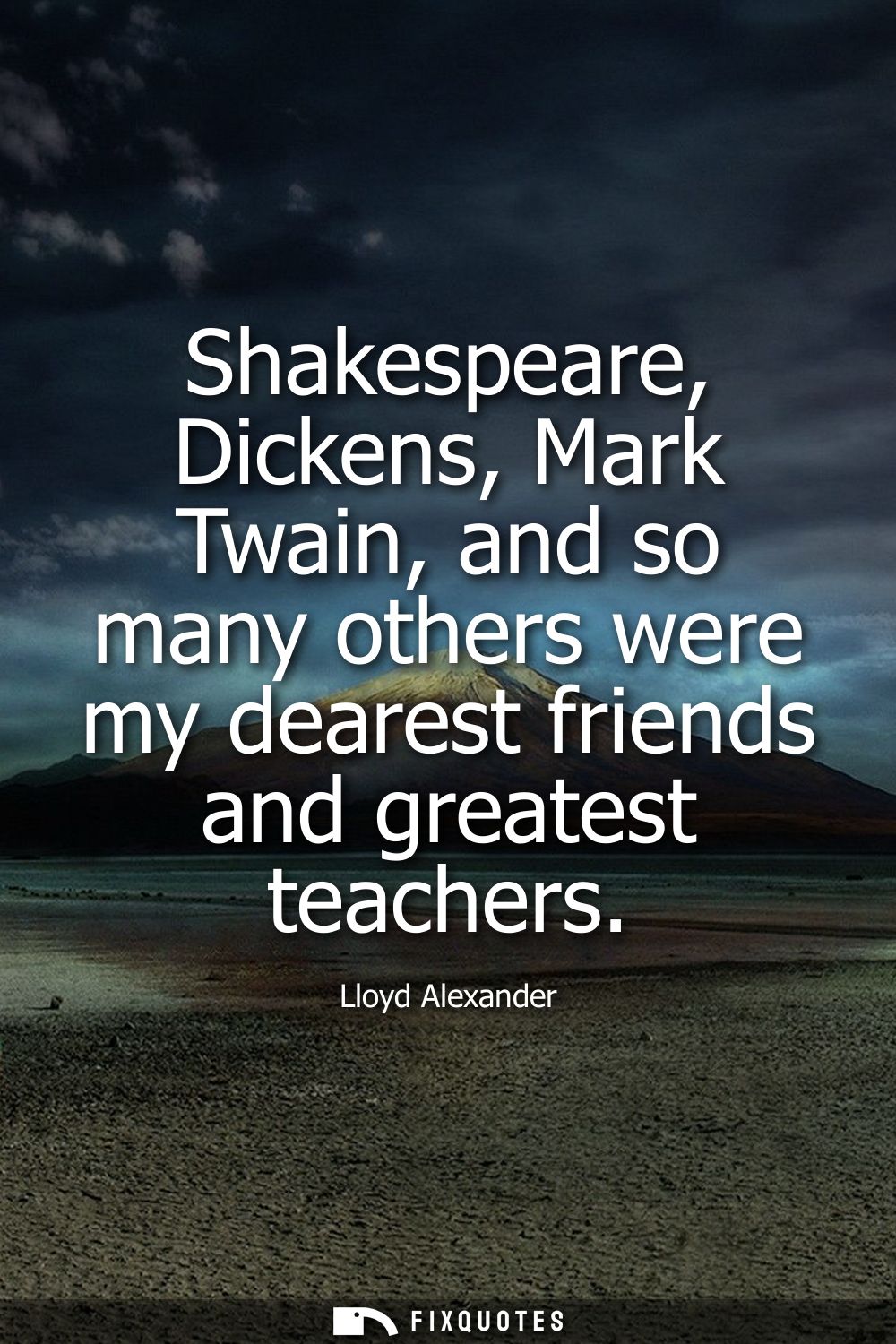
"Shakespeare, Dickens, Mark Twain, and so many others were my dearest friends and greatest teachers"
About this Quote
For Lloyd Alexander, the line between literature and companionship isn’t metaphorical; it’s practical. Calling Shakespeare, Dickens, and Mark Twain “dearest friends” frames reading as an intimate, ongoing relationship rather than a school assignment or a prestige ritual. It’s also a quiet flex: these aren’t comforting contemporaries, but towering dead men whose work can still feel like a voice in the room. Alexander is reminding you that the canon only stays alive if it becomes personal.
The pairing of “friends” with “teachers” matters. Friends offer solace, mischief, and permission; teachers demand craft, discipline, and standards. Alexander suggests he got both from books: emotional fellowship and an apprenticeship in storytelling. Shakespeare supplies range and moral complication, Dickens offers empathy sharpened into social critique, Twain brings the American knack for humor that smuggles in indictment. Alexander’s subtext is that you learn not by extracting “themes,” but by living alongside sentences until their rhythms recalibrate your instincts.
Contextually, this fits a writer best known for youth fantasy (The Chronicles of Prydain), a field long treated as secondary to “serious” literature. The quote is a gentle rebuttal: his lineage runs straight through the heavyweights. It also doubles as an invitation to young readers and aspiring writers: you can build a private mentorship with geniuses for the price of attention. The real intent is democratizing. Great books aren’t museum pieces; they’re comrades you can argue with, imitate, and outgrow.
The pairing of “friends” with “teachers” matters. Friends offer solace, mischief, and permission; teachers demand craft, discipline, and standards. Alexander suggests he got both from books: emotional fellowship and an apprenticeship in storytelling. Shakespeare supplies range and moral complication, Dickens offers empathy sharpened into social critique, Twain brings the American knack for humor that smuggles in indictment. Alexander’s subtext is that you learn not by extracting “themes,” but by living alongside sentences until their rhythms recalibrate your instincts.
Contextually, this fits a writer best known for youth fantasy (The Chronicles of Prydain), a field long treated as secondary to “serious” literature. The quote is a gentle rebuttal: his lineage runs straight through the heavyweights. It also doubles as an invitation to young readers and aspiring writers: you can build a private mentorship with geniuses for the price of attention. The real intent is democratizing. Great books aren’t museum pieces; they’re comrades you can argue with, imitate, and outgrow.
Quote Details
| Topic | Book |
|---|
More Quotes by Lloyd
Add to List