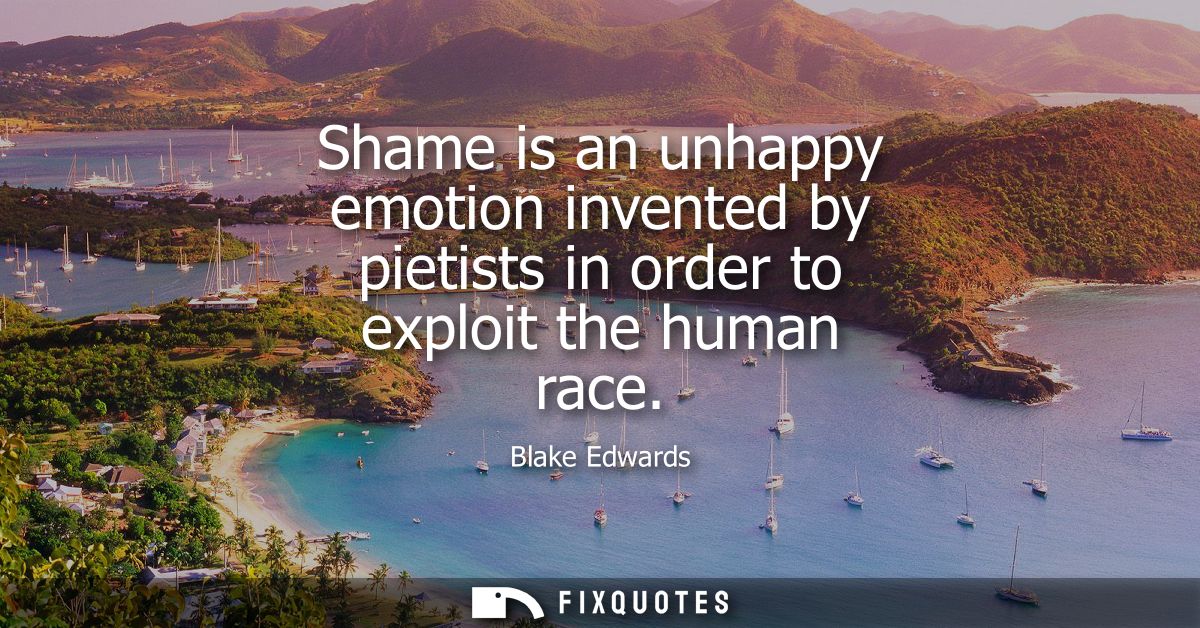
"Shame is an unhappy emotion invented by pietists in order to exploit the human race"
About this Quote
Coming from a director, the line also reads like a defense of appetite and messiness against a culture that demands tidy self-erasure. Edwards built a career on comedy that exposes the absurdity of propriety: the pratfall as social critique. Shame, in his worldview, isn’t the moral compass that prevents harm; it’s the spotlight that forces performance. You don’t simply behave well. You look like someone who behaves well, which is how hypocrisy becomes a civic virtue.
The subtext is less "do whatever you want" than "notice who benefits when you feel dirty". Pietism here isn’t just religion; it’s any posture of sanctimony that converts discomfort into control. Edwards is cynical about that conversion, and he’s not subtle on purpose. The exaggeration is part of the craft: a comic overstatement that reveals a serious point about how cultures domesticate people, not through laws alone, but through an emotion that makes us do the cop’s work for free.
Quote Details
| Topic | Ethics & Morality |
|---|---|
| Source | Later attribution: You Break It, You Die (William Delaney, 2009) modern compilationISBN: 9781606938102 · ID: LOpQlp-MYdIC
Evidence:
... Shame is an unhappy emotion invented by pietists in order to exploit the human race . " * Victor / Victoria Metro Goldwyn Mayer ( MGM ) Studios 1982. Directed by Blake Edward . Written by Blake Edwards and Hans Hoemburg . Starring Julie ... |
| Cite |
Citation Formats
APA Style (7th ed.)
Edwards, Blake. (2026, March 21). Shame is an unhappy emotion invented by pietists in order to exploit the human race. FixQuotes. https://fixquotes.com/quotes/shame-is-an-unhappy-emotion-invented-by-pietists-149626/
Chicago Style
Edwards, Blake. "Shame is an unhappy emotion invented by pietists in order to exploit the human race." FixQuotes. March 21, 2026. https://fixquotes.com/quotes/shame-is-an-unhappy-emotion-invented-by-pietists-149626/.
MLA Style (9th ed.)
"Shame is an unhappy emotion invented by pietists in order to exploit the human race." FixQuotes, 21 Mar. 2026, https://fixquotes.com/quotes/shame-is-an-unhappy-emotion-invented-by-pietists-149626/. Accessed 31 Mar. 2026.