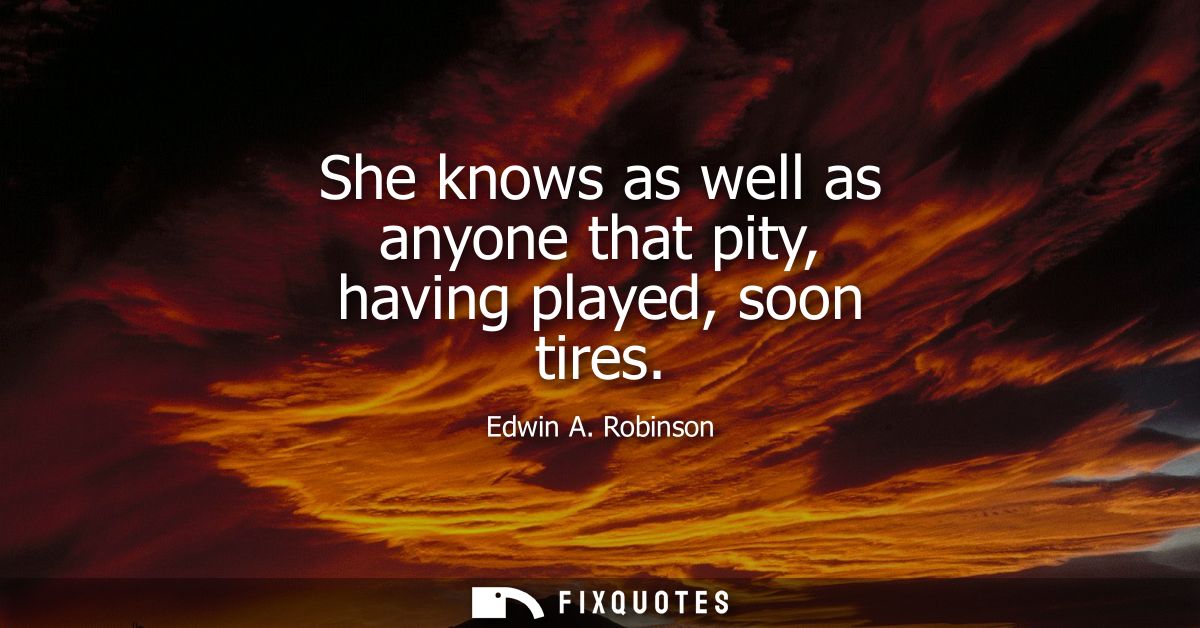
"She knows as well as anyone that pity, having played, soon tires"
About this Quote
Pity is a short-lived currency, and Robinson spends it with a kind of austere precision. “Having played” turns compassion into performance: something put on, tried out, even enjoyed for a moment. The verb carries the faint cruelty of a parlor game, suggesting that sympathy can function less as moral response than as pastime, a way for onlookers to feel briefly noble before drifting back to their own lives. Robinson’s line doesn’t moralize; it quietly exposes the mechanism.
The syntax matters. “She knows as well as anyone” gives the woman a hard-earned literacy about social feeling. This isn’t naive victimhood awaiting rescue; it’s experience speaking, the knowledge that attention comes with a timer. Pity “soon tires” not because suffering ends, but because spectators do. The line implies a social economy where the afflicted must navigate not just pain but the exhaustion of other people’s concern.
Robinson, writing in an America jittery with class anxiety and small-town scrutiny, often stages lives under the gaze of communities that can’t quite sustain their own generosity. His characters are frequently trapped between private despair and public reading, where reputation is brittle and empathy is conditional. The subtext is especially modern: compassion as a consumable, outrage and tenderness alike subject to burnout. What makes the line land is its refusal of consolation. It grants “she” agency only in the bleak form of knowing the pattern - that the audience leaves, and the wound remains onstage.
The syntax matters. “She knows as well as anyone” gives the woman a hard-earned literacy about social feeling. This isn’t naive victimhood awaiting rescue; it’s experience speaking, the knowledge that attention comes with a timer. Pity “soon tires” not because suffering ends, but because spectators do. The line implies a social economy where the afflicted must navigate not just pain but the exhaustion of other people’s concern.
Robinson, writing in an America jittery with class anxiety and small-town scrutiny, often stages lives under the gaze of communities that can’t quite sustain their own generosity. His characters are frequently trapped between private despair and public reading, where reputation is brittle and empathy is conditional. The subtext is especially modern: compassion as a consumable, outrage and tenderness alike subject to burnout. What makes the line land is its refusal of consolation. It grants “she” agency only in the bleak form of knowing the pattern - that the audience leaves, and the wound remains onstage.
Quote Details
| Topic | Wisdom |
|---|---|
| Source | Help us find the source |
| Cite |
Citation Formats
APA Style (7th ed.)
Robinson, Edwin A. (2026, January 17). She knows as well as anyone that pity, having played, soon tires. FixQuotes. https://fixquotes.com/quotes/she-knows-as-well-as-anyone-that-pity-having-58694/
Chicago Style
Robinson, Edwin A. "She knows as well as anyone that pity, having played, soon tires." FixQuotes. January 17, 2026. https://fixquotes.com/quotes/she-knows-as-well-as-anyone-that-pity-having-58694/.
MLA Style (9th ed.)
"She knows as well as anyone that pity, having played, soon tires." FixQuotes, 17 Jan. 2026, https://fixquotes.com/quotes/she-knows-as-well-as-anyone-that-pity-having-58694/. Accessed 7 Apr. 2026.
More Quotes by Edwin
Add to List