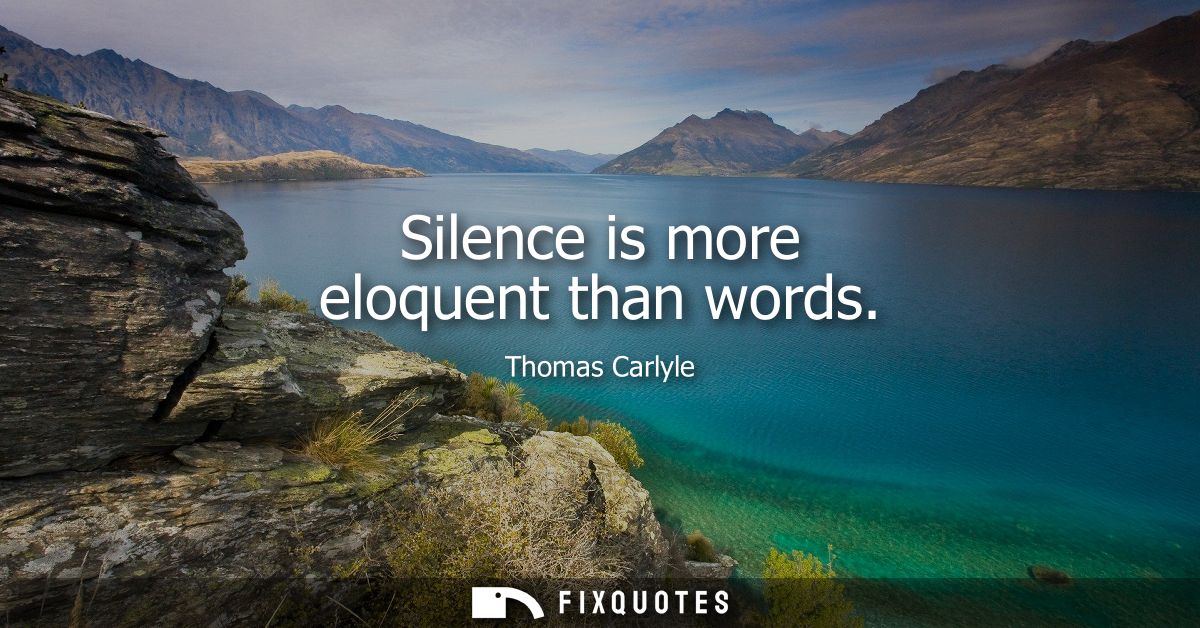
"Silence is more eloquent than words"
About this Quote
Carlyle’s line flatters quiet not as passivity but as force: a refusal to cheapen experience by translating it into the thin coinage of talk. “Eloquent” is the trapdoor here. He borrows the language of persuasion - the very art of speech - to crown its opposite. The irony isn’t cute; it’s disciplinary. Silence becomes a moral posture, a way to stand against the era’s swelling marketplace of opinion, chatter, and self-advertisement.
The intent is partly aesthetic (some things are too large, too tangled, too sacred for neat phrasing) and partly political. Carlyle wrote in a 19th-century Britain accelerating into mass print, mass meetings, and mass confidence in “progress.” He distrusted that confidence. In his worldview, real authority comes from character, labor, and lived conviction, not from fluency. So the subtext reads like an indictment of public life: when everyone has words, words stop costing anything.
Silence also does reputational work. It signals depth, self-control, even superiority - a cultivated masculinity of restraint that Carlyle and his contemporaries often romanticized. That’s why the line still travels well in modern culture: it appeals to the exhaustion of constant posting, constant hot takes, constant performance. But it’s not purely therapeutic. It’s a power move. Silence can be dignity, but it can also be evasion, a way to avoid accountability while looking profound. Carlyle is betting you’ll admire the quiet anyway.
The intent is partly aesthetic (some things are too large, too tangled, too sacred for neat phrasing) and partly political. Carlyle wrote in a 19th-century Britain accelerating into mass print, mass meetings, and mass confidence in “progress.” He distrusted that confidence. In his worldview, real authority comes from character, labor, and lived conviction, not from fluency. So the subtext reads like an indictment of public life: when everyone has words, words stop costing anything.
Silence also does reputational work. It signals depth, self-control, even superiority - a cultivated masculinity of restraint that Carlyle and his contemporaries often romanticized. That’s why the line still travels well in modern culture: it appeals to the exhaustion of constant posting, constant hot takes, constant performance. But it’s not purely therapeutic. It’s a power move. Silence can be dignity, but it can also be evasion, a way to avoid accountability while looking profound. Carlyle is betting you’ll admire the quiet anyway.
Quote Details
| Topic | Wisdom |
|---|
More Quotes by Thomas
Add to List