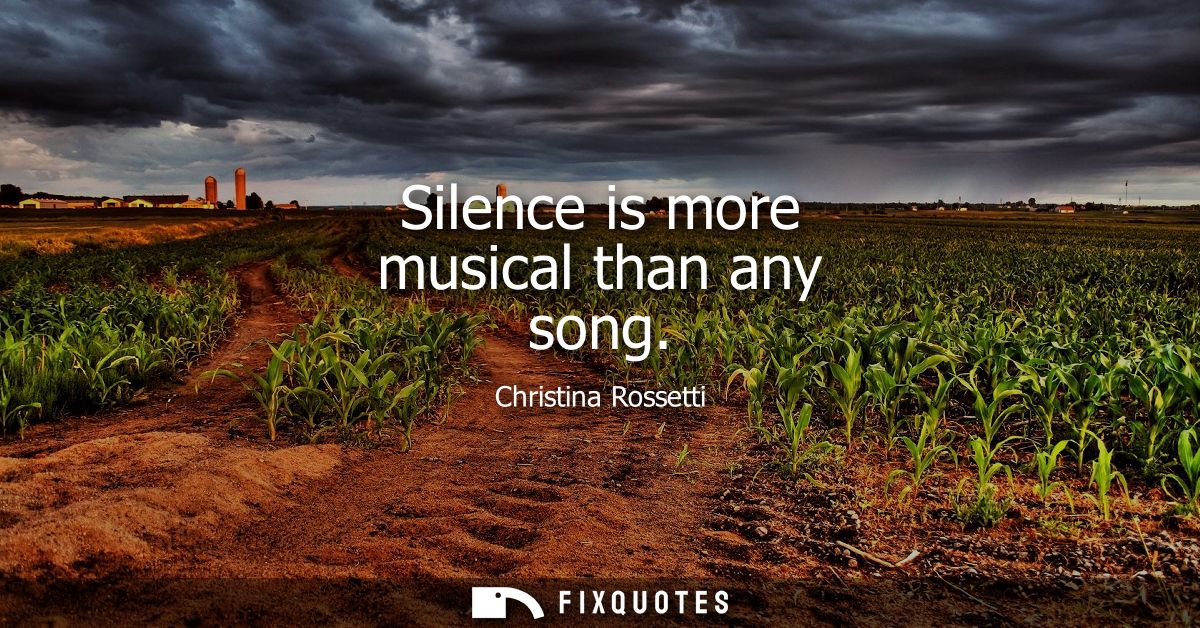
"Silence is more musical than any song"
About this Quote
Rossetti’s line lands like a rest in a score: not an absence, but a deliberate shape that makes everything else intelligible. “Silence is more musical than any song” turns the obvious hierarchy upside down. We’re trained to treat music as sound and silence as the dead air between tracks. Rossetti, a poet steeped in devotional intensity and emotional restraint, insists that the unsounded can be the most sonorous thing in the room.
The intent feels partly aesthetic, partly moral. In a Victorian culture that prized self-control (especially from women), silence becomes a disciplined art, not a failure to speak. Rossetti’s poems often hinge on withheld speech, renunciation, and the ache of what can’t be openly claimed. Read that way, the “more musical” isn’t a cute paradox; it’s a claim that longing, restraint, and reverence create their own harmonics. Silence is where desire can exist without being spent.
Subtext: songs can perform. They can persuade, seduce, announce. Silence refuses that economy. It won’t flatter an audience; it won’t resolve into a neat chorus. It also carries power: the pause that rebukes, the hush of prayer, the quiet after grief when language feels like a betrayal. In musical terms, rests create tension and release; in social terms, they can signal dignity or defiance.
Context matters: Rossetti wrote amid High Victorian religiosity and the aesthetic movement’s obsession with sound, lyric, and purity of form. Her twist is to locate “music” not in ornament but in restraint - a poetics of the unsaid that still vibrates.
The intent feels partly aesthetic, partly moral. In a Victorian culture that prized self-control (especially from women), silence becomes a disciplined art, not a failure to speak. Rossetti’s poems often hinge on withheld speech, renunciation, and the ache of what can’t be openly claimed. Read that way, the “more musical” isn’t a cute paradox; it’s a claim that longing, restraint, and reverence create their own harmonics. Silence is where desire can exist without being spent.
Subtext: songs can perform. They can persuade, seduce, announce. Silence refuses that economy. It won’t flatter an audience; it won’t resolve into a neat chorus. It also carries power: the pause that rebukes, the hush of prayer, the quiet after grief when language feels like a betrayal. In musical terms, rests create tension and release; in social terms, they can signal dignity or defiance.
Context matters: Rossetti wrote amid High Victorian religiosity and the aesthetic movement’s obsession with sound, lyric, and purity of form. Her twist is to locate “music” not in ornament but in restraint - a poetics of the unsaid that still vibrates.
Quote Details
| Topic | Poetry |
|---|---|
| Source | Help us find the source |
| Cite |
Citation Formats
APA Style (7th ed.)
Rossetti, Christina. (2026, January 18). Silence is more musical than any song. FixQuotes. https://fixquotes.com/quotes/silence-is-more-musical-than-any-song-8411/
Chicago Style
Rossetti, Christina. "Silence is more musical than any song." FixQuotes. January 18, 2026. https://fixquotes.com/quotes/silence-is-more-musical-than-any-song-8411/.
MLA Style (9th ed.)
"Silence is more musical than any song." FixQuotes, 18 Jan. 2026, https://fixquotes.com/quotes/silence-is-more-musical-than-any-song-8411/. Accessed 27 Mar. 2026.
More Quotes by Christina
Add to List