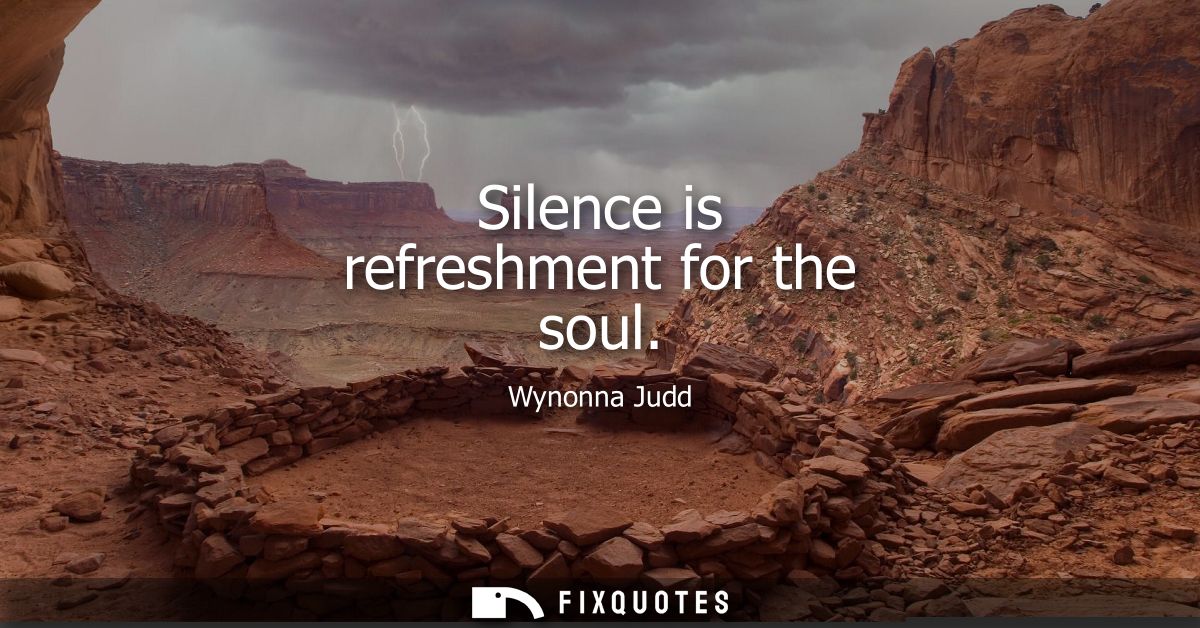
"Silence is refreshment for the soul"
About this Quote
In Wynonna Judd's mouth, "Silence is refreshment for the soul" lands less like a monkish proverb and more like a hard-won coping tool. This is an artist whose life has been lived at performance volume: stadium soundchecks, the noise of praise and criticism, the family mythology that follows you into every room. When someone like Judd praises silence, she isn't selling serenity as a lifestyle accessory; she's naming the one resource fame and modern life systematically steal.
The line works because it flips the usual metaphor. We treat silence as absence, a blank space to be filled. Judd treats it as nourishment, something you take in rather than endure. "Refreshment" is deliberately physical and everyday: a glass of water, a breath after a long run. That choice keeps the sentiment grounded, not spiritualized into vague wellness-speak. It also hints at exhaustion. You don't need refreshment unless you're depleted.
The subtext is boundary-setting. Silence becomes a form of self-defense against the constant demands of being legible to others: interviews, expectations, the pressure to narrate your pain into content. For musicians especially, quiet can feel almost illicit, like stepping off the stage without apologizing. Read in the context of Judd's public openness about mental health and survival, the quote doubles as a gentle rebuke to a culture that confuses access with intimacy. Sometimes the most radical act isn't speaking your truth; it's refusing to be noisy on command.
The line works because it flips the usual metaphor. We treat silence as absence, a blank space to be filled. Judd treats it as nourishment, something you take in rather than endure. "Refreshment" is deliberately physical and everyday: a glass of water, a breath after a long run. That choice keeps the sentiment grounded, not spiritualized into vague wellness-speak. It also hints at exhaustion. You don't need refreshment unless you're depleted.
The subtext is boundary-setting. Silence becomes a form of self-defense against the constant demands of being legible to others: interviews, expectations, the pressure to narrate your pain into content. For musicians especially, quiet can feel almost illicit, like stepping off the stage without apologizing. Read in the context of Judd's public openness about mental health and survival, the quote doubles as a gentle rebuke to a culture that confuses access with intimacy. Sometimes the most radical act isn't speaking your truth; it's refusing to be noisy on command.
Quote Details
| Topic | Meditation |
|---|
More Quotes by Wynonna
Add to List