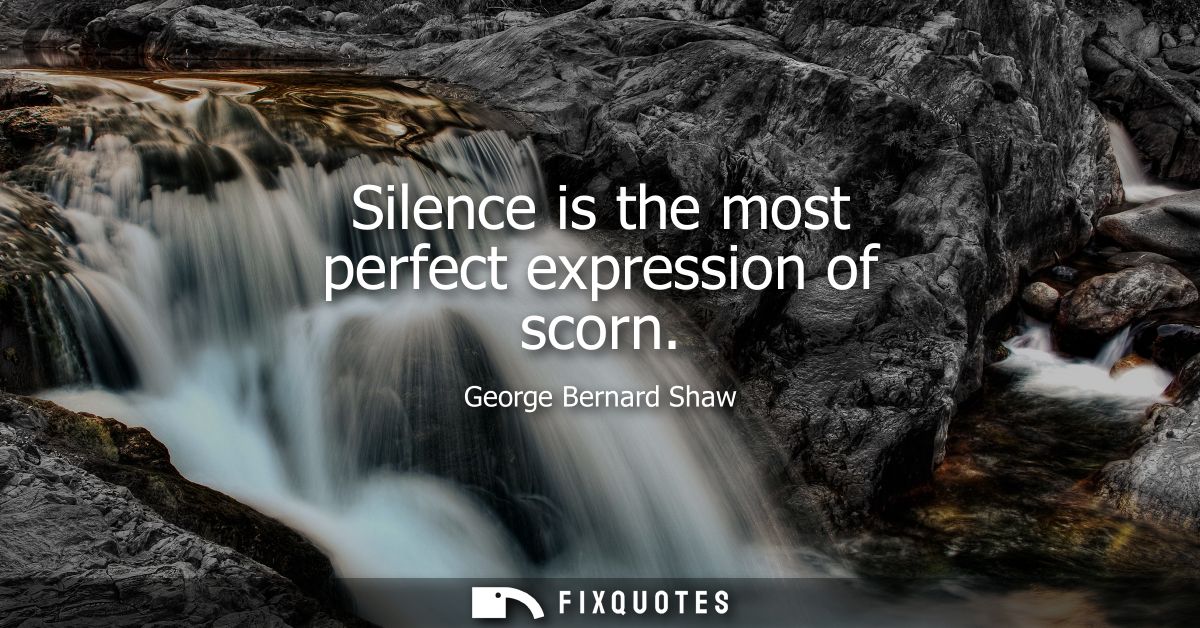
"Silence is the most perfect expression of scorn"
About this Quote
Shaw’s line cuts because it treats silence not as absence but as a deliberately wielded social weapon. Scorn, in this framing, isn’t the hot satisfaction of an insult; it’s the cold efficiency of refusing to grant someone the basic dignity of acknowledgment. Speech invites exchange. Silence cancels the premise that the other party is worth the effort. That’s why it lands with such a precise sting: it’s rejection masquerading as restraint.
The subtext is theatrical in the most Shaw way. A dramatist knows that dialogue isn’t only what characters say; it’s what they deny each other. Silence onstage is never neutral. It’s blocking, timing, a pause that forces the audience to feel the power imbalance. Shaw’s scorn is “perfect” because it’s self-protecting and self-justifying: the silent person can claim maturity, composure, even moral high ground, while still administering punishment. You don’t have to get your hands dirty when you can simply withdraw recognition.
Context matters. Shaw lived in a culture of manners, reputations, and public debate, where the currency of status was attention. In that world, ignoring someone isn’t passive; it’s a verdict. The line also reads as a critique of polite society’s cruelty: the genteel version of violence is social erasure.
It still resonates now, when our public sphere runs on replies, ratios, and “engagement.” Silence can be sanity, yes. But Shaw is naming its darker edge: the quiet that says, unmistakably, you don’t qualify for my words.
The subtext is theatrical in the most Shaw way. A dramatist knows that dialogue isn’t only what characters say; it’s what they deny each other. Silence onstage is never neutral. It’s blocking, timing, a pause that forces the audience to feel the power imbalance. Shaw’s scorn is “perfect” because it’s self-protecting and self-justifying: the silent person can claim maturity, composure, even moral high ground, while still administering punishment. You don’t have to get your hands dirty when you can simply withdraw recognition.
Context matters. Shaw lived in a culture of manners, reputations, and public debate, where the currency of status was attention. In that world, ignoring someone isn’t passive; it’s a verdict. The line also reads as a critique of polite society’s cruelty: the genteel version of violence is social erasure.
It still resonates now, when our public sphere runs on replies, ratios, and “engagement.” Silence can be sanity, yes. But Shaw is naming its darker edge: the quiet that says, unmistakably, you don’t qualify for my words.
Quote Details
| Topic | Sarcastic |
|---|---|
| Source | Help us find the source |
| Cite |
Citation Formats
APA Style (7th ed.)
Shaw, George Bernard. (2026, January 17). Silence is the most perfect expression of scorn. FixQuotes. https://fixquotes.com/quotes/silence-is-the-most-perfect-expression-of-scorn-35031/
Chicago Style
Shaw, George Bernard. "Silence is the most perfect expression of scorn." FixQuotes. January 17, 2026. https://fixquotes.com/quotes/silence-is-the-most-perfect-expression-of-scorn-35031/.
MLA Style (9th ed.)
"Silence is the most perfect expression of scorn." FixQuotes, 17 Jan. 2026, https://fixquotes.com/quotes/silence-is-the-most-perfect-expression-of-scorn-35031/. Accessed 27 Mar. 2026.
More Quotes by George
Add to List