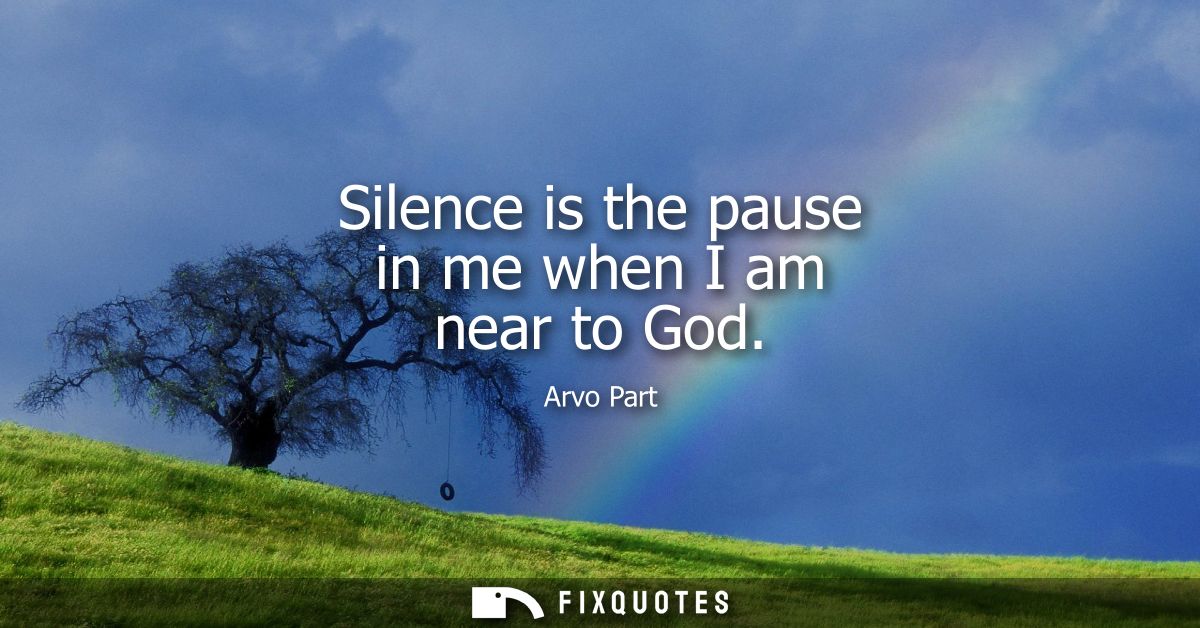
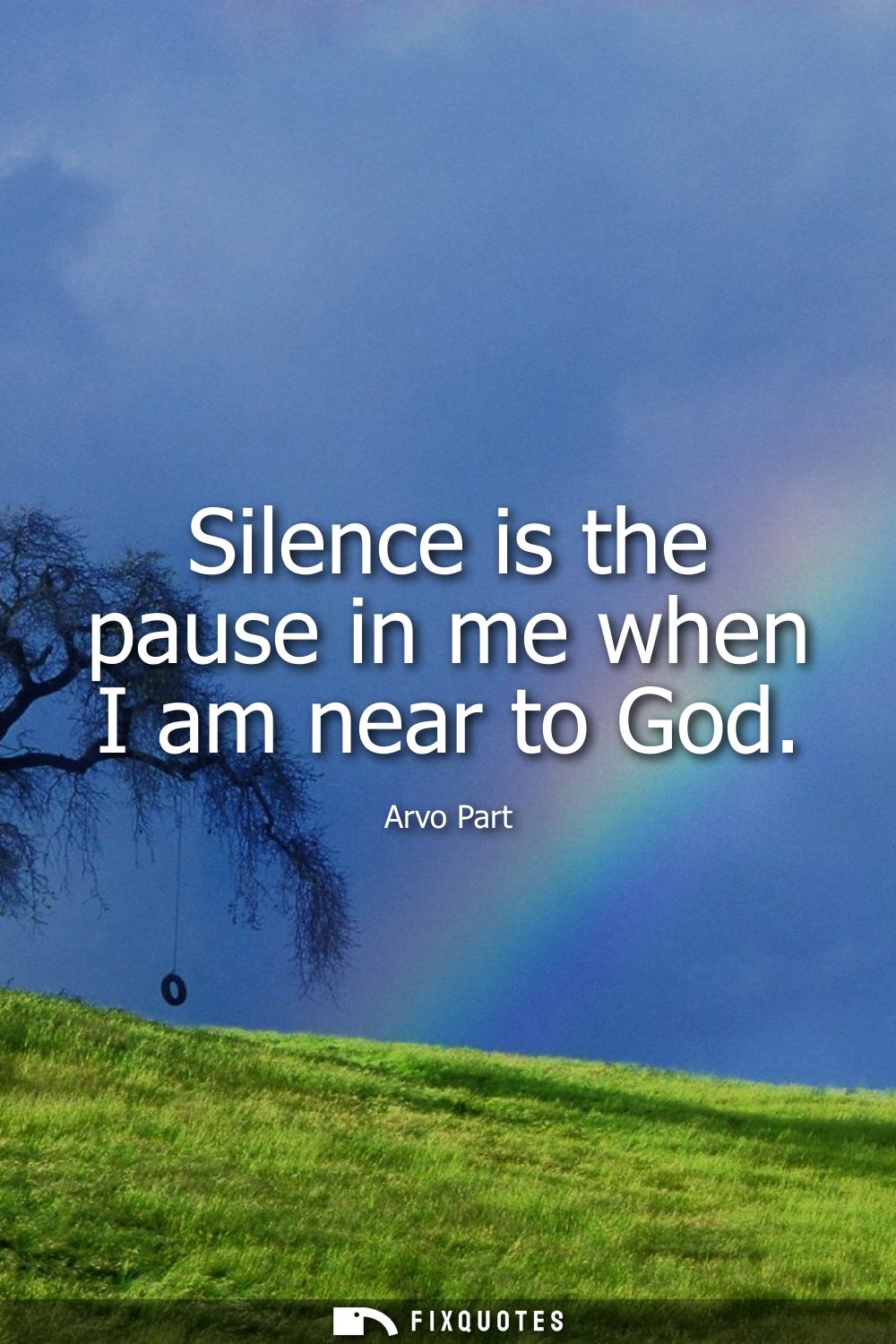
"Silence is the pause in me when I am near to God"
About this Quote
Silence, for Arvo Part, isn’t the absence of sound; it’s the moment music stops performing and starts listening. “The pause in me” flips silence from an external condition into an interior discipline - a deliberate clearing of the self. That’s the telltale Part move: he treats restraint as an instrument, making emptiness feel engineered rather than incidental. The line implies a body and mind that are normally busy with noise - thought, ego, the constant need to fill space - and a rare suspension where something larger can be felt.
The theology is intimate and practical, not preachy. “Near to God” avoids grand declarations of certainty; it’s proximity, not possession. Part doesn’t claim revelation, only nearness, a modest but charged distance. That’s also a composer’s language: closeness without contact, resonance without grasping. Silence becomes the medium where the sacred can register because it’s the only room left where it can be heard.
Context matters: Part’s music, especially after his creative crisis and turn toward early sacred forms, is built around spareness - tintinnabuli lines, slow-moving harmonies, the impression of bells in an empty church. In that world, pauses aren’t breaks; they’re load-bearing walls. He’s inviting the listener into the same spiritual technology: patience, attention, humility. The subtext is almost defiant in a culture that treats constant output as virtue. Part proposes the opposite: meaning arrives when you stop insisting on it.
The theology is intimate and practical, not preachy. “Near to God” avoids grand declarations of certainty; it’s proximity, not possession. Part doesn’t claim revelation, only nearness, a modest but charged distance. That’s also a composer’s language: closeness without contact, resonance without grasping. Silence becomes the medium where the sacred can register because it’s the only room left where it can be heard.
Context matters: Part’s music, especially after his creative crisis and turn toward early sacred forms, is built around spareness - tintinnabuli lines, slow-moving harmonies, the impression of bells in an empty church. In that world, pauses aren’t breaks; they’re load-bearing walls. He’s inviting the listener into the same spiritual technology: patience, attention, humility. The subtext is almost defiant in a culture that treats constant output as virtue. Part proposes the opposite: meaning arrives when you stop insisting on it.
Quote Details
| Topic | God |
|---|---|
| Source | Help us find the source |
| Cite |
Citation Formats
APA Style (7th ed.)
Part, Arvo. (2026, January 15). Silence is the pause in me when I am near to God. FixQuotes. https://fixquotes.com/quotes/silence-is-the-pause-in-me-when-i-am-near-to-god-114085/
Chicago Style
Part, Arvo. "Silence is the pause in me when I am near to God." FixQuotes. January 15, 2026. https://fixquotes.com/quotes/silence-is-the-pause-in-me-when-i-am-near-to-god-114085/.
MLA Style (9th ed.)
"Silence is the pause in me when I am near to God." FixQuotes, 15 Jan. 2026, https://fixquotes.com/quotes/silence-is-the-pause-in-me-when-i-am-near-to-god-114085/. Accessed 10 Feb. 2026.
More Quotes by Arvo
Add to List