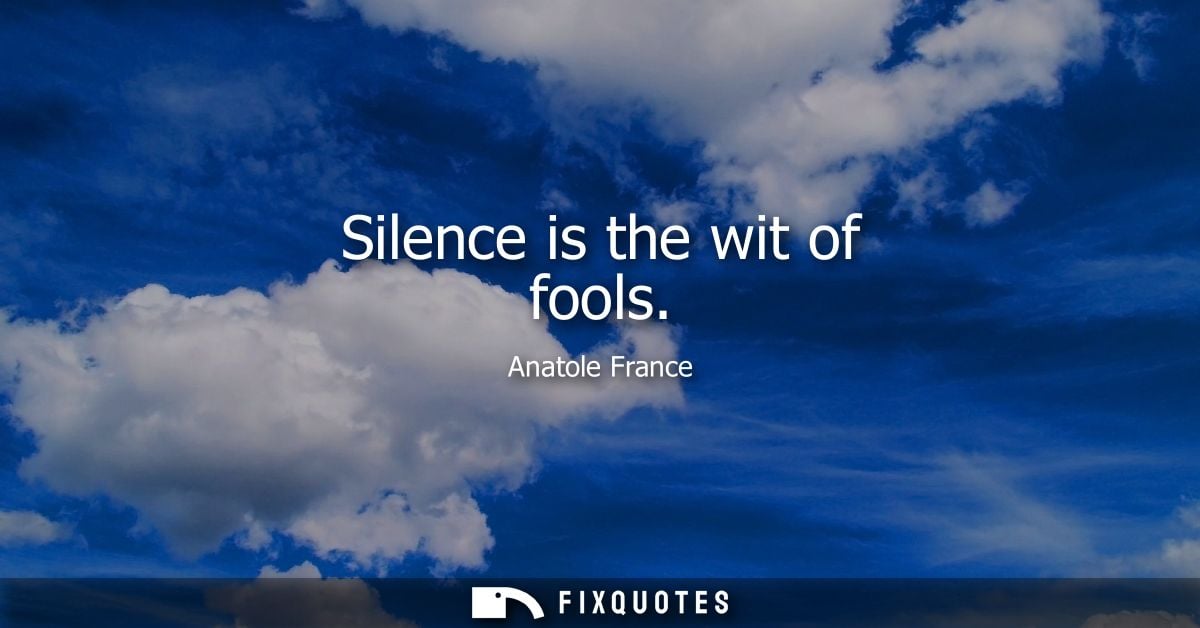
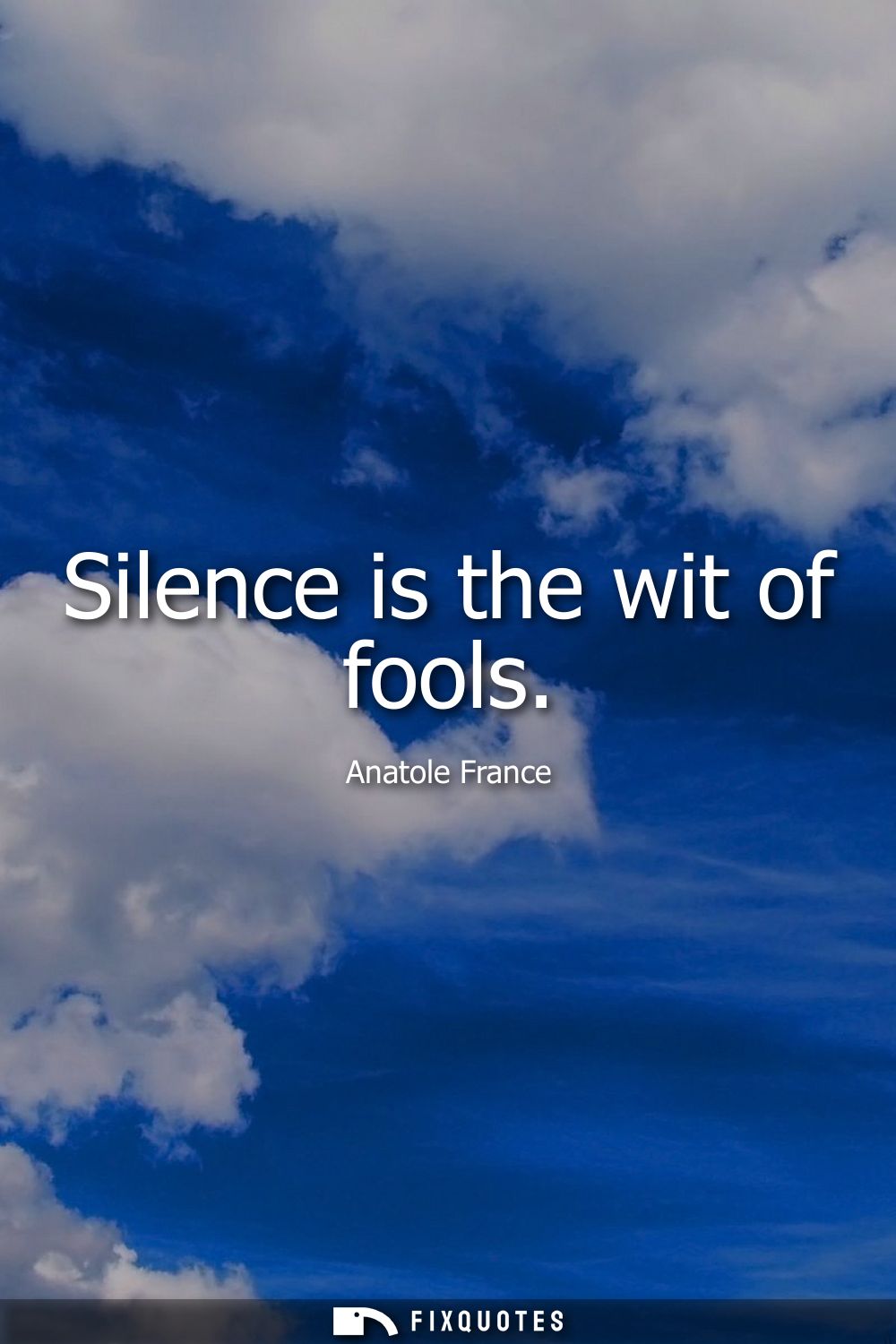
"Silence is the wit of fools"
About this Quote
Anatole France’s line lands like a sly correction to the pieties we attach to quiet. “Silence” usually gets marketed as restraint, dignity, even wisdom. France flips the halo: sometimes keeping your mouth shut isn’t self-control, it’s self-protection. The “wit” here isn’t brilliance but a cheap substitute for it, a defensive tactic dressed up as virtue. If you have nothing to say, silence can be the only performance that doesn’t expose you.
The barb works because it weaponizes a compliment. Calling silence “wit” sounds generous for half a beat, then the sentence snaps shut on “fools,” revealing the trap. It’s a tiny machine of irony: the supposed sophistication of quiet becomes the calling card of intellectual vacancy. France isn’t arguing that silence is always bad; he’s puncturing the social alibi that lets mediocrity masquerade as depth. In salons, classrooms, parliaments, and now comment threads, noncommittal quiet can read as seriousness. France insists that reading is often a misfire.
Context matters. Writing in fin-de-siecle France, France moved through literary culture where conversation was sport and reputation was made in the exchange. In that world, silence could be strategy: let others overextend, nod gravely, borrow authority from the room’s assumptions. The subtext is a warning about how status operates. People don’t just fail to speak because they lack ideas; they also learn that ambiguity can be a form of power. France needles that power by naming it for what it can be: the last refuge of the unprepared.
The barb works because it weaponizes a compliment. Calling silence “wit” sounds generous for half a beat, then the sentence snaps shut on “fools,” revealing the trap. It’s a tiny machine of irony: the supposed sophistication of quiet becomes the calling card of intellectual vacancy. France isn’t arguing that silence is always bad; he’s puncturing the social alibi that lets mediocrity masquerade as depth. In salons, classrooms, parliaments, and now comment threads, noncommittal quiet can read as seriousness. France insists that reading is often a misfire.
Context matters. Writing in fin-de-siecle France, France moved through literary culture where conversation was sport and reputation was made in the exchange. In that world, silence could be strategy: let others overextend, nod gravely, borrow authority from the room’s assumptions. The subtext is a warning about how status operates. People don’t just fail to speak because they lack ideas; they also learn that ambiguity can be a form of power. France needles that power by naming it for what it can be: the last refuge of the unprepared.
Quote Details
| Topic | Witty One-Liners |
|---|---|
| Source | Help us find the source |
| Cite |
Citation Formats
APA Style (7th ed.)
France, Anatole. (2026, January 15). Silence is the wit of fools. FixQuotes. https://fixquotes.com/quotes/silence-is-the-wit-of-fools-34598/
Chicago Style
France, Anatole. "Silence is the wit of fools." FixQuotes. January 15, 2026. https://fixquotes.com/quotes/silence-is-the-wit-of-fools-34598/.
MLA Style (9th ed.)
"Silence is the wit of fools." FixQuotes, 15 Jan. 2026, https://fixquotes.com/quotes/silence-is-the-wit-of-fools-34598/. Accessed 27 Mar. 2026.
More Quotes by Anatole
Add to List