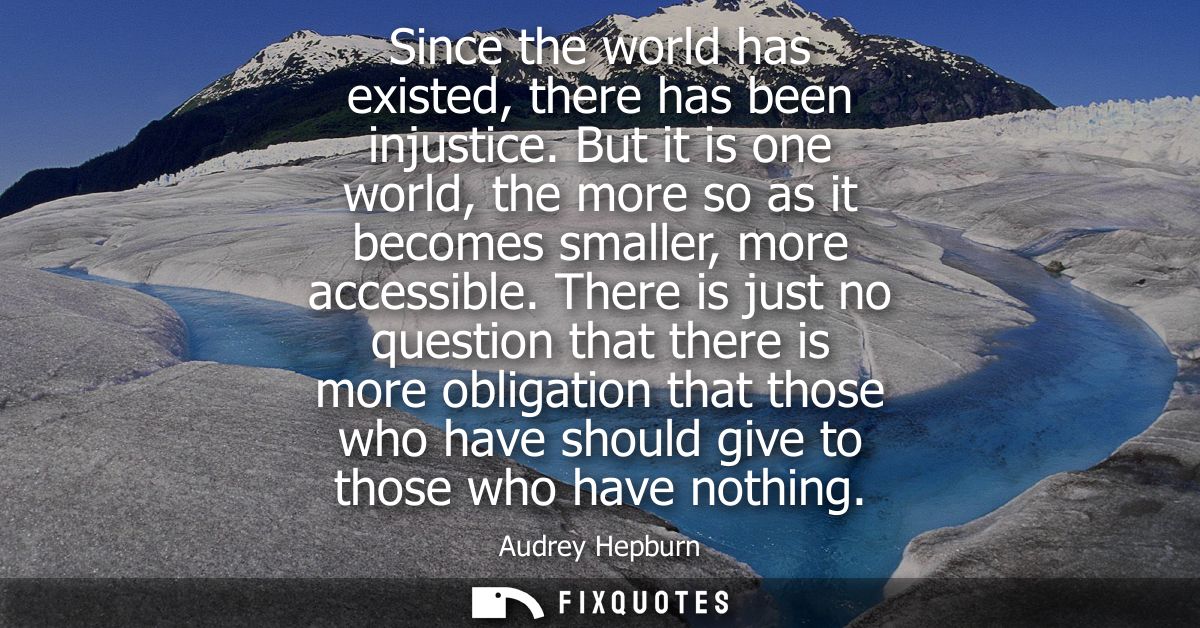
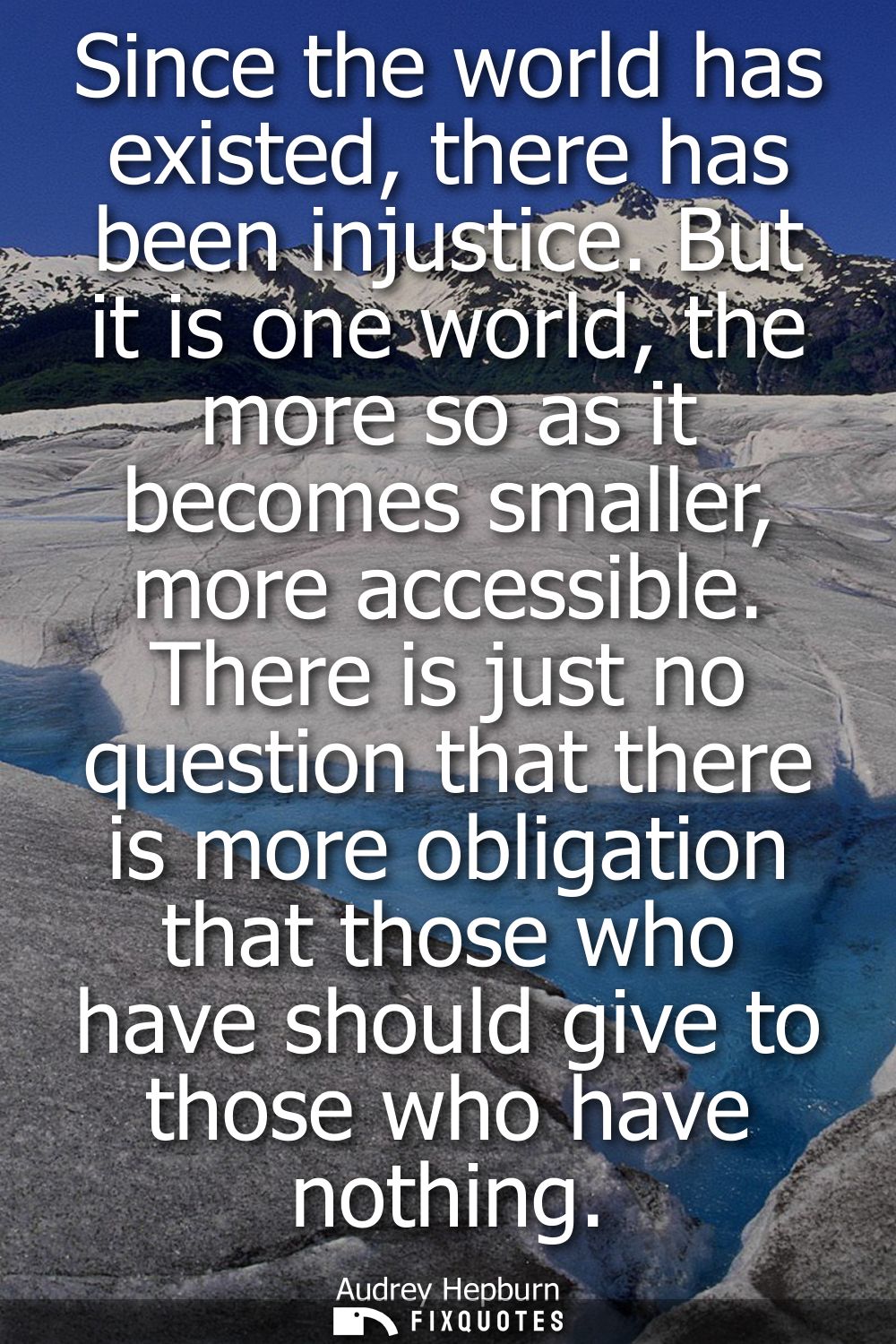
"Since the world has existed, there has been injustice. But it is one world, the more so as it becomes smaller, more accessible. There is just no question that there is more obligation that those who have should give to those who have nothing"
About this Quote
Hepburn’s line lands with the quiet authority of someone who could have coasted on glamour and instead chose moral insistence. She starts by conceding the oldest, bleakest truth in politics: injustice isn’t new, and nobody gets to be surprised by it. That opening disarms the usual defenses. If injustice is eternal, then outrage alone is cheap. The pivot is the real move: “one world… smaller, more accessible.” In a pre-internet celebrity era, she’s naming a modern condition we now take for granted - proximity. Technology, travel, media, and global markets collapse distance, making suffering harder to file away as “over there.” The subtext is blunt: ignorance is no longer plausible, so innocence is no longer a shield.
Her most pointed choice is “obligation,” not “charity.” Charity flatters the giver; obligation implicates them. She’s reframing aid from a feel-good option into a debt created by interdependence and uneven distribution. “Those who have” isn’t just rich individuals; it’s the comfortable West, consumer societies, anyone buffered from scarcity by systems that often rely on someone else’s cheap labor, unstable politics, or extracted resources. The sentence structure mirrors that moral gravity: broad history, tightened geography, unavoidable duty.
Context matters. Hepburn’s public life as a UNICEF Goodwill Ambassador gave her a platform that could have been pure image management. Instead, she uses celebrity as a delivery system for an argument: in a connected world, compassion is no longer private virtue; it’s public responsibility.
Her most pointed choice is “obligation,” not “charity.” Charity flatters the giver; obligation implicates them. She’s reframing aid from a feel-good option into a debt created by interdependence and uneven distribution. “Those who have” isn’t just rich individuals; it’s the comfortable West, consumer societies, anyone buffered from scarcity by systems that often rely on someone else’s cheap labor, unstable politics, or extracted resources. The sentence structure mirrors that moral gravity: broad history, tightened geography, unavoidable duty.
Context matters. Hepburn’s public life as a UNICEF Goodwill Ambassador gave her a platform that could have been pure image management. Instead, she uses celebrity as a delivery system for an argument: in a connected world, compassion is no longer private virtue; it’s public responsibility.
Quote Details
| Topic | Justice |
|---|
More Quotes by Audrey
Add to List