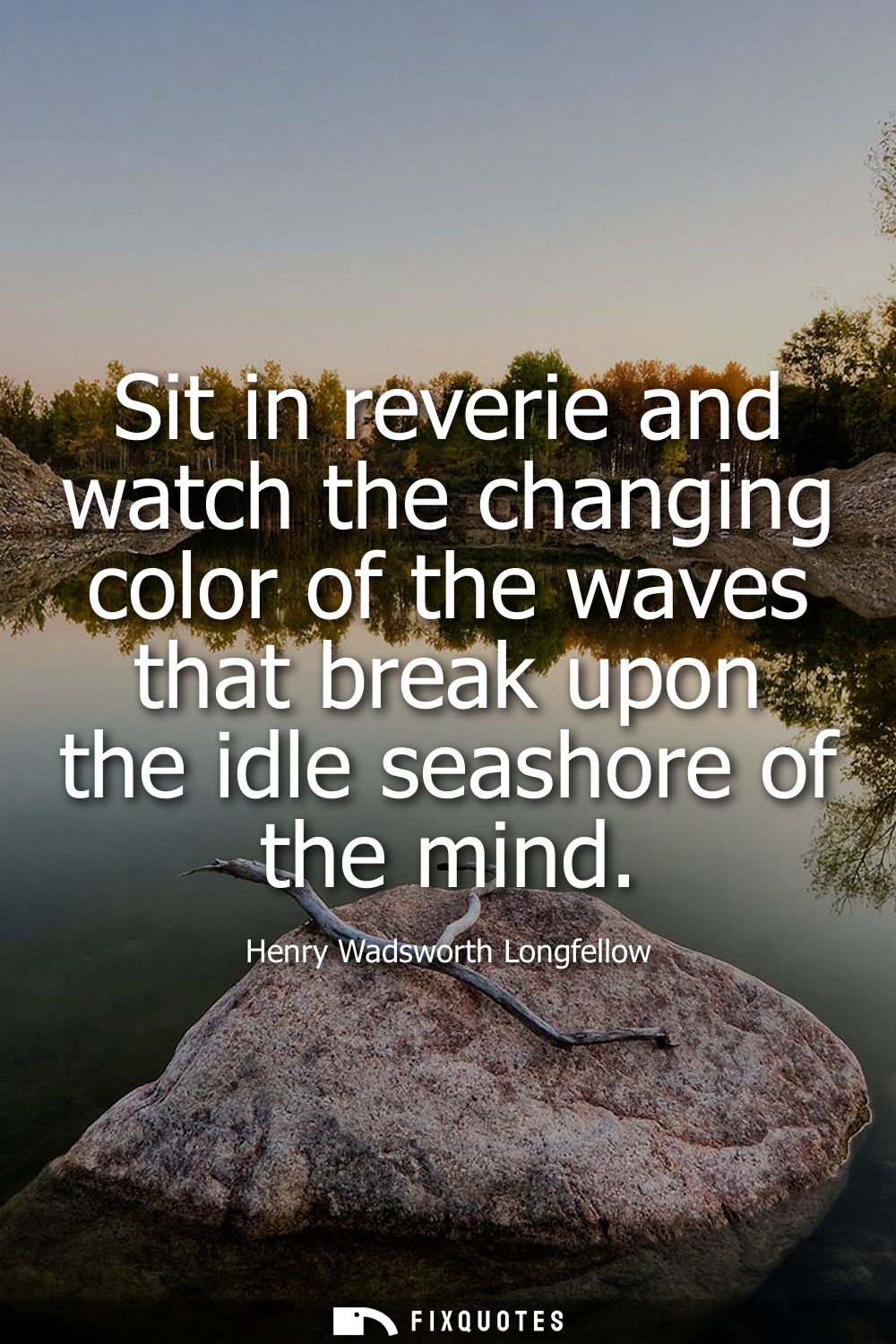
"Sit in reverie and watch the changing color of the waves that break upon the idle seashore of the mind"
About this Quote
The subtext is a quiet argument about attention. The “idle seashore” sounds passive, even lazy, until you notice what’s active: the waves. Longfellow gives agency to the world of sensation and memory, not to the self that wants to steer it. Reverie becomes an observational practice: watch, don’t manufacture. “Changing color” is the masterstroke, insisting that what looks like sameness (wave after wave) is actually continuous variation. It’s an aesthetic lesson and a psychological one: moods shift, meanings refract, thoughts tint themselves according to light you didn’t know was there.
Contextually, Longfellow wrote in an era that prized moral productivity and clear-minded reason, yet his popularity depended on making contemplation feel respectable and nourishing. This line offers a compromise: surrender to the mind’s weather, but do it with a poet’s vigilance.
Quote Details
| Topic | Poetry |
|---|---|
| Source | Help us find the source |
| Cite |
Citation Formats
APA Style (7th ed.)
Longfellow, Henry Wadsworth. (2026, January 15). Sit in reverie and watch the changing color of the waves that break upon the idle seashore of the mind. FixQuotes. https://fixquotes.com/quotes/sit-in-reverie-and-watch-the-changing-color-of-51983/
Chicago Style
Longfellow, Henry Wadsworth. "Sit in reverie and watch the changing color of the waves that break upon the idle seashore of the mind." FixQuotes. January 15, 2026. https://fixquotes.com/quotes/sit-in-reverie-and-watch-the-changing-color-of-51983/.
MLA Style (9th ed.)
"Sit in reverie and watch the changing color of the waves that break upon the idle seashore of the mind." FixQuotes, 15 Jan. 2026, https://fixquotes.com/quotes/sit-in-reverie-and-watch-the-changing-color-of-51983/. Accessed 12 Feb. 2026.