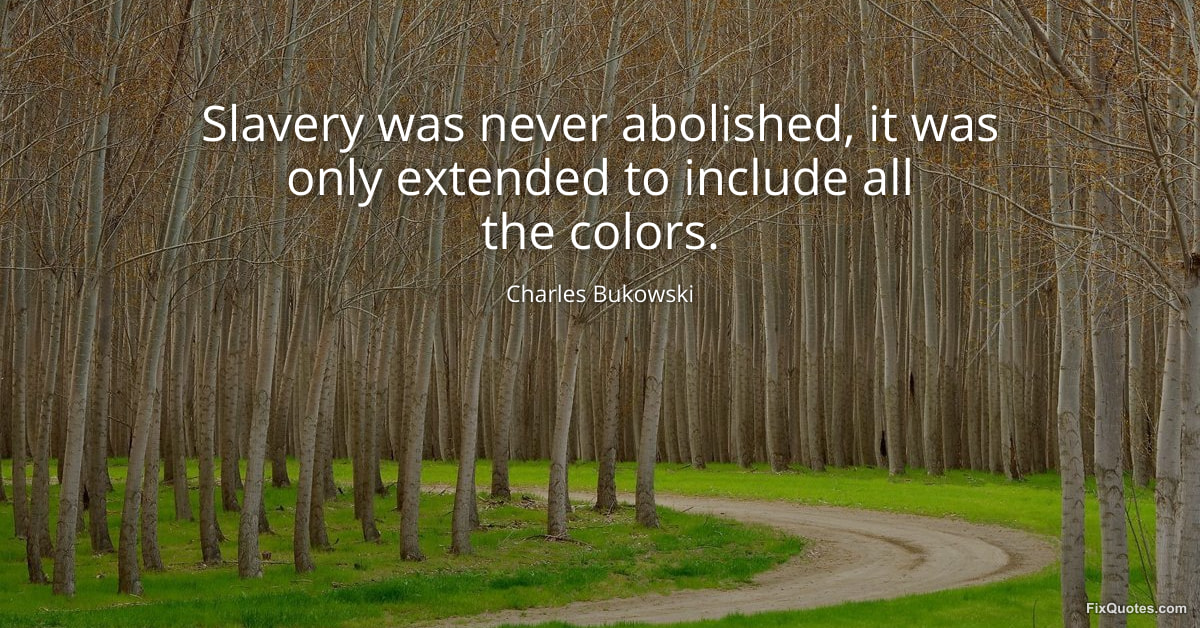
"Slavery was never abolished, it was only extended to include all the colors"
About this Quote
The subtext is class first, morality second. By saying slavery was “extended”, he yanks the discussion away from a closed chapter of American guilt and into the everyday economics of wage labor, debt, surveillance, and institutional coercion. It’s the Bukowski move: turn righteous narratives into a sour joke about who really gets to be free. The line’s power comes from its ugly overreach. “All the colors” is deliberately blunt, flattening difference to spotlight a shared condition: everyone is owned by something, and it’s usually rent, bosses, and the slow grind of survival.
Context matters because the quote also risks becoming a rhetorical shortcut. By universalizing “slavery”, it can blur the specific, racialized brutality of chattel slavery and the afterlives that didn’t hit everyone equally. That tension is part of why it works: it’s both an indictment of the system and a dare to argue back, forcing readers to separate metaphor from history while still feeling the squeeze Bukowski insists is real.
Quote Details
| Topic | Human Rights |
|---|---|
| Source | Help us find the source |
| Cite |
Citation Formats
APA Style (7th ed.)
Bukowski, Charles. (2026, February 10). Slavery was never abolished, it was only extended to include all the colors. FixQuotes. https://fixquotes.com/quotes/slavery-was-never-abolished-it-was-only-extended-185133/
Chicago Style
Bukowski, Charles. "Slavery was never abolished, it was only extended to include all the colors." FixQuotes. February 10, 2026. https://fixquotes.com/quotes/slavery-was-never-abolished-it-was-only-extended-185133/.
MLA Style (9th ed.)
"Slavery was never abolished, it was only extended to include all the colors." FixQuotes, 10 Feb. 2026, https://fixquotes.com/quotes/slavery-was-never-abolished-it-was-only-extended-185133/. Accessed 12 Feb. 2026.