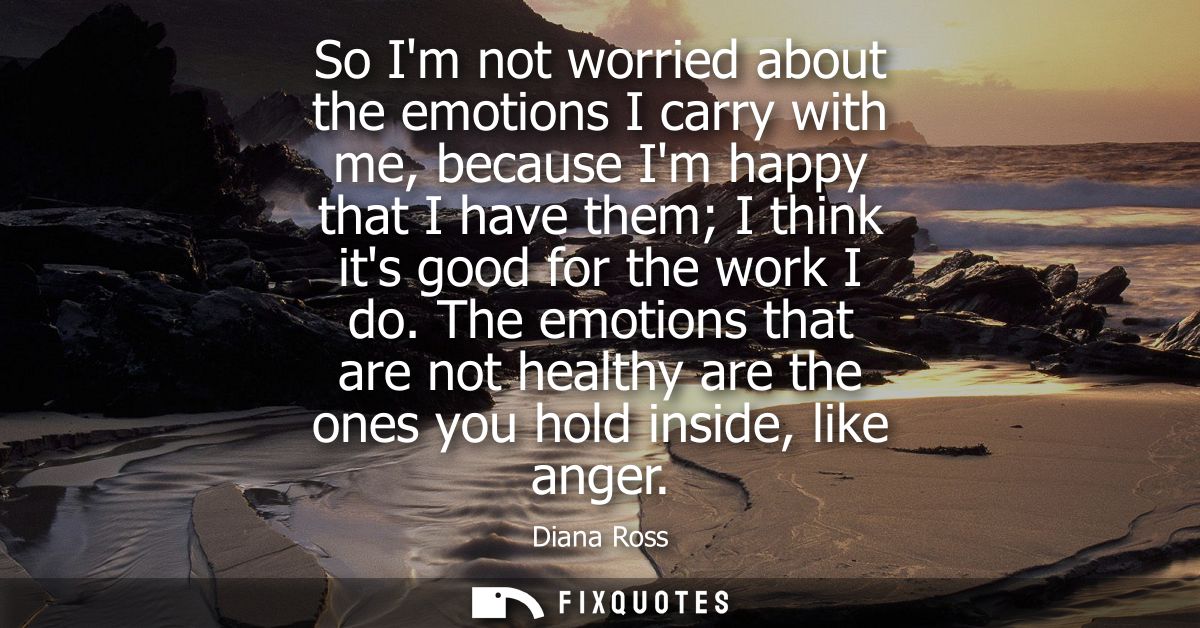
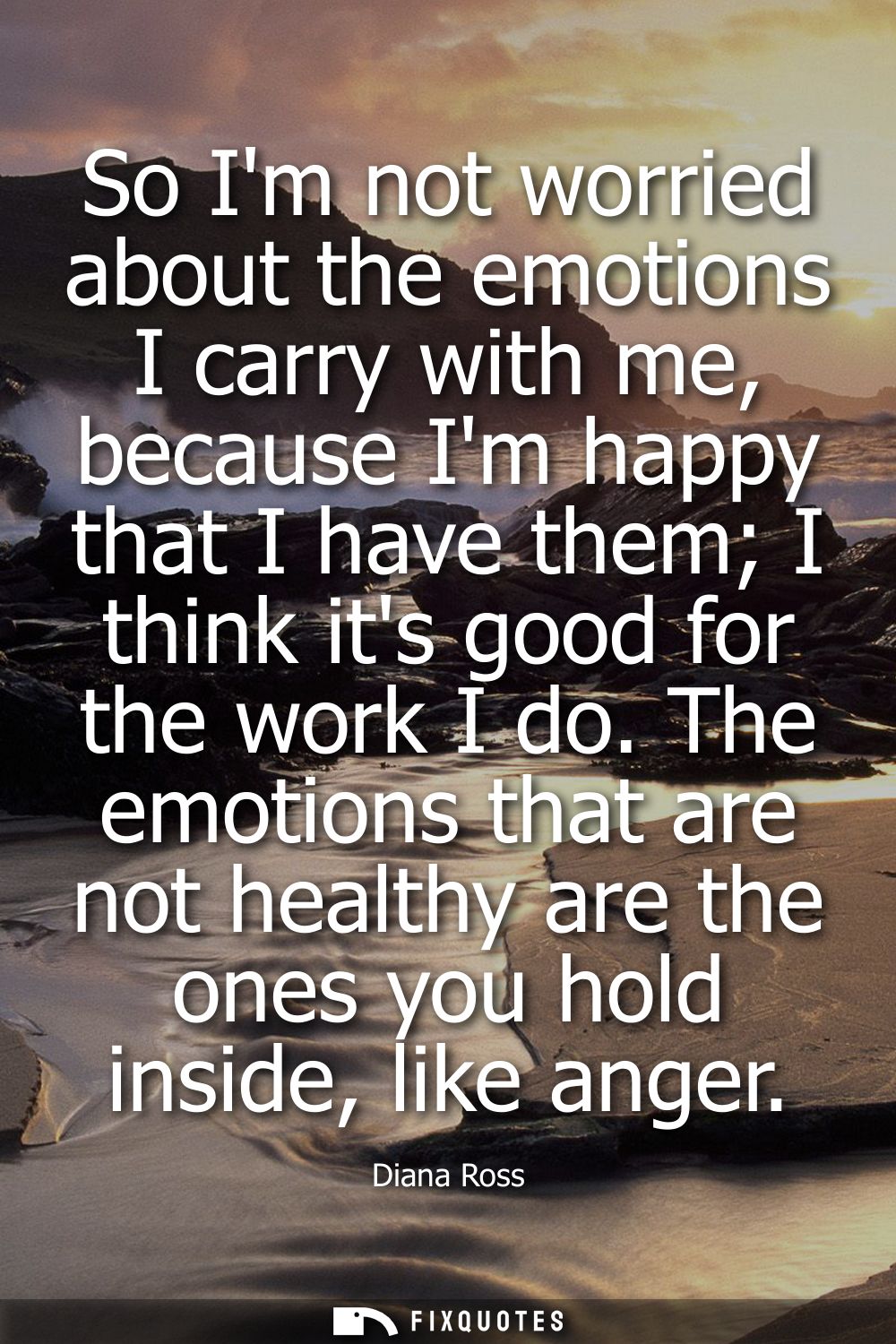
"So I'm not worried about the emotions I carry with me, because I'm happy that I have them; I think it's good for the work I do. The emotions that are not healthy are the ones you hold inside, like anger"
About this Quote
Ross frames feeling not as a liability but as creative inventory, and that’s a quietly radical stance in an industry built on packaging women as “effortless.” The first move is defensive in a savvy way: “I’m not worried” pre-empts the familiar critique that an emotional woman is unstable, difficult, unprofessional. She flips the script by treating emotion like a carry-on she chose, not a mess she’s dragging behind her. It’s agency disguised as reassurance.
Then she makes the key cultural bargain explicit: emotions are “good for the work I do.” Coming from a performer whose career spans Motown polish, crossover stardom, and decades of public scrutiny, the subtext is practical. Pop stardom demands vulnerability on cue, night after night, while keeping your private life camera-ready. Ross suggests the trick isn’t to become numb; it’s to metabolize feeling into performance rather than letting it calcify into something corrosive.
Her sharpest line is the distinction between carried emotions and hidden ones. “Hold inside, like anger” isn’t a self-help cliché here; it’s a diagnosis of celebrity survival. Anger is the emotion women are trained to suppress because it threatens likability and control. By calling it “not healthy,” she’s not condemning anger itself so much as the forced containment of it - the pressure to smile through insult, racism, misogyny, bad contracts, the constant appraisal.
The intent reads as permission and warning at once: feel fully, use it, don’t let it rot in you. It’s a performer’s ethic that doubles as a politics of self-preservation.
Then she makes the key cultural bargain explicit: emotions are “good for the work I do.” Coming from a performer whose career spans Motown polish, crossover stardom, and decades of public scrutiny, the subtext is practical. Pop stardom demands vulnerability on cue, night after night, while keeping your private life camera-ready. Ross suggests the trick isn’t to become numb; it’s to metabolize feeling into performance rather than letting it calcify into something corrosive.
Her sharpest line is the distinction between carried emotions and hidden ones. “Hold inside, like anger” isn’t a self-help cliché here; it’s a diagnosis of celebrity survival. Anger is the emotion women are trained to suppress because it threatens likability and control. By calling it “not healthy,” she’s not condemning anger itself so much as the forced containment of it - the pressure to smile through insult, racism, misogyny, bad contracts, the constant appraisal.
The intent reads as permission and warning at once: feel fully, use it, don’t let it rot in you. It’s a performer’s ethic that doubles as a politics of self-preservation.
Quote Details
| Topic | Anger |
|---|
More Quotes by Diana
Add to List