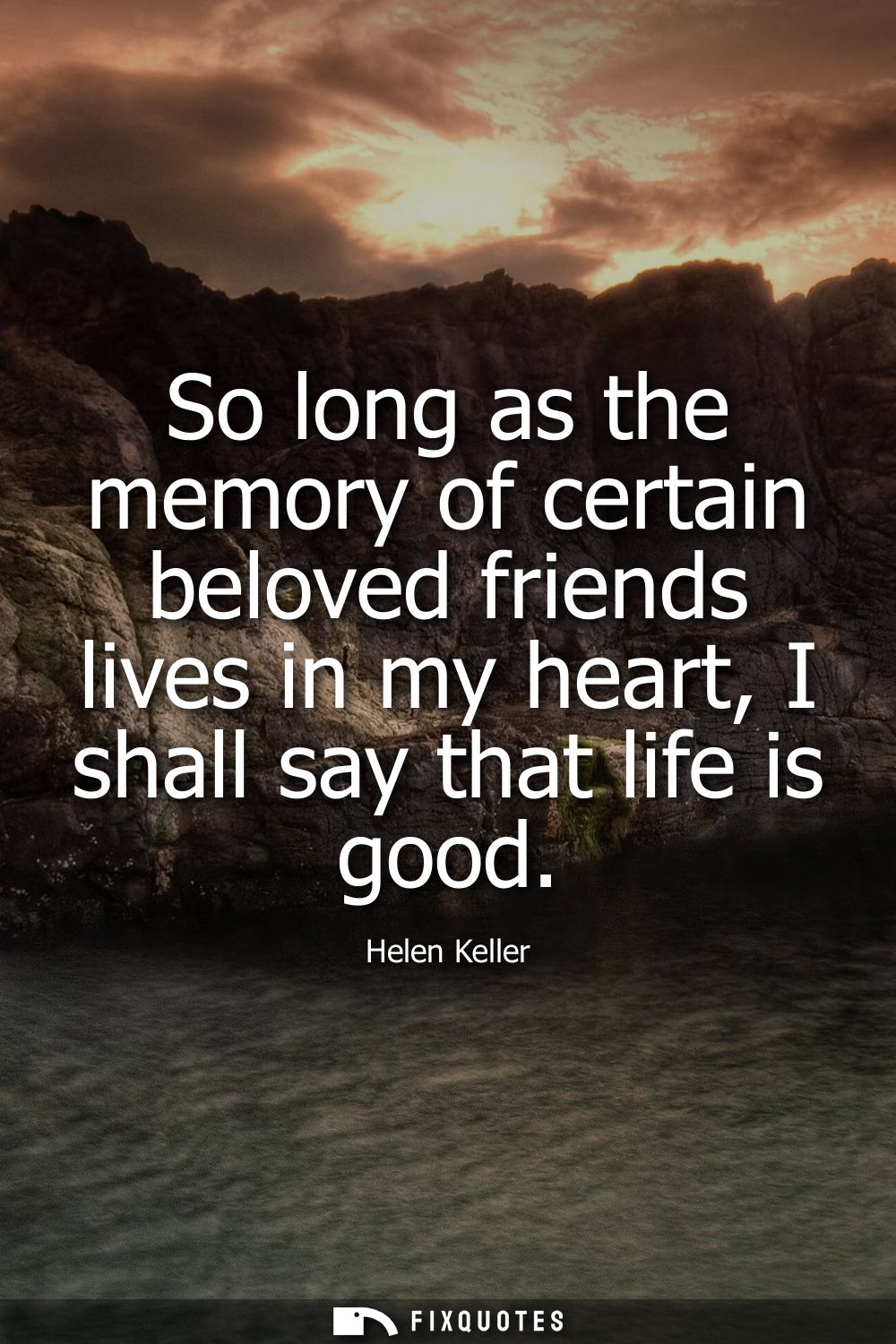
"So long as the memory of certain beloved friends lives in my heart, I shall say that life is good"
About this Quote
The phrasing matters. “Certain beloved friends” is deliberately selective, resisting the pressure to turn private mourning into public piety. Keller isn’t praising humanity in the abstract; she’s naming the precise, irreplaceable people who anchor a life. “Lives in my heart” sounds like a cliché until you remember who’s speaking: a woman whose sensory access to the world was radically constrained, whose experience of intimacy often traveled through touch, language, and memory rather than casual sight or sound. For Keller, memory isn’t a soft-focus scrapbook. It’s a technology of presence.
The subtext is defiance against the era’s preferred narrative about disability: that a life marked by limitation must be redeemed by achievement or optimism. Keller, who lived through political upheavals and personal bereavements, offers a quieter rebuttal. She stakes meaning on attachment, not conquest; on continuity, not denial. The line is a manifesto for a life where love doesn’t erase pain, but gives it a frame that doesn’t collapse.
Quote Details
| Topic | Friendship |
|---|---|
| Source | Later attribution: Helen Keller: Autobiographies & Other Writings (LOA #378) (Helen Keller, 2024) modern compilationISBN: 9781598537826 · ID: E6rEEAAAQBAJ
Evidence:
... Helen Keller Kim E. Nielsen. with his mind - a gesture of the soul rather than of the face . His voice was truly ... So long as the memory of certain beloved friends lives in my heart I shall say that life is good . The affluence of ... |
| Cite |
Citation Formats
APA Style (7th ed.)
Keller, Helen. (2026, March 1). So long as the memory of certain beloved friends lives in my heart, I shall say that life is good. FixQuotes. https://fixquotes.com/quotes/so-long-as-the-memory-of-certain-beloved-friends-14119/
Chicago Style
Keller, Helen. "So long as the memory of certain beloved friends lives in my heart, I shall say that life is good." FixQuotes. March 1, 2026. https://fixquotes.com/quotes/so-long-as-the-memory-of-certain-beloved-friends-14119/.
MLA Style (9th ed.)
"So long as the memory of certain beloved friends lives in my heart, I shall say that life is good." FixQuotes, 1 Mar. 2026, https://fixquotes.com/quotes/so-long-as-the-memory-of-certain-beloved-friends-14119/. Accessed 30 Mar. 2026.