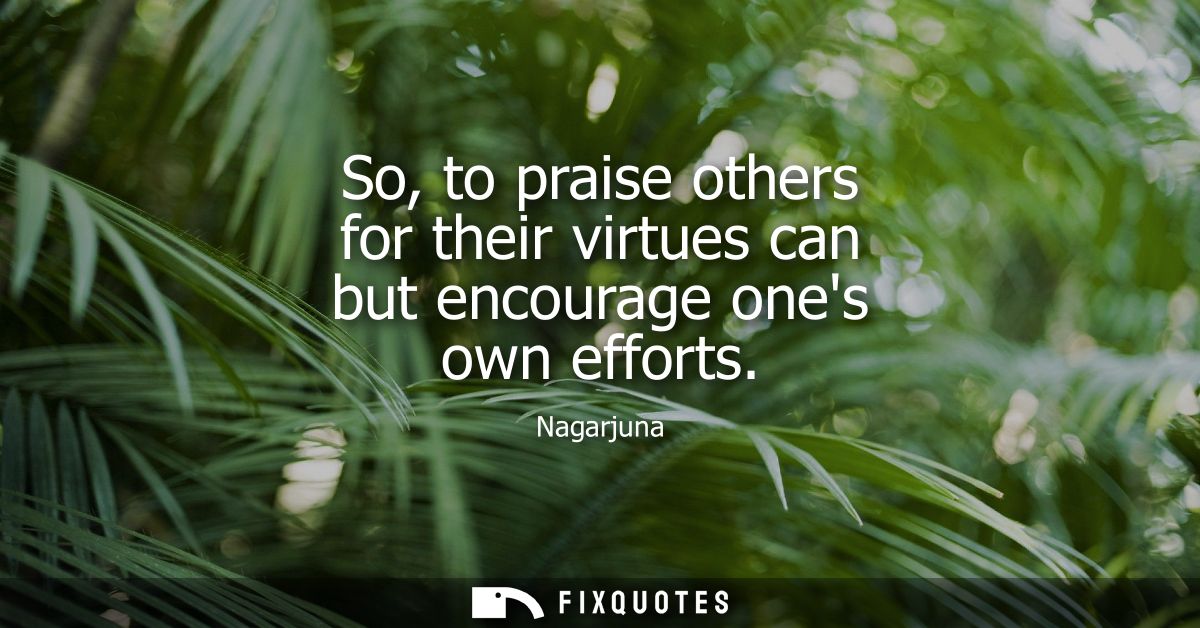
"So, to praise others for their virtues can but encourage one's own efforts"
About this Quote
Praise, in Nagarjuna's hands, is less a moral pat on the head than a disciplined way of loosening the ego's grip. "To praise others for their virtues" sounds like etiquette, but the engine is psychological: attention is finite, and where you place it trains you. When you practice seeing virtue in someone else, you're also rehearsing the very standards you claim to admire. The compliment becomes a mirror you have to live up to.
The subtext is distinctly Buddhist and distinctly Nagarjuna: what we call "my virtue" is not a private possession sealed inside an enduring self. It's contingent, cultivated, relational. Praising another person's patience or generosity isn't merely recognition; it subtly reconfigures the conditions that make patience or generosity more likely in you. It redirects the mind away from envy and comparison (two habits that thrive on the fantasy of a solid, separate self) and toward aspiration and imitation, which are quieter and more sustainable motivators.
Context matters. Nagarjuna, the great architect of Madhyamaka, spends much of his work dismantling the instinct to reify: to turn fluid processes into fixed things. Here, praise is a practical antidote to that instinct. It shifts the focus from "I am good" to "goodness is doable", from identity to practice. There's also an ethical politics embedded in it: communities become sturdier when admiration circulates outward rather than inward. The line isn't preaching niceness; it's offering a technique for self-cultivation that bypasses self-obsession by making other people the training ground.
The subtext is distinctly Buddhist and distinctly Nagarjuna: what we call "my virtue" is not a private possession sealed inside an enduring self. It's contingent, cultivated, relational. Praising another person's patience or generosity isn't merely recognition; it subtly reconfigures the conditions that make patience or generosity more likely in you. It redirects the mind away from envy and comparison (two habits that thrive on the fantasy of a solid, separate self) and toward aspiration and imitation, which are quieter and more sustainable motivators.
Context matters. Nagarjuna, the great architect of Madhyamaka, spends much of his work dismantling the instinct to reify: to turn fluid processes into fixed things. Here, praise is a practical antidote to that instinct. It shifts the focus from "I am good" to "goodness is doable", from identity to practice. There's also an ethical politics embedded in it: communities become sturdier when admiration circulates outward rather than inward. The line isn't preaching niceness; it's offering a technique for self-cultivation that bypasses self-obsession by making other people the training ground.
Quote Details
| Topic | Self-Improvement |
|---|---|
| Source | Help us find the source |
| Cite |
Citation Formats
APA Style (7th ed.)
Nagarjuna. (2026, January 18). So, to praise others for their virtues can but encourage one's own efforts. FixQuotes. https://fixquotes.com/quotes/so-to-praise-others-for-their-virtues-can-but-7738/
Chicago Style
Nagarjuna. "So, to praise others for their virtues can but encourage one's own efforts." FixQuotes. January 18, 2026. https://fixquotes.com/quotes/so-to-praise-others-for-their-virtues-can-but-7738/.
MLA Style (9th ed.)
"So, to praise others for their virtues can but encourage one's own efforts." FixQuotes, 18 Jan. 2026, https://fixquotes.com/quotes/so-to-praise-others-for-their-virtues-can-but-7738/. Accessed 5 Mar. 2026.
More Quotes by Nagarjuna
Add to List