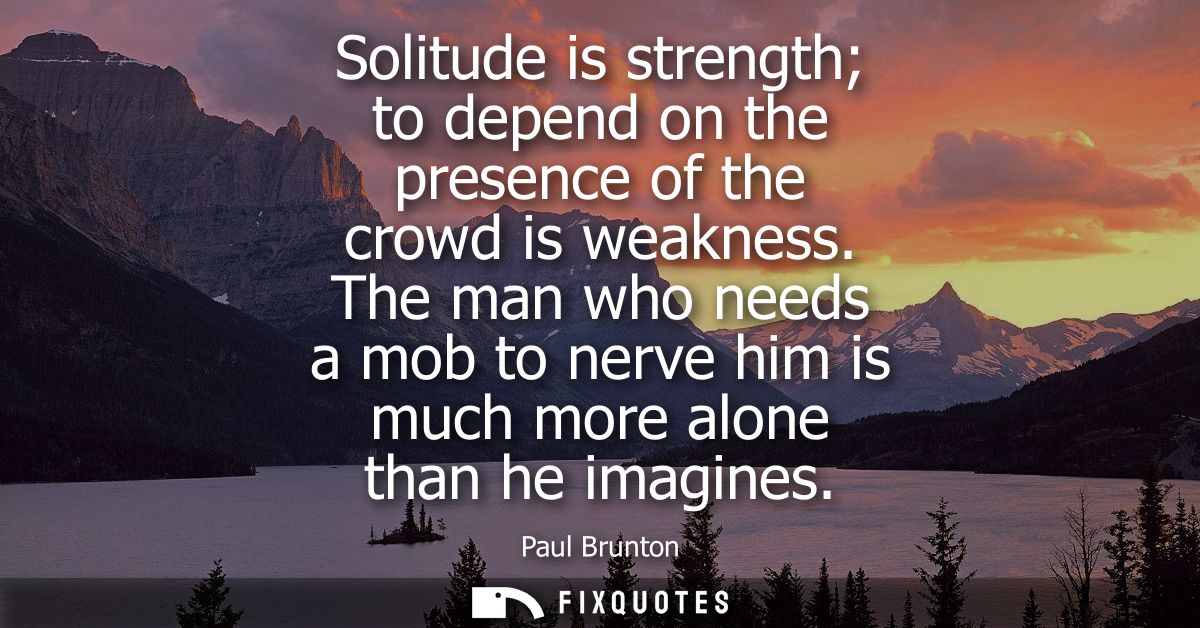
"Solitude is strength; to depend on the presence of the crowd is weakness. The man who needs a mob to nerve him is much more alone than he imagines"
About this Quote
Brunton isn’t praising loneliness as a lifestyle so much as attacking a particular kind of social dependency: the need to be witnessed in order to feel real. “Solitude is strength” lands like a paradox because we’re trained to equate strength with influence, allies, numbers. Brunton flips the metric. Strength, for him, is interior sovereignty: the ability to endure your own mind without outsourcing courage to applause, agreement, or collective momentum.
The phrasing is doing quiet rhetorical work. “Crowd” and “mob” aren’t neutral nouns; they carry moral weather. A crowd can be festive, but a mob is volatile, suggestible, hungry for contagion. By moving from “crowd” to “mob,” Brunton sharpens the critique from mere social comfort to psychological reliance on collective heat. “To nerve him” is surgical: it suggests the man’s courage is pharmacological, a shot administered by other people’s energy. The crowd becomes a stimulant, not a community.
The sting is the final turn: needing a mob makes you “much more alone than he imagines.” That’s Brunton’s subtext about modern alienation before the term became clichéd. If your confidence requires a chorus, you don’t actually have companionship; you have proximity. The self remains uninhabited, avoided, untrained. In the background is Brunton’s spiritual-philosophical project (influenced by Eastern contemplative traditions): solitude as discipline, not retreat. The aim isn’t misanthropy; it’s a self sturdy enough to meet others without dissolving into them.
The phrasing is doing quiet rhetorical work. “Crowd” and “mob” aren’t neutral nouns; they carry moral weather. A crowd can be festive, but a mob is volatile, suggestible, hungry for contagion. By moving from “crowd” to “mob,” Brunton sharpens the critique from mere social comfort to psychological reliance on collective heat. “To nerve him” is surgical: it suggests the man’s courage is pharmacological, a shot administered by other people’s energy. The crowd becomes a stimulant, not a community.
The sting is the final turn: needing a mob makes you “much more alone than he imagines.” That’s Brunton’s subtext about modern alienation before the term became clichéd. If your confidence requires a chorus, you don’t actually have companionship; you have proximity. The self remains uninhabited, avoided, untrained. In the background is Brunton’s spiritual-philosophical project (influenced by Eastern contemplative traditions): solitude as discipline, not retreat. The aim isn’t misanthropy; it’s a self sturdy enough to meet others without dissolving into them.
Quote Details
| Topic | Wisdom |
|---|---|
| Source | Help us find the source |
More Quotes by Paul
Add to List