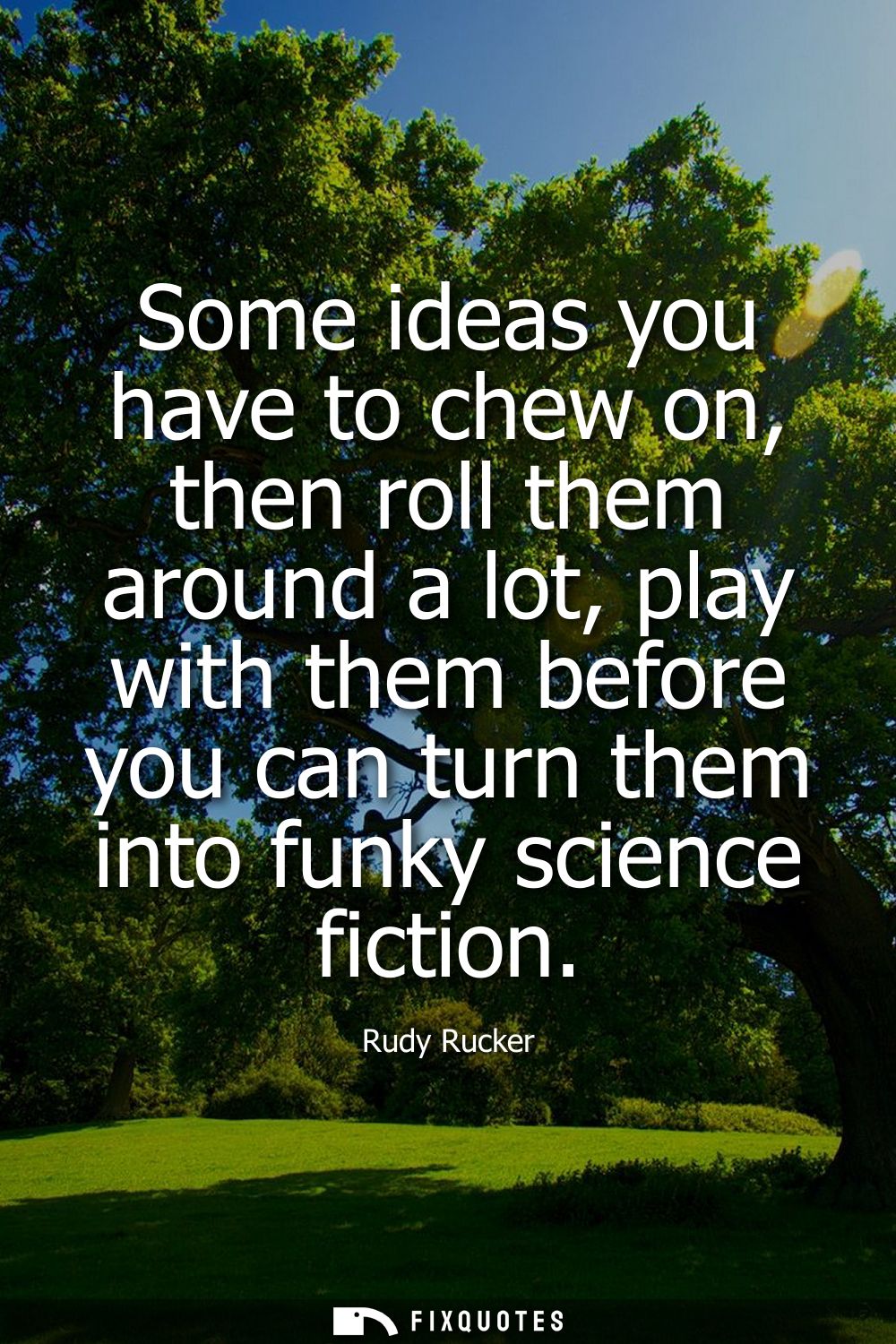
"Some ideas you have to chew on, then roll them around a lot, play with them before you can turn them into funky science fiction"
About this Quote
Rudy Rucker’s line reads like a lab note scribbled in the margins of a punk zine: thinking isn’t a lightning strike, it’s mastication. The verbs do the heavy lifting. “Chew,” “roll,” “play” are bodily, even childish actions, yanking “ideas” down from the pedestal of pure intellect and back into the mouth and hands. That’s the subtext: creativity is material, iterative, and a little undignified. You don’t “receive” inspiration; you work it over until it changes texture.
The phrase “a lot” matters because it rejects the mythology of the elegant first draft. Rucker is a scientist, but he’s also one of cyberpunk’s gleeful weirdos, and this is a quiet manifesto for cross-pollination: scientific concepts don’t arrive pre-packaged as narrative. They need friction, repetition, and permission to be toyed with. “Play” is the heresy here, a rebuke to the cultural script that science is rigid while art is free. He’s describing the same cognitive engine in both fields: hypothesis-testing as imaginative rehearsal.
Then he lands on “funky science fiction,” a deliberately unserious adjective that signals an aesthetic goal: not just plausibility, but strangeness with groove. “Funky” implies offbeat, embodied, countercultural - the kind of SF that doesn’t merely predict the future, it metabolizes the present. In an era where “hard” science fiction can become a status performance, Rucker stakes out a different credibility: rigor plus mischief, the mind at work with its sleeves rolled up.
The phrase “a lot” matters because it rejects the mythology of the elegant first draft. Rucker is a scientist, but he’s also one of cyberpunk’s gleeful weirdos, and this is a quiet manifesto for cross-pollination: scientific concepts don’t arrive pre-packaged as narrative. They need friction, repetition, and permission to be toyed with. “Play” is the heresy here, a rebuke to the cultural script that science is rigid while art is free. He’s describing the same cognitive engine in both fields: hypothesis-testing as imaginative rehearsal.
Then he lands on “funky science fiction,” a deliberately unserious adjective that signals an aesthetic goal: not just plausibility, but strangeness with groove. “Funky” implies offbeat, embodied, countercultural - the kind of SF that doesn’t merely predict the future, it metabolizes the present. In an era where “hard” science fiction can become a status performance, Rucker stakes out a different credibility: rigor plus mischief, the mind at work with its sleeves rolled up.
Quote Details
| Topic | Writing |
|---|---|
| Source | Help us find the source |
More Quotes by Rudy
Add to List