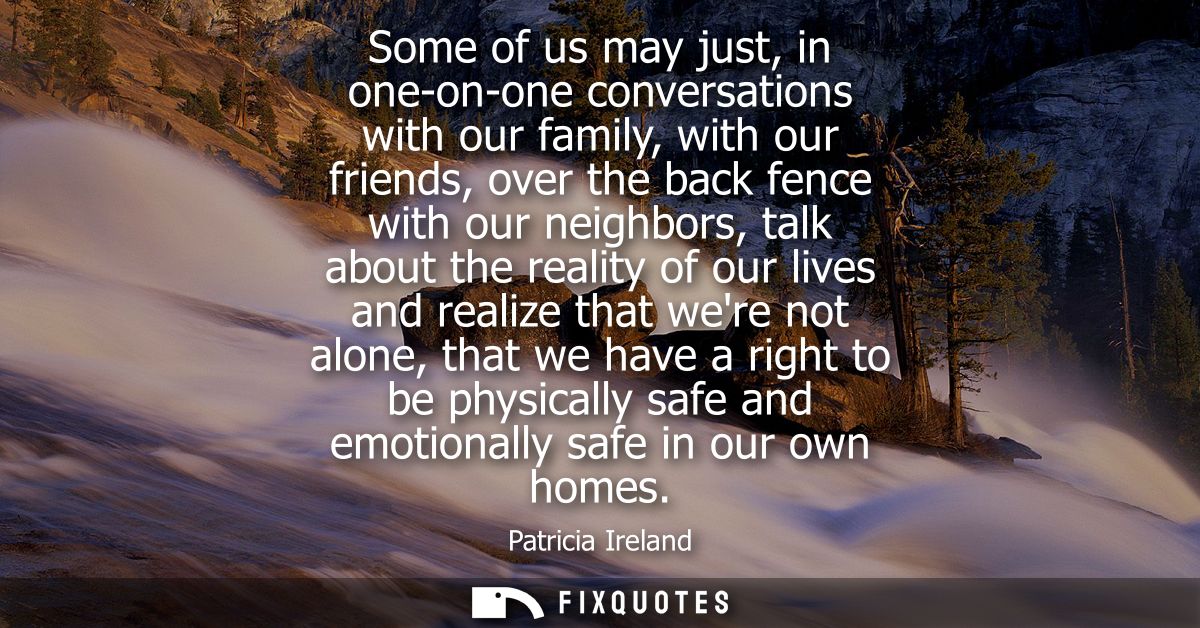
"Some of us may just, in one-on-one conversations with our family, with our friends, over the back fence with our neighbors, talk about the reality of our lives and realize that we're not alone, that we have a right to be physically safe and emotionally safe in our own homes"
About this Quote
The subtext is sharper than the tone. Talking “about the reality of our lives” implies that silence has been doing someone else’s work. The line “realize that we’re not alone” is an antidote to isolation, but it’s also an indictment: people have been made to feel alone on purpose, because loneliness keeps harm looking like a personal failure rather than a pattern. Ireland is threading the needle between comfort and confrontation, inviting recognition without naming specific perpetrators. That’s not coyness; it’s a way to reach those who are still negotiating denial, fear, or loyalty.
Her phrase “a right to be physically safe and emotionally safe in our own homes” is a deliberate expansion. Physical safety is legible, court-adjacent. Emotional safety is harder to litigate, easier to dismiss, and yet often the precondition for everything else. In the activist context Ireland comes from - feminism’s fight to make domestic violence and coercion publicly speakable - the home is not presumed sanctuary. It’s contested territory. The rhetoric works because it flips a familiar American ideal (home as refuge) into a standard people can measure their lives against, then insists that standard is not a luxury. It’s a right.
Quote Details
| Topic | Human Rights |
|---|---|
| Source | Help us find the source |
| Cite |
Citation Formats
APA Style (7th ed.)
Ireland, Patricia. (2026, January 15). Some of us may just, in one-on-one conversations with our family, with our friends, over the back fence with our neighbors, talk about the reality of our lives and realize that we're not alone, that we have a right to be physically safe and emotionally safe in our own homes. FixQuotes. https://fixquotes.com/quotes/some-of-us-may-just-in-one-on-one-conversations-159056/
Chicago Style
Ireland, Patricia. "Some of us may just, in one-on-one conversations with our family, with our friends, over the back fence with our neighbors, talk about the reality of our lives and realize that we're not alone, that we have a right to be physically safe and emotionally safe in our own homes." FixQuotes. January 15, 2026. https://fixquotes.com/quotes/some-of-us-may-just-in-one-on-one-conversations-159056/.
MLA Style (9th ed.)
"Some of us may just, in one-on-one conversations with our family, with our friends, over the back fence with our neighbors, talk about the reality of our lives and realize that we're not alone, that we have a right to be physically safe and emotionally safe in our own homes." FixQuotes, 15 Jan. 2026, https://fixquotes.com/quotes/some-of-us-may-just-in-one-on-one-conversations-159056/. Accessed 19 Feb. 2026.