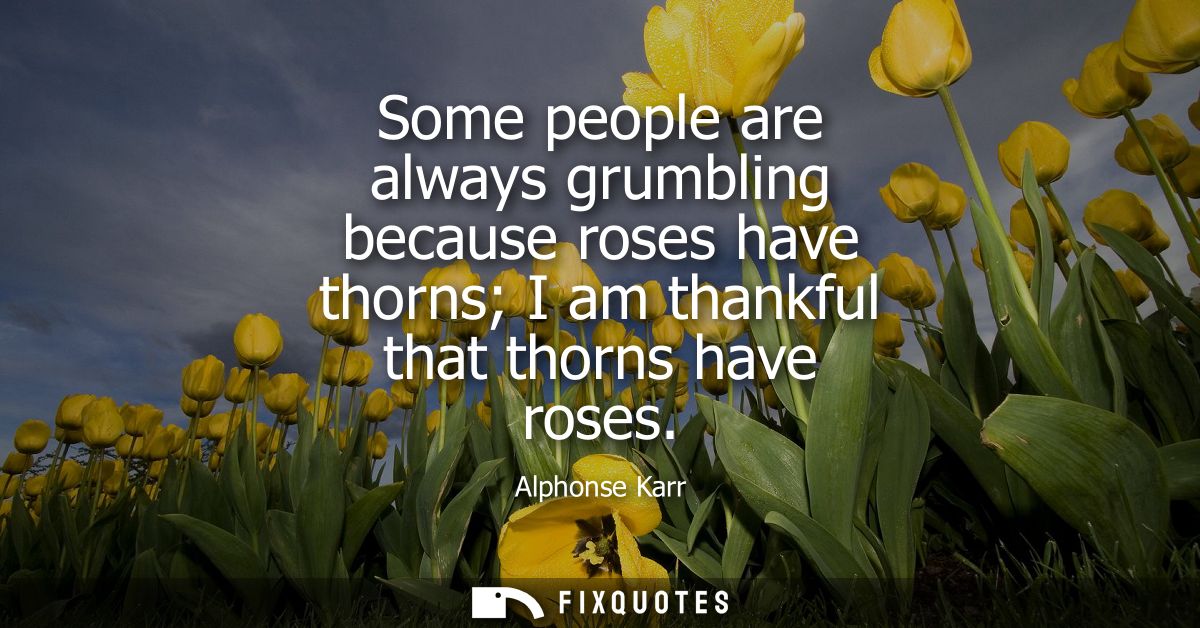
"Some people are always grumbling because roses have thorns; I am thankful that thorns have roses"
About this Quote
The subtext is sharper than it looks. Thorns aren’t erased or spiritualized away; they’re re-framed as the cost of access, the protective logic around beauty. By making the thorn the subject (“thorns have roses”), Karr reverses ownership. Pain isn’t the parasite on pleasure; pleasure is the improbable bloom that shows up even in a world built for defense. That inversion carries a critic’s sensibility: the point isn’t to deny the thorn, it’s to refuse the lazy interpretive habit that lets grievance become identity.
Context matters: Karr worked in 19th-century French letters, an era saturated with polemic, pamphleteering, and performative pessimism. The aphorism reads like a salon-ready rebuke to fashionable cynicism, the kind that mistakes sharpness for insight. Its elegance is strategic: a single image makes a moral argument without preaching, and its wit lands because it forces readers to recognize themselves mid-grumble.
Quote Details
| Topic | Gratitude |
|---|---|
| Source | Help us find the source |
| Cite |
Citation Formats
APA Style (7th ed.)
Karr, Alphonse. (2026, January 16). Some people are always grumbling because roses have thorns; I am thankful that thorns have roses. FixQuotes. https://fixquotes.com/quotes/some-people-are-always-grumbling-because-roses-131699/
Chicago Style
Karr, Alphonse. "Some people are always grumbling because roses have thorns; I am thankful that thorns have roses." FixQuotes. January 16, 2026. https://fixquotes.com/quotes/some-people-are-always-grumbling-because-roses-131699/.
MLA Style (9th ed.)
"Some people are always grumbling because roses have thorns; I am thankful that thorns have roses." FixQuotes, 16 Jan. 2026, https://fixquotes.com/quotes/some-people-are-always-grumbling-because-roses-131699/. Accessed 26 Mar. 2026.