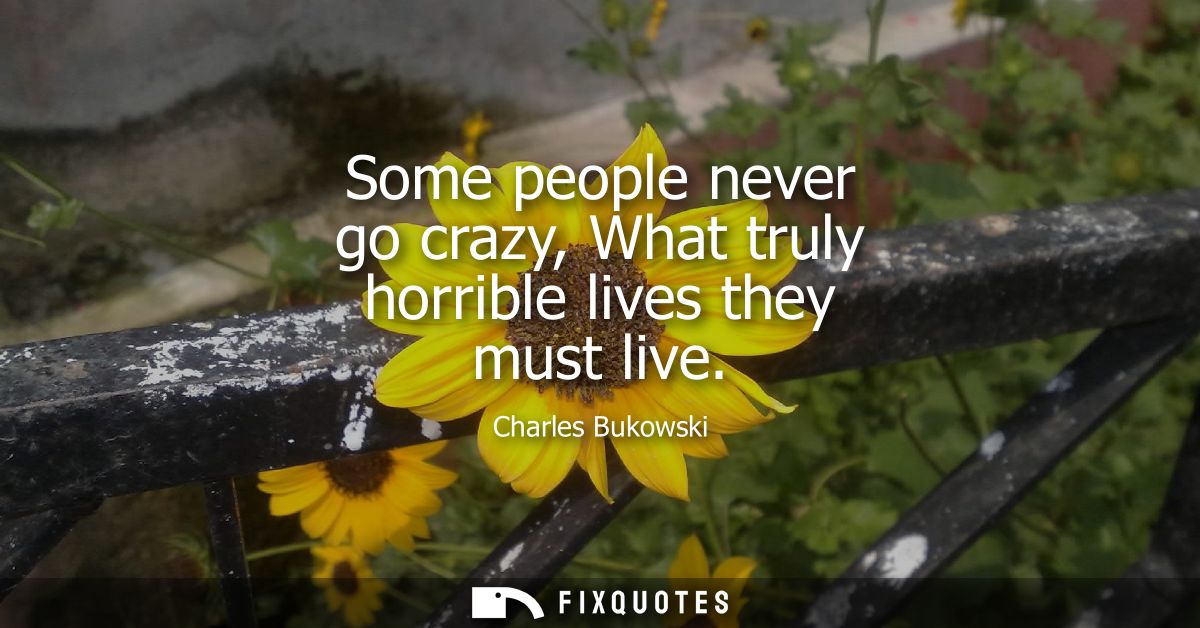
"Some people never go crazy, What truly horrible lives they must live"
About this Quote
The subtext is less about mental illness than about the domestication of the self. “Crazy” functions as Bukowski’s shortcut for intensity and refusal - a person who has been cracked open by work, sex, poverty, art, drink, or loneliness and didn’t translate it into polite anecdotes. He romanticizes the breakdown as a kind of proof-of-life, a stance that’s both bracing and ethically messy, because it risks aestheticizing real suffering. That tension is the point: Bukowski’s voice thrives on the discomfort of wanting the myth even when you know better.
Context matters. Coming out of mid-century American conformity, writing from the gutter and the barstool, Bukowski made a career out of attacking the clean narrative of success. The sentence lands like a cigarette flicked at self-help culture: if your life has never threatened to unmake you, maybe you weren’t really living - or maybe you were simply well-insulated. Either way, he’s daring the reader to admit what their composure costs.
Quote Details
| Topic | Witty One-Liners |
|---|---|
| Source | Help us find the source |
| Cite |
Citation Formats
APA Style (7th ed.)
Bukowski, Charles. (2026, January 16). Some people never go crazy, What truly horrible lives they must live. FixQuotes. https://fixquotes.com/quotes/some-people-never-go-crazy-what-truly-horrible-117227/
Chicago Style
Bukowski, Charles. "Some people never go crazy, What truly horrible lives they must live." FixQuotes. January 16, 2026. https://fixquotes.com/quotes/some-people-never-go-crazy-what-truly-horrible-117227/.
MLA Style (9th ed.)
"Some people never go crazy, What truly horrible lives they must live." FixQuotes, 16 Jan. 2026, https://fixquotes.com/quotes/some-people-never-go-crazy-what-truly-horrible-117227/. Accessed 13 Feb. 2026.