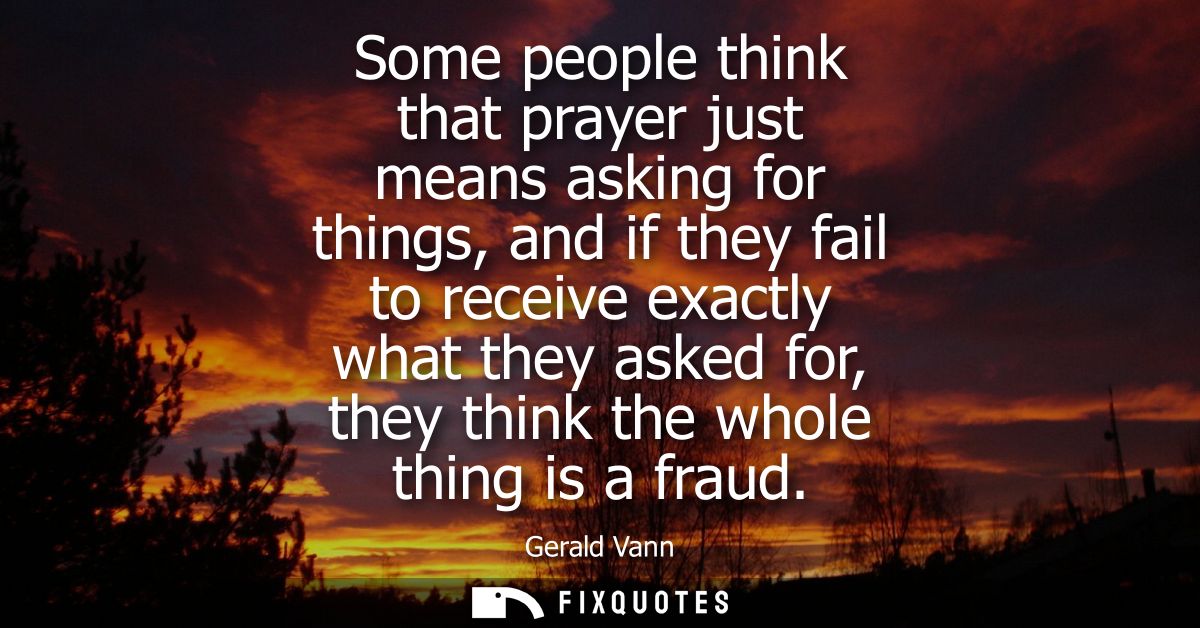
"Some people think that prayer just means asking for things, and if they fail to receive exactly what they asked for, they think the whole thing is a fraud"
About this Quote
The subtext is sharper than it first appears. Vann is warning that this "asking-for-things" model doesn’t merely misunderstand prayer; it turns God into a service provider and the person praying into a customer. That framing makes cynicism almost inevitable, because it reduces an encounter with the divine to an outcomes spreadsheet. If the only metric is "Did I get what I wanted?" then unanswered prayer becomes evidence of deception, not an invitation to rethink desire, timing, or the nature of relationship itself.
Context matters: writing as a mid-20th-century Catholic theologian, Vann is pushing back against both shallow devotionalism and a rising practical, results-driven mentality that seeped into religious life. The sentence works because it names the emotional logic behind disbelief without caricature. It’s not atheism he’s arguing against; it’s disappointed entitlement dressed up as faith, and the way it collapses mystery into customer service.
Quote Details
| Topic | Prayer |
|---|---|
| Source | Help us find the source |
| Cite |
Citation Formats
APA Style (7th ed.)
Vann, Gerald. (2026, January 16). Some people think that prayer just means asking for things, and if they fail to receive exactly what they asked for, they think the whole thing is a fraud. FixQuotes. https://fixquotes.com/quotes/some-people-think-that-prayer-just-means-asking-120036/
Chicago Style
Vann, Gerald. "Some people think that prayer just means asking for things, and if they fail to receive exactly what they asked for, they think the whole thing is a fraud." FixQuotes. January 16, 2026. https://fixquotes.com/quotes/some-people-think-that-prayer-just-means-asking-120036/.
MLA Style (9th ed.)
"Some people think that prayer just means asking for things, and if they fail to receive exactly what they asked for, they think the whole thing is a fraud." FixQuotes, 16 Jan. 2026, https://fixquotes.com/quotes/some-people-think-that-prayer-just-means-asking-120036/. Accessed 3 Apr. 2026.