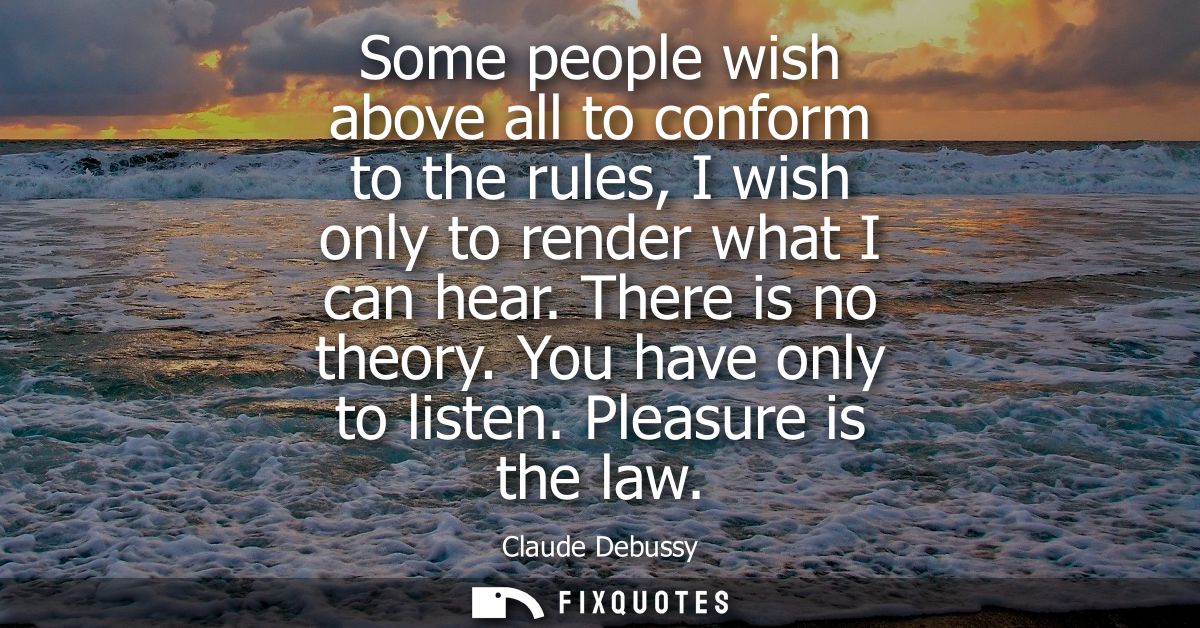
"Some people wish above all to conform to the rules, I wish only to render what I can hear. There is no theory. You have only to listen. Pleasure is the law"
About this Quote
Debussy’s jab at “rules” isn’t anti-intellectual; it’s anti-policing. In late-19th-century Paris, musical legitimacy meant Germanic architecture: development, strict harmony, the cathedral logic of sonata form. Debussy heard that as bureaucracy masquerading as taste. His provocation - “There is no theory. You have only to listen” - is less a rejection of craft than a refusal to let textbooks dictate what the ear is allowed to enjoy. He’s staking out a radical hierarchy: sensation first, doctrine last.
The slyness is in how he frames obedience as someone else’s psychological need: “Some people wish above all to conform.” Conformity becomes a personality type, not a virtue. Against it he offers a different discipline: rendering “what I can hear.” That phrasing matters. He doesn’t claim cosmic truth; he claims perception, a private acoustics shaped by timbre, color, and atmosphere. It’s the aesthetic of “Prélude a l’apres-midi d’un faune” in sentence form: music as a kind of attentive drifting, structured by nuance rather than rules you can diagram.
“Pleasure is the law” lands like a scandal because it drags the body into a conversation usually owned by the academy. Debussy isn’t saying pleasure is shallow; he’s saying it’s diagnostic. If the listening experience doesn’t persuade the senses, the theory is counterfeit. The subtext is cultural politics: a French composer asserting autonomy from inherited authority, making the ear - not the institution - the final court of appeal.
The slyness is in how he frames obedience as someone else’s psychological need: “Some people wish above all to conform.” Conformity becomes a personality type, not a virtue. Against it he offers a different discipline: rendering “what I can hear.” That phrasing matters. He doesn’t claim cosmic truth; he claims perception, a private acoustics shaped by timbre, color, and atmosphere. It’s the aesthetic of “Prélude a l’apres-midi d’un faune” in sentence form: music as a kind of attentive drifting, structured by nuance rather than rules you can diagram.
“Pleasure is the law” lands like a scandal because it drags the body into a conversation usually owned by the academy. Debussy isn’t saying pleasure is shallow; he’s saying it’s diagnostic. If the listening experience doesn’t persuade the senses, the theory is counterfeit. The subtext is cultural politics: a French composer asserting autonomy from inherited authority, making the ear - not the institution - the final court of appeal.
Quote Details
| Topic | Music |
|---|---|
| Source | Help us find the source |
More Quotes by Claude
Add to List