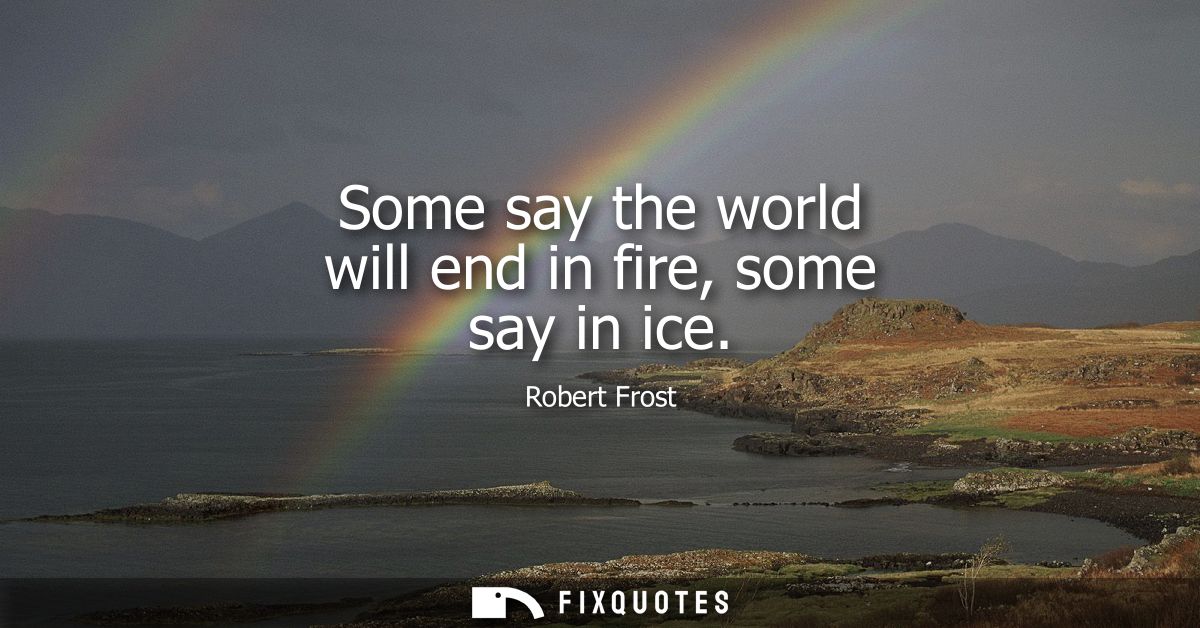
"Some say the world will end in fire, some say in ice"
About this Quote
Frost opens with a line that sounds like folksy porch talk, then quietly turns it into a cosmology of human impulses. "Some say" is doing sly work: he refuses the prophetic voice, sidestepping certainty in favor of a communal shrug. The apocalypse arrives not as divine revelation but as argument, gossip, opinion. That modesty is the trapdoor; once you’re in, you realize he’s staging an ethics debate inside an end-of-the-world scenario.
Fire and ice are elemental, almost childish in their clarity, which is why they land. Frost is simplifying the emotional landscape into two clean forces: desire and hatred, heat and cold. He’s also poking at the human habit of turning inner weather into outer destiny. The line invites you to picture catastrophe, then nudges you toward recognizing the everyday versions of it - the ways appetite consumes, the ways resentment freezes. The apocalypse becomes a metaphor you can’t safely keep abstract.
Context matters: Frost is writing in the early 20th century, when modernity is accelerating and old certainties feel less stable. Yet he doesn’t reach for machines, wars, or headlines. He reaches for temperament. That choice is the intent: to suggest the world ends not just through spectacular events but through the ordinary extremes we cultivate.
The brilliance is the tone: calm, balanced, almost conversational. It implies that the end won’t be announced with trumpets; it will arrive wearing the familiar masks we already excuse.
Fire and ice are elemental, almost childish in their clarity, which is why they land. Frost is simplifying the emotional landscape into two clean forces: desire and hatred, heat and cold. He’s also poking at the human habit of turning inner weather into outer destiny. The line invites you to picture catastrophe, then nudges you toward recognizing the everyday versions of it - the ways appetite consumes, the ways resentment freezes. The apocalypse becomes a metaphor you can’t safely keep abstract.
Context matters: Frost is writing in the early 20th century, when modernity is accelerating and old certainties feel less stable. Yet he doesn’t reach for machines, wars, or headlines. He reaches for temperament. That choice is the intent: to suggest the world ends not just through spectacular events but through the ordinary extremes we cultivate.
The brilliance is the tone: calm, balanced, almost conversational. It implies that the end won’t be announced with trumpets; it will arrive wearing the familiar masks we already excuse.
Quote Details
| Topic | Poetry |
|---|---|
| Source | "Fire and Ice", poem by Robert Frost; first published in Harper's Magazine, Dec. 1920; collected in New Hampshire (1923). |
| Cite |
Citation Formats
APA Style (7th ed.)
Frost, Robert. (2026, January 15). Some say the world will end in fire, some say in ice. FixQuotes. https://fixquotes.com/quotes/some-say-the-world-will-end-in-fire-some-say-in-28920/
Chicago Style
Frost, Robert. "Some say the world will end in fire, some say in ice." FixQuotes. January 15, 2026. https://fixquotes.com/quotes/some-say-the-world-will-end-in-fire-some-say-in-28920/.
MLA Style (9th ed.)
"Some say the world will end in fire, some say in ice." FixQuotes, 15 Jan. 2026, https://fixquotes.com/quotes/some-say-the-world-will-end-in-fire-some-say-in-28920/. Accessed 20 Mar. 2026.
More Quotes by Robert
Add to List