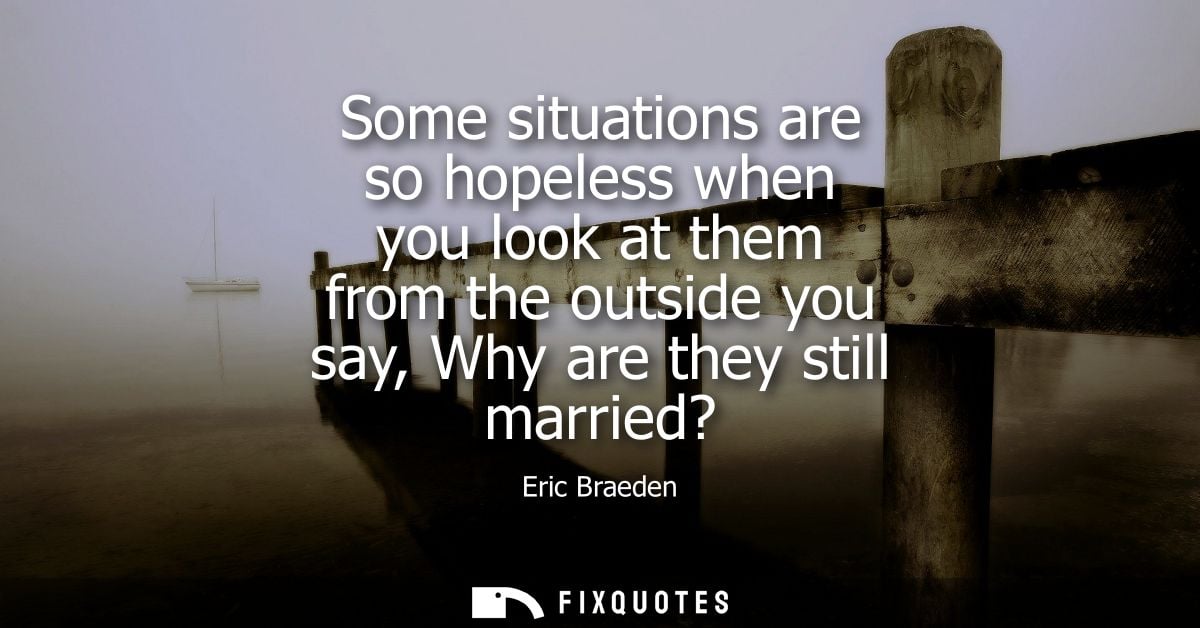
"Some situations are so hopeless when you look at them from the outside you say, Why are they still married?"
About this Quote
As an actor best known for playing marriage-adjacent melodrama, Braeden is also slyly commenting on the way narrative expectations contaminate our view of real couples. Outsiders are trained by movies, TV, and therapy-speak to treat relationships like plotlines: if the arc is bad, cancel the show. But the people inside the marriage aren’t watching a season; they’re managing a life. The subtext is that “hopeless” can be a misunderstanding of what the couple is actually optimizing for: stability, children, money, immigration status, caregiving, religion, fear, loyalty, habit, or the quiet belief that a bad present doesn’t erase a shared past.
The rhetorical trick is the casual “still.” It carries impatience and superiority, the assumption that leaving is the obvious, modern, self-respecting move. Braeden punctures that smugness without romanticizing endurance. He’s pointing at the blind spot in public commentary: relationships can look irrational from the curb precisely because their logic is internal, messy, and often invisible.
Quote Details
| Topic | Marriage |
|---|---|
| Source | Help us find the source |
| Cite |
Citation Formats
APA Style (7th ed.)
Braeden, Eric. (2026, January 15). Some situations are so hopeless when you look at them from the outside you say, Why are they still married? FixQuotes. https://fixquotes.com/quotes/some-situations-are-so-hopeless-when-you-look-at-140631/
Chicago Style
Braeden, Eric. "Some situations are so hopeless when you look at them from the outside you say, Why are they still married?" FixQuotes. January 15, 2026. https://fixquotes.com/quotes/some-situations-are-so-hopeless-when-you-look-at-140631/.
MLA Style (9th ed.)
"Some situations are so hopeless when you look at them from the outside you say, Why are they still married?" FixQuotes, 15 Jan. 2026, https://fixquotes.com/quotes/some-situations-are-so-hopeless-when-you-look-at-140631/. Accessed 30 Mar. 2026.