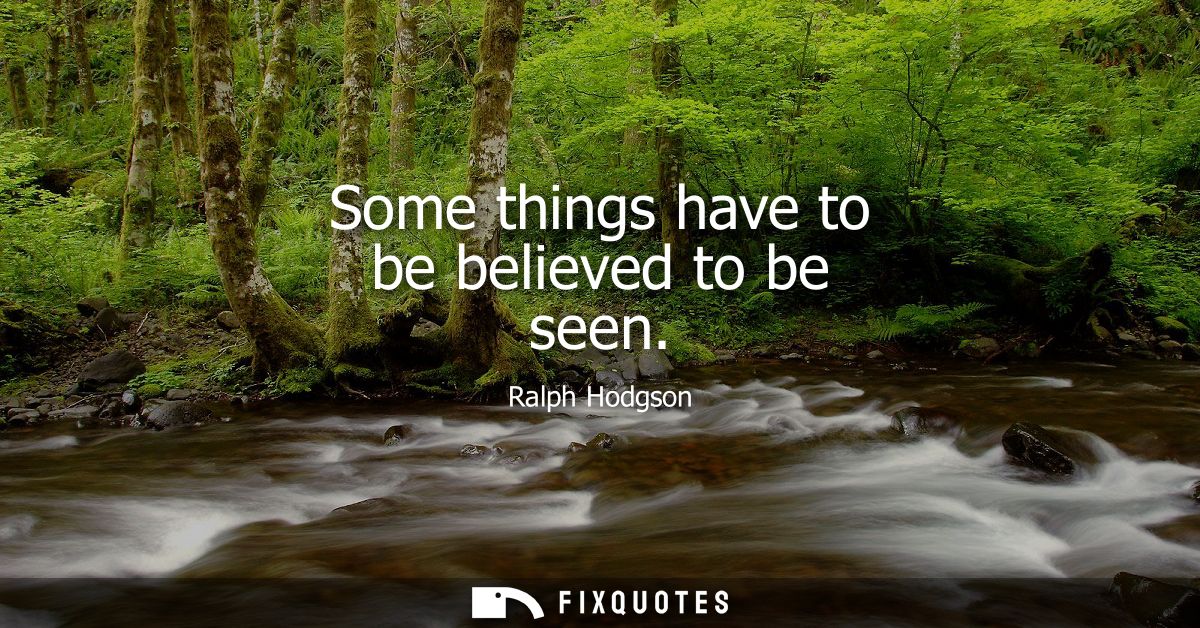
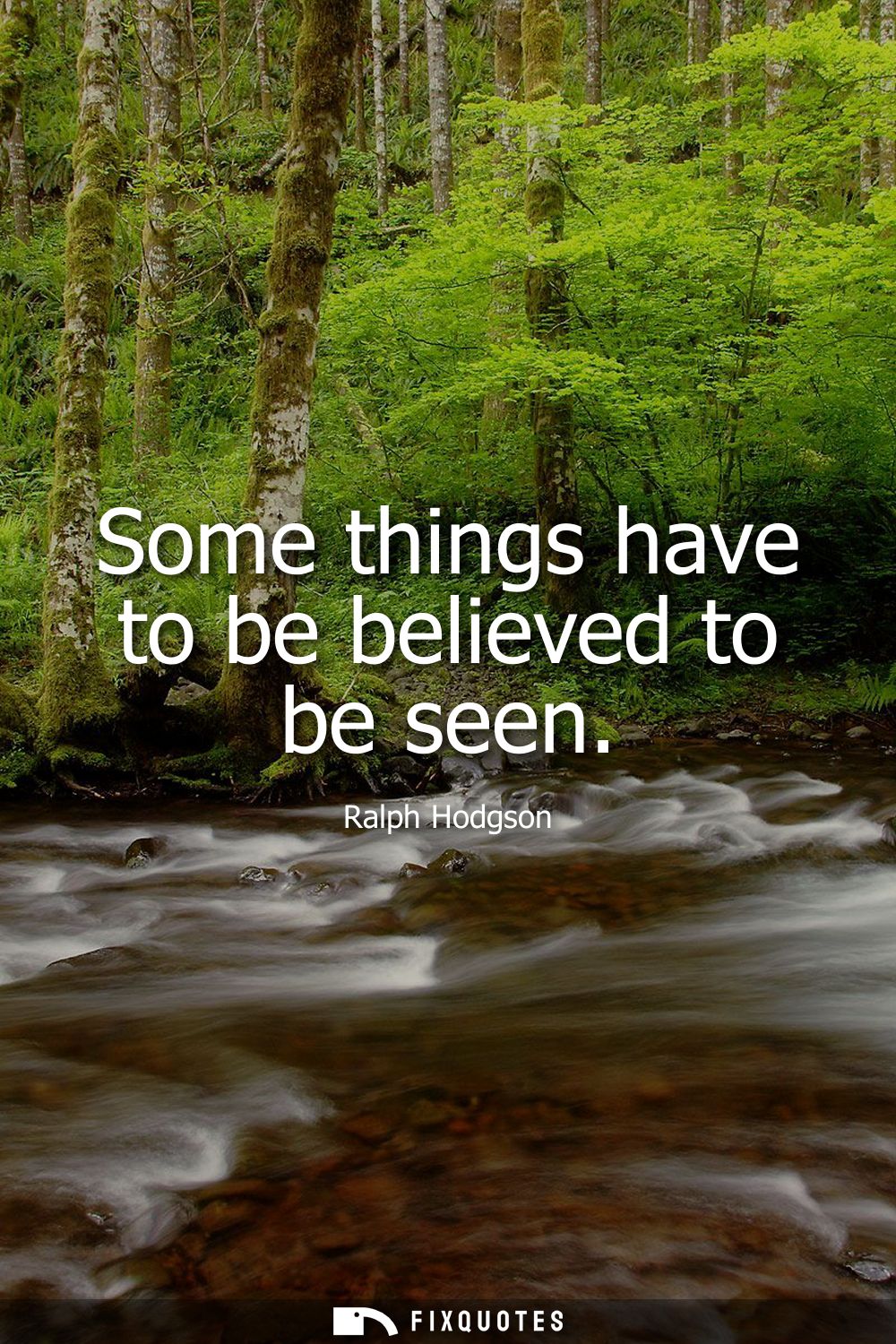
"Some things have to be believed to be seen"
About this Quote
Faith runs ahead of proof in Hodgson's line, and that reversal is the point. "Some things have to be believed to be seen" flips the sturdy Enlightenment promise that evidence produces conviction. Here, conviction is the instrument that makes certain evidence legible at all. Hodgson, a poet who wrote in an era jittery with modernity's shocks (industrial speed, new sciences, disenchanted cities), is staking out poetry's jurisdiction: not the measurable world, but the felt one. He suggests that perception isn't a neutral camera; it's a selective, hungry organ trained by what we already grant as possible.
The intent is quietly polemical. It's a defense of imagination and spiritual receptivity against the modern temptation to dismiss anything that can't be audited. The subtext: skepticism can be a kind of self-fulfilling blindness. If you refuse the premise that wonder, grace, or meaning might exist, you won't notice the fragile evidence of them when they arrive - the faint pattern, the almost-coincidence, the human gesture that doesn't "prove" anything yet changes the temperature of a life.
What makes the line work is its compact paradox and its passive construction. "Have to" implies necessity, not preference: some truths require a wager. And "be seen" stays deliberately vague, letting the reader supply the object - love, art, God, justice, even one's own potential. It's not an argument so much as a dare: test how much of reality your worldview is allowing you to perceive.
The intent is quietly polemical. It's a defense of imagination and spiritual receptivity against the modern temptation to dismiss anything that can't be audited. The subtext: skepticism can be a kind of self-fulfilling blindness. If you refuse the premise that wonder, grace, or meaning might exist, you won't notice the fragile evidence of them when they arrive - the faint pattern, the almost-coincidence, the human gesture that doesn't "prove" anything yet changes the temperature of a life.
What makes the line work is its compact paradox and its passive construction. "Have to" implies necessity, not preference: some truths require a wager. And "be seen" stays deliberately vague, letting the reader supply the object - love, art, God, justice, even one's own potential. It's not an argument so much as a dare: test how much of reality your worldview is allowing you to perceive.
Quote Details
| Topic | Faith |
|---|---|
| Source | Help us find the source |
| Cite |
Citation Formats
APA Style (7th ed.)
Hodgson, Ralph. (2026, January 14). Some things have to be believed to be seen. FixQuotes. https://fixquotes.com/quotes/some-things-have-to-be-believed-to-be-seen-159531/
Chicago Style
Hodgson, Ralph. "Some things have to be believed to be seen." FixQuotes. January 14, 2026. https://fixquotes.com/quotes/some-things-have-to-be-believed-to-be-seen-159531/.
MLA Style (9th ed.)
"Some things have to be believed to be seen." FixQuotes, 14 Jan. 2026, https://fixquotes.com/quotes/some-things-have-to-be-believed-to-be-seen-159531/. Accessed 12 Feb. 2026.
More Quotes by Ralph
Add to List