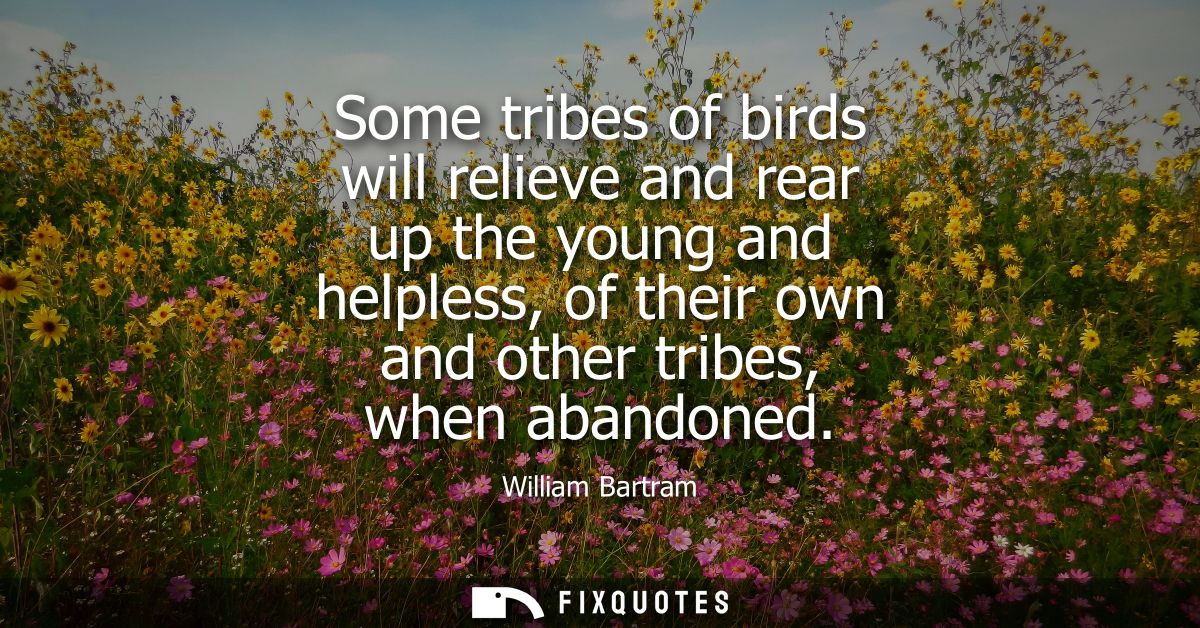
"Some tribes of birds will relieve and rear up the young and helpless, of their own and other tribes, when abandoned"
About this Quote
Bartram’s line lands like an 18th-century field note that quietly detonates a moral argument. He isn’t praising birds for being “nice.” He’s smuggling a worldview into natural history: care is not an anomaly, and compassion isn’t the private property of humans, churches, or “civilized” society. In a period that loved ranking life into ladders - reason over instinct, man over animal, Europe over everyone else - Bartram points to an inconvenient behavior that scrambles the hierarchy. Birds, supposedly driven by blind impulse, perform something that reads like elective responsibility.
The phrasing does careful work. “Relieve and rear up” is domestic, almost social-welfare language; it makes avian behavior legible through human verbs of guardianship, not just survival. Then the real provocation: “of their own and other tribes.” Bartram chooses “tribes,” a term loaded in colonial discourse, commonly used to categorize Indigenous peoples. Applied to birds, it subtly mocks the human obsession with in-groups and out-groups, suggesting that what we call “tribalism” may be less natural than we pretend. If birds can cross the boundary, why can’t we?
“Abandoned” supplies the emotional pressure point: this is about what happens when systems fail and the vulnerable are left behind. Bartram’s environmentalism isn’t only about scenery and specimens; it’s an ethics of interdependence. Nature, in his telling, is not a war of all against all. It’s also a series of unexpected adoptions, a rebuke to the idea that empathy requires a human soul.
The phrasing does careful work. “Relieve and rear up” is domestic, almost social-welfare language; it makes avian behavior legible through human verbs of guardianship, not just survival. Then the real provocation: “of their own and other tribes.” Bartram chooses “tribes,” a term loaded in colonial discourse, commonly used to categorize Indigenous peoples. Applied to birds, it subtly mocks the human obsession with in-groups and out-groups, suggesting that what we call “tribalism” may be less natural than we pretend. If birds can cross the boundary, why can’t we?
“Abandoned” supplies the emotional pressure point: this is about what happens when systems fail and the vulnerable are left behind. Bartram’s environmentalism isn’t only about scenery and specimens; it’s an ethics of interdependence. Nature, in his telling, is not a war of all against all. It’s also a series of unexpected adoptions, a rebuke to the idea that empathy requires a human soul.
Quote Details
| Topic | Nature |
|---|---|
| Source | Help us find the source |
More Quotes by William
Add to List