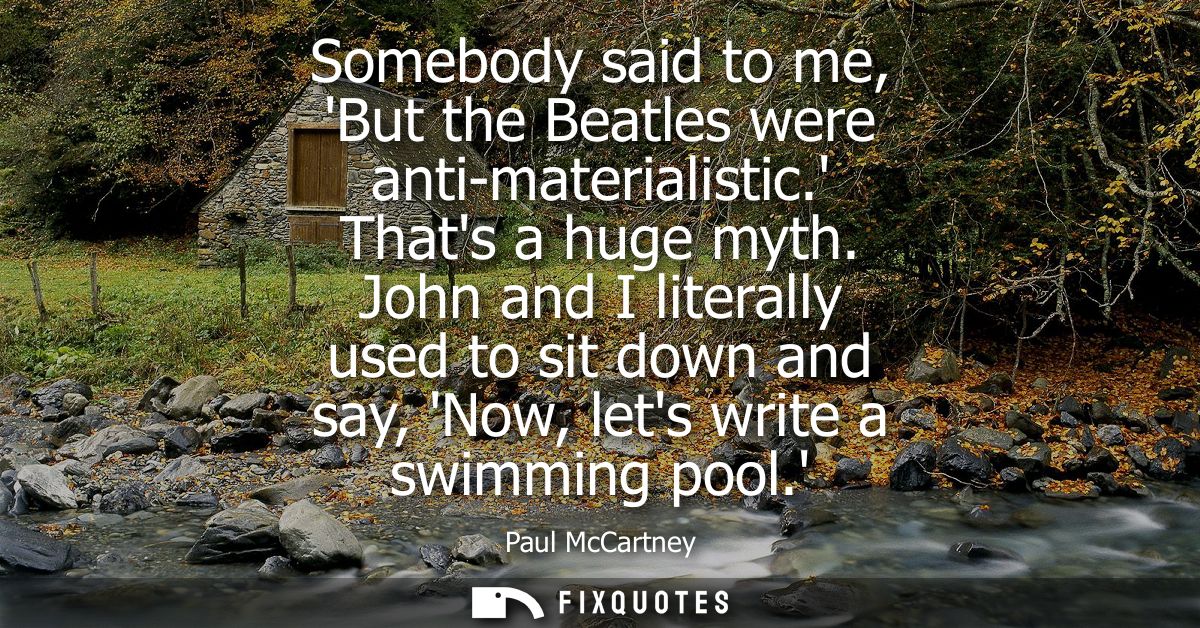
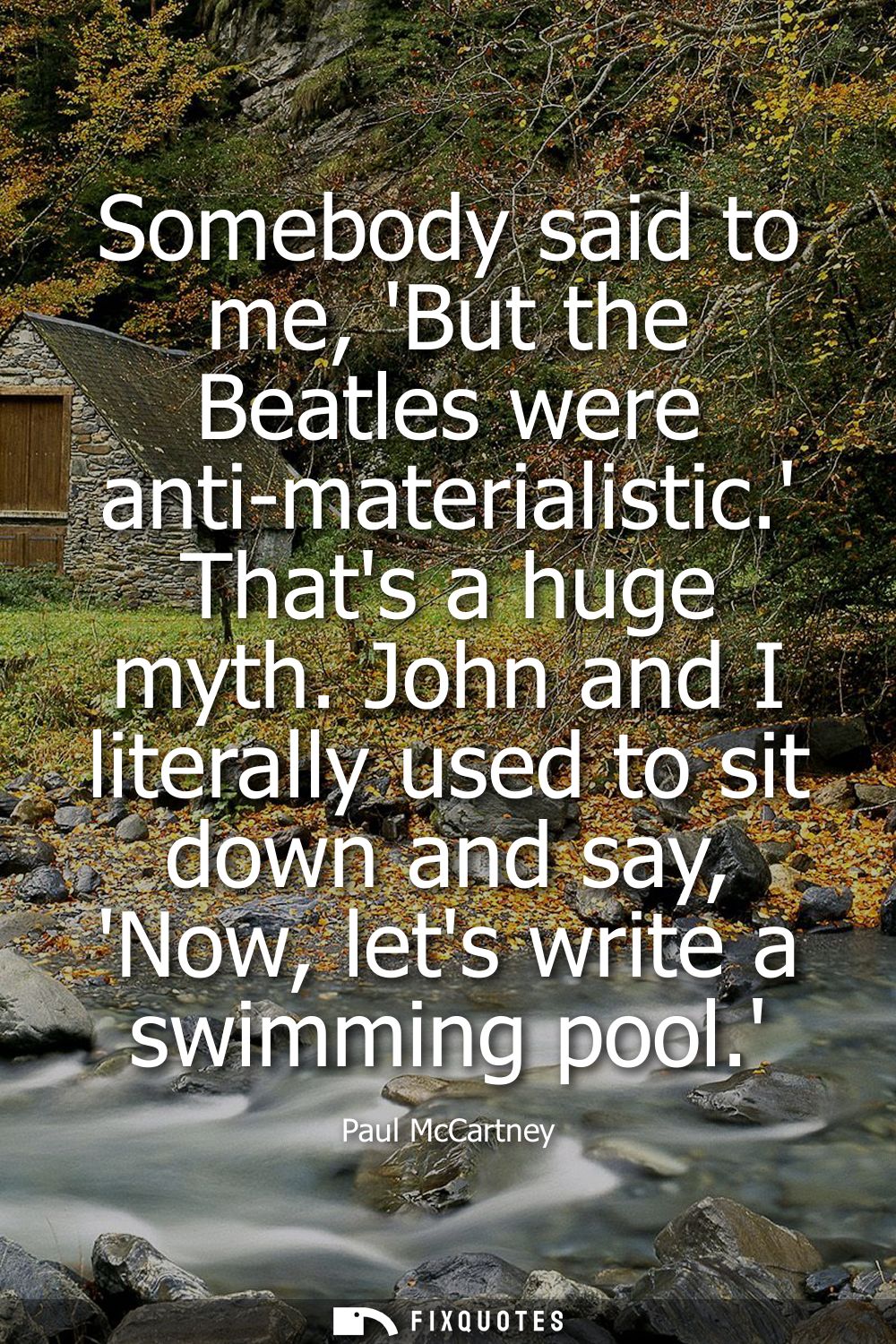
"Somebody said to me, 'But the Beatles were anti-materialistic.' That's a huge myth. John and I literally used to sit down and say, 'Now, let's write a swimming pool.'"
About this Quote
The intent isn’t to confess greed so much as to correct the record. Post-1960s nostalgia likes its geniuses morally uncomplicated: artists either sell out or stay pure. McCartney refuses the binary. The subtext is that wanting money doesn’t negate artistry; it can sit right next to ambition, craft, even idealism. That’s also a quiet defense of pop itself. The Beatles were working musicians who understood the marketplace and learned to play it better than anyone. Romanticizing them as anti-materialistic is just another way of denying how hard they worked - and how strategic they were.
Context matters: this is McCartney, long cast as the “commercial” Beatle, reclaiming the honesty of wanting success. He’s also highlighting a broader cultural myth-making machine that turns messy humans into symbols. The joke lands because it collapses the distance between legend and ledger, reminding you that the greatest songs in history were still made by people who liked nice things and knew exactly what a chorus could buy.
Quote Details
| Topic | Music |
|---|---|
| Source | Help us find the source |
| Cite |
Citation Formats
APA Style (7th ed.)
McCartney, Paul. (2026, January 17). Somebody said to me, 'But the Beatles were anti-materialistic.' That's a huge myth. John and I literally used to sit down and say, 'Now, let's write a swimming pool.'. FixQuotes. https://fixquotes.com/quotes/somebody-said-to-me-but-the-beatles-were-28527/
Chicago Style
McCartney, Paul. "Somebody said to me, 'But the Beatles were anti-materialistic.' That's a huge myth. John and I literally used to sit down and say, 'Now, let's write a swimming pool.'." FixQuotes. January 17, 2026. https://fixquotes.com/quotes/somebody-said-to-me-but-the-beatles-were-28527/.
MLA Style (9th ed.)
"Somebody said to me, 'But the Beatles were anti-materialistic.' That's a huge myth. John and I literally used to sit down and say, 'Now, let's write a swimming pool.'." FixQuotes, 17 Jan. 2026, https://fixquotes.com/quotes/somebody-said-to-me-but-the-beatles-were-28527/. Accessed 18 Feb. 2026.