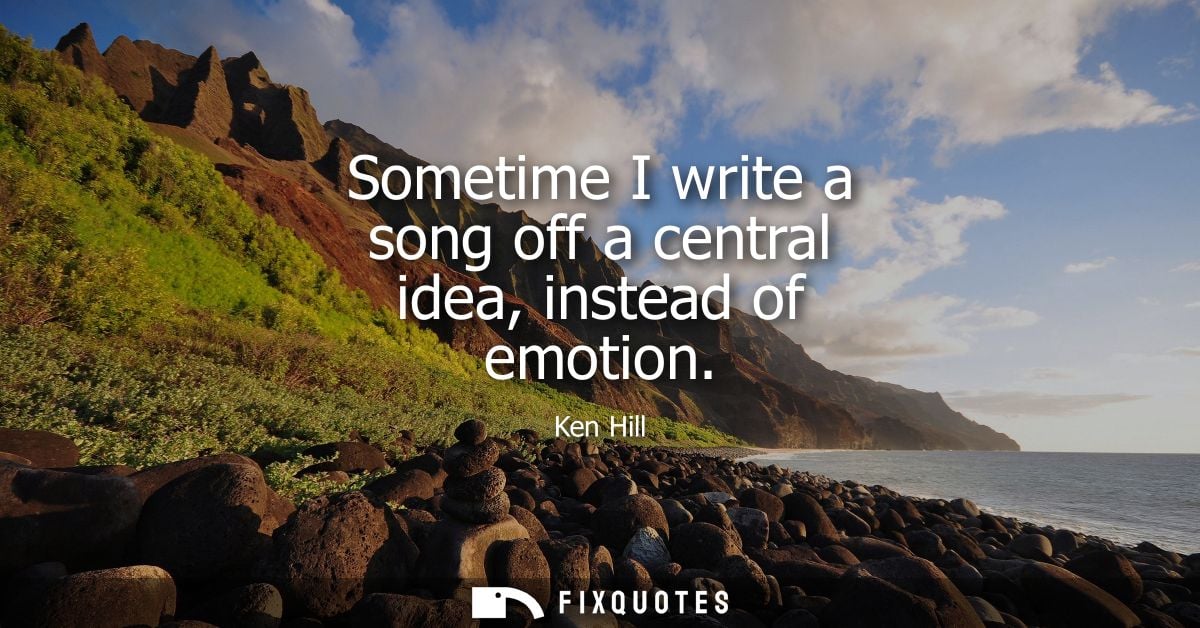
"Sometime I write a song off a central idea, instead of emotion"
About this Quote
Ken Hill’s line quietly rebukes the romantic myth that songwriting is just bottled feeling poured onto a staff. Coming from a playwright, it lands less as confession than as a craft note: sometimes the engine isn’t heartbreak or euphoria, it’s structure. A “central idea” is a dramatic premise, a spine you can build scenes around, a question you can keep worrying until it yields a chorus. In theatre, emotion is essential, but it’s also unreliable; ideas are repeatable. Eight shows a week demands architecture.
The subtext is pragmatic and a little heretical. Hill is admitting that emotion can be a tool, not the source. That’s a provocative stance in a culture that polices authenticity, especially in music, where “real” often gets measured by how raw the singer sounds. Hill suggests another kind of honesty: intellectual clarity. Writing from an idea doesn’t mean coldness; it means the feeling is recruited after the fact, shaped to serve the argument. The song becomes a miniature play with a thesis.
There’s also a contextual wink to Hill’s world of adaptation and pastiche. A playwright working in musical theatre often writes under constraints: character, plot, motif, pacing. In that ecosystem, “emotion” is frequently a destination engineered by craft choices - rhythm, repetition, strategic revelation - rather than a diary entry set to chords. Hill’s phrasing (“instead of emotion”) isn’t anti-feeling; it’s pro-intent. He’s telling you the secret: the tear lands harder when someone has planned where it falls.
The subtext is pragmatic and a little heretical. Hill is admitting that emotion can be a tool, not the source. That’s a provocative stance in a culture that polices authenticity, especially in music, where “real” often gets measured by how raw the singer sounds. Hill suggests another kind of honesty: intellectual clarity. Writing from an idea doesn’t mean coldness; it means the feeling is recruited after the fact, shaped to serve the argument. The song becomes a miniature play with a thesis.
There’s also a contextual wink to Hill’s world of adaptation and pastiche. A playwright working in musical theatre often writes under constraints: character, plot, motif, pacing. In that ecosystem, “emotion” is frequently a destination engineered by craft choices - rhythm, repetition, strategic revelation - rather than a diary entry set to chords. Hill’s phrasing (“instead of emotion”) isn’t anti-feeling; it’s pro-intent. He’s telling you the secret: the tear lands harder when someone has planned where it falls.
Quote Details
| Topic | Music |
|---|---|
| Source | Help us find the source |
| Cite |
Citation Formats
APA Style (7th ed.)
Hill, Ken. (2026, January 16). Sometime I write a song off a central idea, instead of emotion. FixQuotes. https://fixquotes.com/quotes/sometime-i-write-a-song-off-a-central-idea-101784/
Chicago Style
Hill, Ken. "Sometime I write a song off a central idea, instead of emotion." FixQuotes. January 16, 2026. https://fixquotes.com/quotes/sometime-i-write-a-song-off-a-central-idea-101784/.
MLA Style (9th ed.)
"Sometime I write a song off a central idea, instead of emotion." FixQuotes, 16 Jan. 2026, https://fixquotes.com/quotes/sometime-i-write-a-song-off-a-central-idea-101784/. Accessed 25 Mar. 2026.
More Quotes by Ken
Add to List