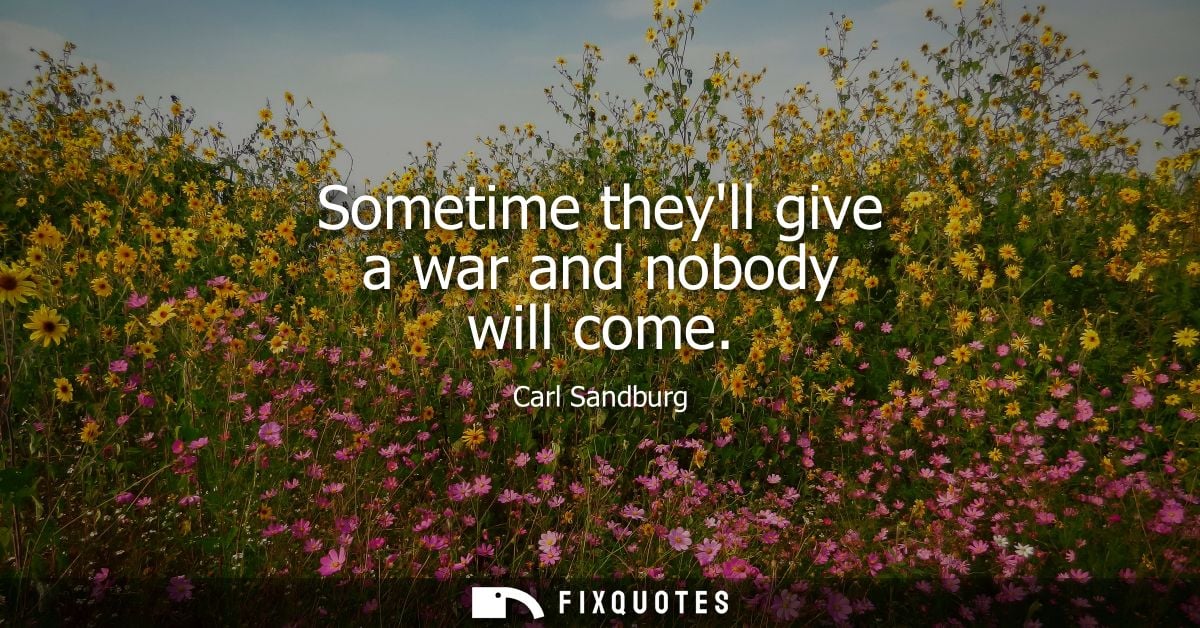
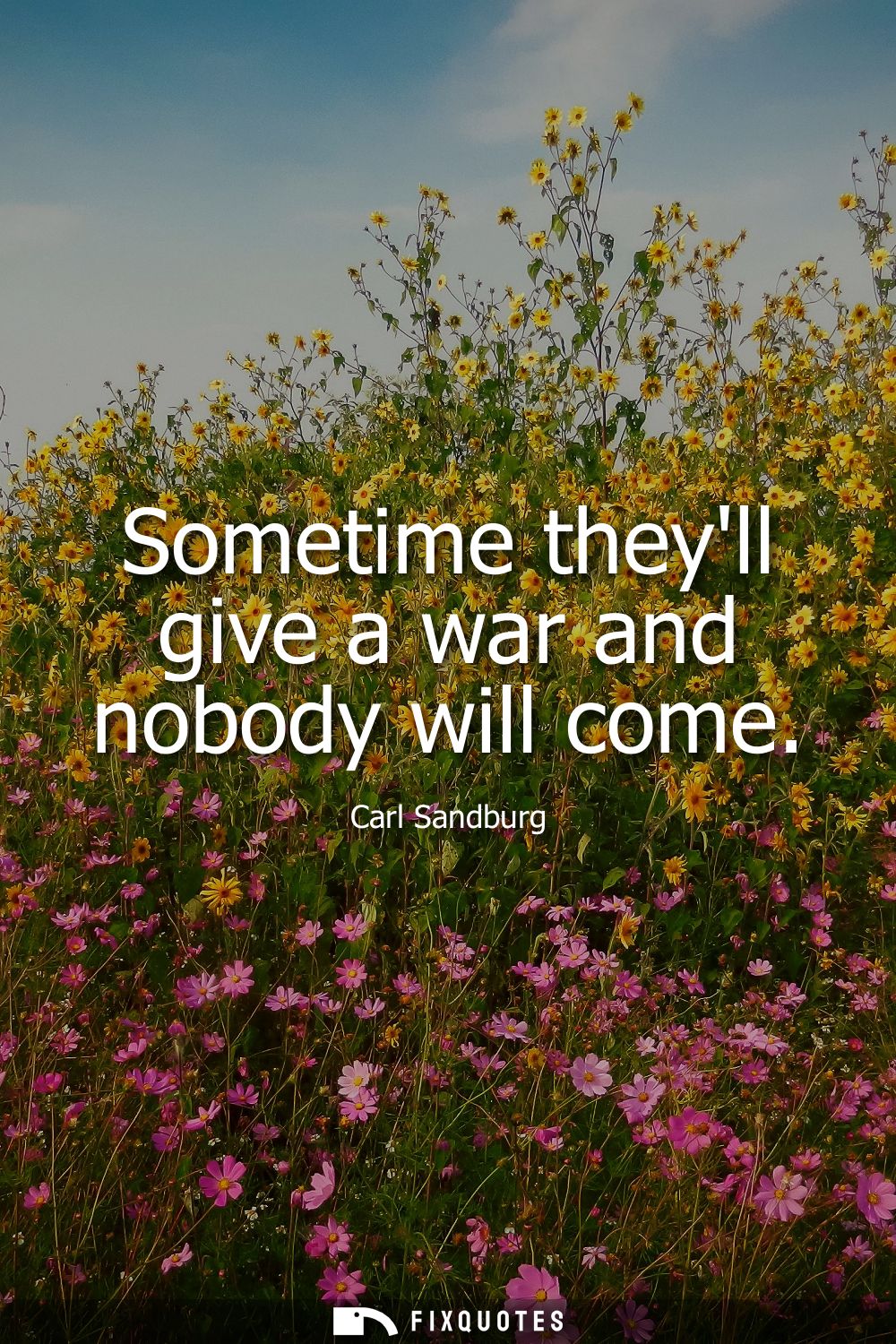
"Sometime they'll give a war and nobody will come"
About this Quote
A war without an audience is Sandburg's neat little nightmare for the people who need wars to be popular. The line sounds like a folksy riff, but it carries a hard political dare: what if ordinary citizens simply refuse the script? Sandburg flips the old patriotic machinery inside out. Instead of treating war as an unstoppable historical force, he treats it like an event someone tries to stage - complete with invitations, pageantry, and the expectation of turnout. That framing is the point. It demystifies war as something manufactured by institutions and sold through rhetoric.
The intent isn't pacifist sentimentality; it's leverage. The verb "give" is doing most of the work. Wars aren't just "fought" or "happen" here, they're handed down by authorities, like a program decision. Sandburg's subtext is labor politics and mass action: withholding participation becomes the ultimate strike. If enough bodies don't report, the gears seize. It's a fantasy of collective agency pitched in the plainest possible language.
Context matters. Sandburg wrote in a century where war was increasingly total: conscription, propaganda, industrialized killing, and public buy-in as a strategic resource. Coming out of World War I's disillusionment and into the looming shadow of World War II, the idea that people could opt out reads both naive and radical. The line works because it exposes an uncomfortable truth: war requires consent, even if it's coerced, and legitimacy is another kind of ammunition. Sandburg compresses that into one sentence you can chant, and that's why it endures.
The intent isn't pacifist sentimentality; it's leverage. The verb "give" is doing most of the work. Wars aren't just "fought" or "happen" here, they're handed down by authorities, like a program decision. Sandburg's subtext is labor politics and mass action: withholding participation becomes the ultimate strike. If enough bodies don't report, the gears seize. It's a fantasy of collective agency pitched in the plainest possible language.
Context matters. Sandburg wrote in a century where war was increasingly total: conscription, propaganda, industrialized killing, and public buy-in as a strategic resource. Coming out of World War I's disillusionment and into the looming shadow of World War II, the idea that people could opt out reads both naive and radical. The line works because it exposes an uncomfortable truth: war requires consent, even if it's coerced, and legitimacy is another kind of ammunition. Sandburg compresses that into one sentence you can chant, and that's why it endures.
Quote Details
| Topic | Peace |
|---|---|
| Source | Verified source: The People, Yes (Carl Sandburg, 1936)
Evidence: Sometime they’ll give a war and nobody will come. (Stanza 23, line 23; exact first-edition page not verified). The primary source is Carl Sandburg's own book-length poem The People, Yes, first published in 1936. A secondary but reputable reference source, Respectfully Quoted, identifies the line specifically as stanza 23, line 23, and states it was first published in 1936 in The People, Yes. The Poetry Foundation also credits the poem to The People, Yes and gives the source as 'The People, Yes (Harcourt Inc., 1936).' I could verify the work, year, and line wording, but not the exact page number of the 1936 first edition from the accessible primary-source pages I found. Other candidates (1) Oxford Dictionary of Humorous Quotations (Ned Sherrin, 2008)95.0% ... Sometime they'll give a war and nobody will come . 25 ' Our armies swore terribly in Flanders , ' cried my uncle ... |
| Cite |
Citation Formats
APA Style (7th ed.)
Sandburg, Carl. (2026, March 16). Sometime they'll give a war and nobody will come. FixQuotes. https://fixquotes.com/quotes/sometime-theyll-give-a-war-and-nobody-will-come-64292/
Chicago Style
Sandburg, Carl. "Sometime they'll give a war and nobody will come." FixQuotes. March 16, 2026. https://fixquotes.com/quotes/sometime-theyll-give-a-war-and-nobody-will-come-64292/.
MLA Style (9th ed.)
"Sometime they'll give a war and nobody will come." FixQuotes, 16 Mar. 2026, https://fixquotes.com/quotes/sometime-theyll-give-a-war-and-nobody-will-come-64292/. Accessed 2 Apr. 2026.
More Quotes by Carl
Add to List