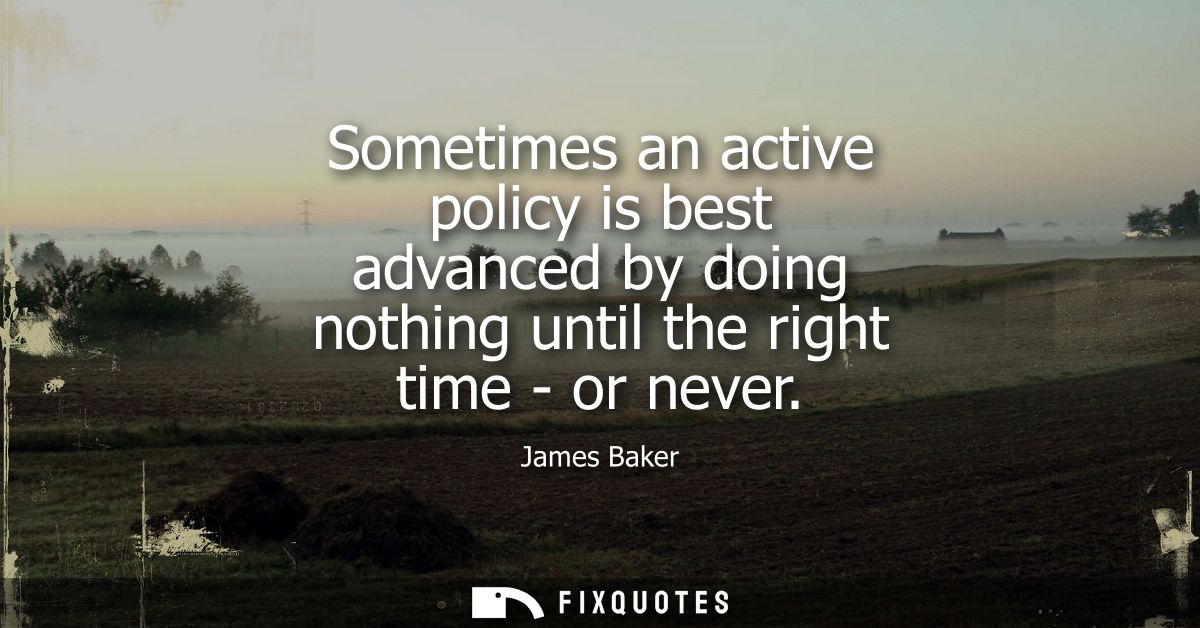
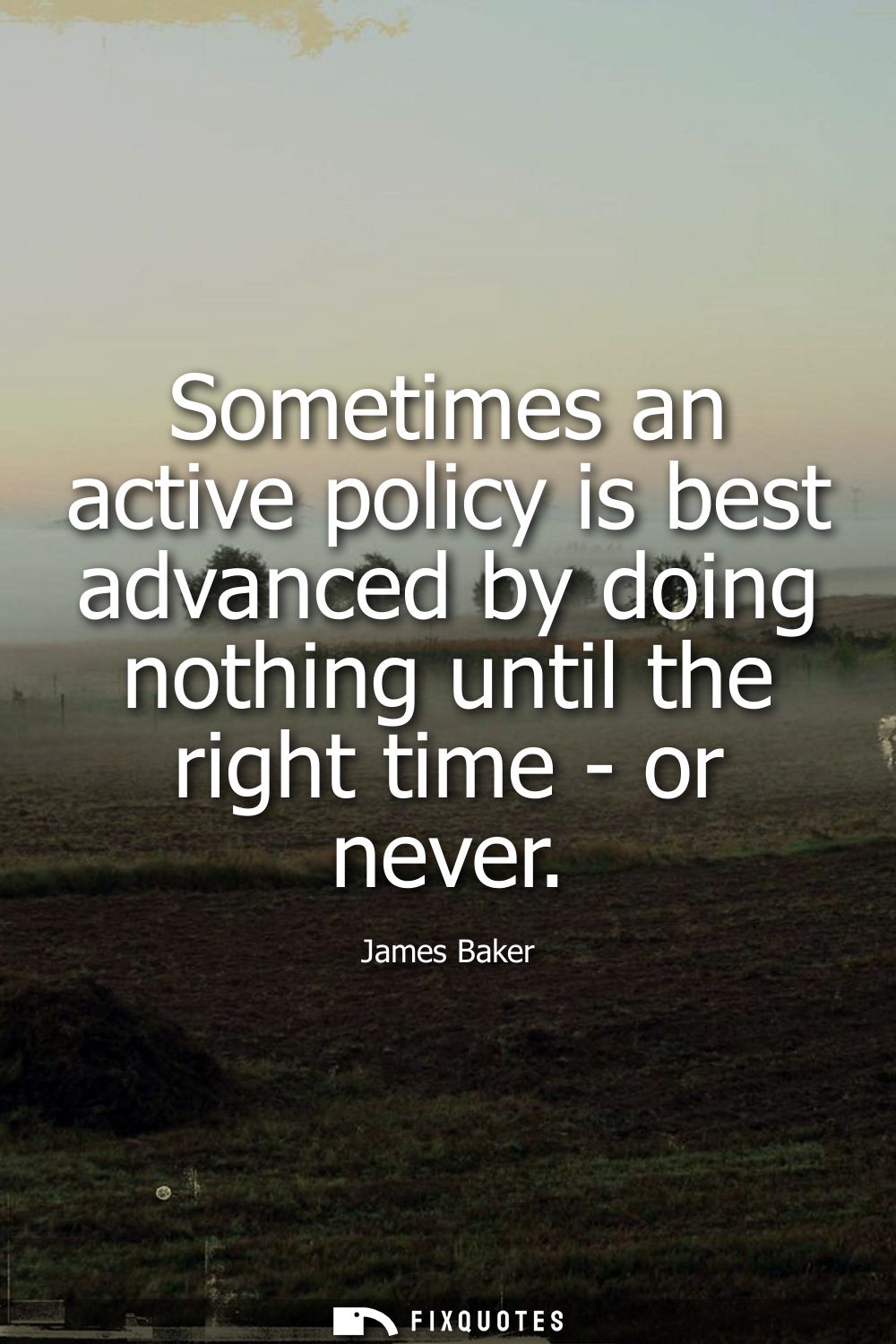
"Sometimes an active policy is best advanced by doing nothing until the right time - or never"
About this Quote
The subtext is almost mischievously candid. An “active policy” that advances through inaction suggests that the most consequential decisions can be made by refusing to make them - by letting pressure build, letting allies and adversaries reveal their limits, letting a crisis clarify what was previously arguable. Baker, a major operator in the Reagan-Bush years, trafficked in leverage: coalition management, diplomatic signaling, and timing as a weapon. In that world, rushing is a way to lose; commitment too early becomes a hostage to events.
The kicker is “or never.” That’s not indecision; it’s plausible deniability elevated to doctrine. It acknowledges that some problems are better left unsolved if solving them creates a bigger mess, or if the political cost outweighs the gain. The brilliance of the phrasing is its inversion of the usual moral posture. We’re trained to equate leadership with action. Baker quietly argues that patience can be an intervention - and that, in politics, abstention is often the most aggressive move on the board.
Quote Details
| Topic | Decision-Making |
|---|---|
| Source | Help us find the source |
| Cite |
Citation Formats
APA Style (7th ed.)
Baker, James. (2026, January 16). Sometimes an active policy is best advanced by doing nothing until the right time - or never. FixQuotes. https://fixquotes.com/quotes/sometimes-an-active-policy-is-best-advanced-by-132999/
Chicago Style
Baker, James. "Sometimes an active policy is best advanced by doing nothing until the right time - or never." FixQuotes. January 16, 2026. https://fixquotes.com/quotes/sometimes-an-active-policy-is-best-advanced-by-132999/.
MLA Style (9th ed.)
"Sometimes an active policy is best advanced by doing nothing until the right time - or never." FixQuotes, 16 Jan. 2026, https://fixquotes.com/quotes/sometimes-an-active-policy-is-best-advanced-by-132999/. Accessed 2 Apr. 2026.