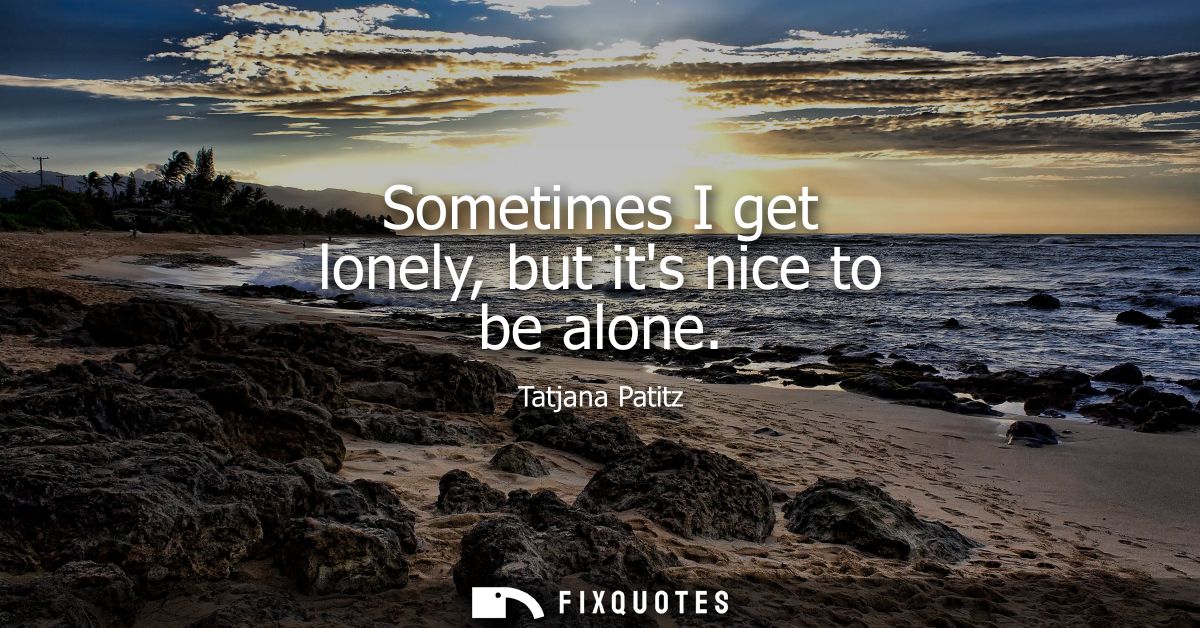
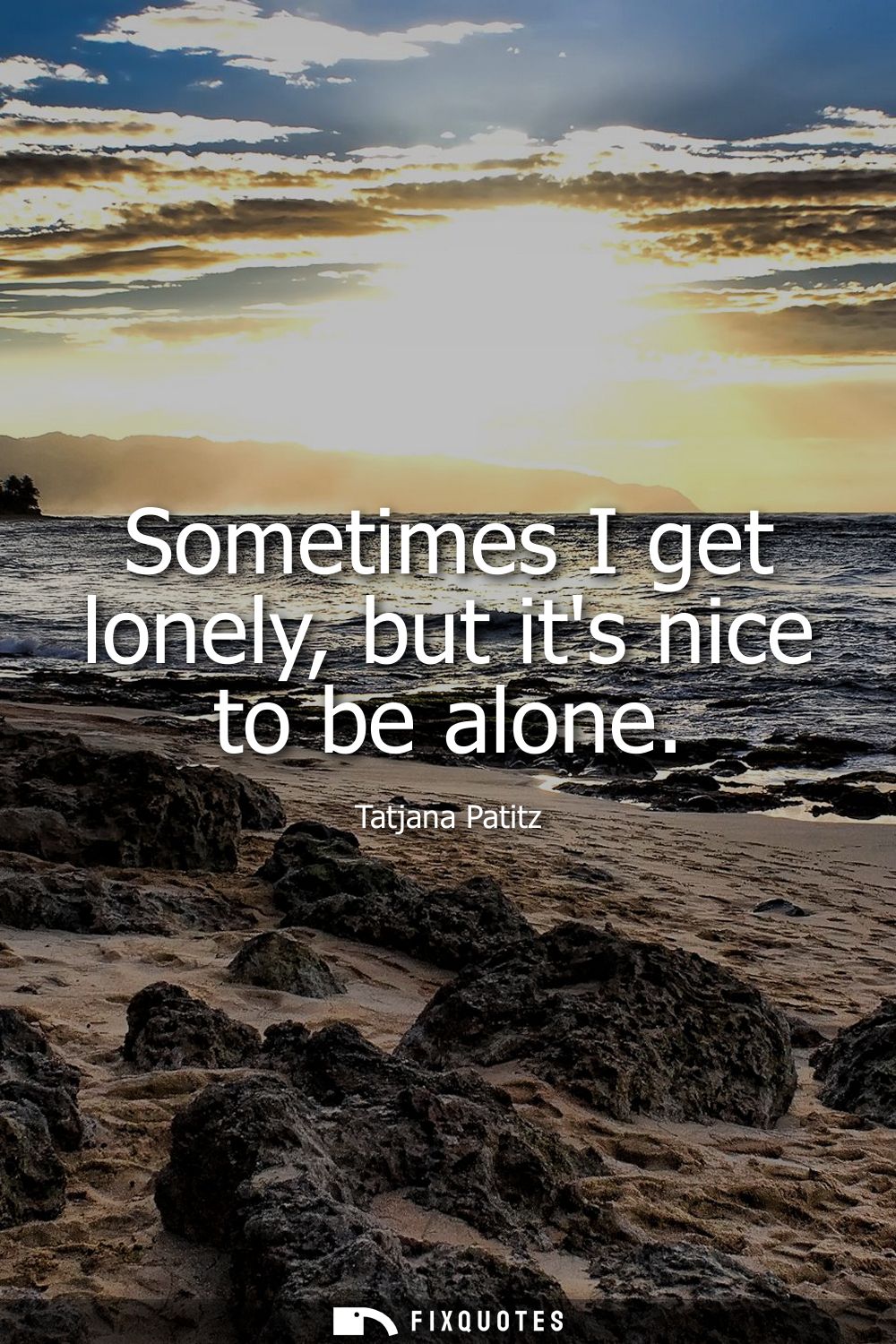
"Sometimes I get lonely, but it's nice to be alone"
About this Quote
Loneliness usually gets framed as a problem to solve, a glitch in the social feed. Tatjana Patitz flips it into something more complicated: a feeling that stings, and a state that can still be chosen. The line works because it refuses to pick a team. It admits the ache without turning it into a confession, then pivots to pleasure with the same calm honesty. That balance feels especially pointed coming from a model, a profession built on being watched.
Patitz’s era of supermodel fame was a high-gloss machine: constant travel, constant visibility, a public image so curated it can start to feel like a roommate you didn’t invite. In that context, “alone” isn’t just a mood; it’s a kind of reclaimed territory. She’s hinting at the paradox of celebrity: you can be surrounded by people, stylists, photographers, fans, and still feel untethered. Loneliness becomes less about a lack of company and more about a lack of intimacy or control.
The subtext is self-protection. “Nice to be alone” reads like a boundary said softly but firmly, a refusal to treat solitude as a failure that needs fixing. It also quietly critiques the expectation that women, especially women whose job is to be visually available, should be emotionally available too. Patitz isn’t romanticizing isolation; she’s naming the relief of stepping out of performance. The intent is not to glamorize sadness, but to normalize a mature truth: solitude can be restorative even when it’s not entirely voluntary.
Patitz’s era of supermodel fame was a high-gloss machine: constant travel, constant visibility, a public image so curated it can start to feel like a roommate you didn’t invite. In that context, “alone” isn’t just a mood; it’s a kind of reclaimed territory. She’s hinting at the paradox of celebrity: you can be surrounded by people, stylists, photographers, fans, and still feel untethered. Loneliness becomes less about a lack of company and more about a lack of intimacy or control.
The subtext is self-protection. “Nice to be alone” reads like a boundary said softly but firmly, a refusal to treat solitude as a failure that needs fixing. It also quietly critiques the expectation that women, especially women whose job is to be visually available, should be emotionally available too. Patitz isn’t romanticizing isolation; she’s naming the relief of stepping out of performance. The intent is not to glamorize sadness, but to normalize a mature truth: solitude can be restorative even when it’s not entirely voluntary.
Quote Details
| Topic | Loneliness |
|---|---|
| Source | Help us find the source |
| Cite |
Citation Formats
APA Style (7th ed.)
Patitz, Tatjana. (2026, January 16). Sometimes I get lonely, but it's nice to be alone. FixQuotes. https://fixquotes.com/quotes/sometimes-i-get-lonely-but-its-nice-to-be-alone-107100/
Chicago Style
Patitz, Tatjana. "Sometimes I get lonely, but it's nice to be alone." FixQuotes. January 16, 2026. https://fixquotes.com/quotes/sometimes-i-get-lonely-but-its-nice-to-be-alone-107100/.
MLA Style (9th ed.)
"Sometimes I get lonely, but it's nice to be alone." FixQuotes, 16 Jan. 2026, https://fixquotes.com/quotes/sometimes-i-get-lonely-but-its-nice-to-be-alone-107100/. Accessed 9 Mar. 2026.
More Quotes by Tatjana
Add to List