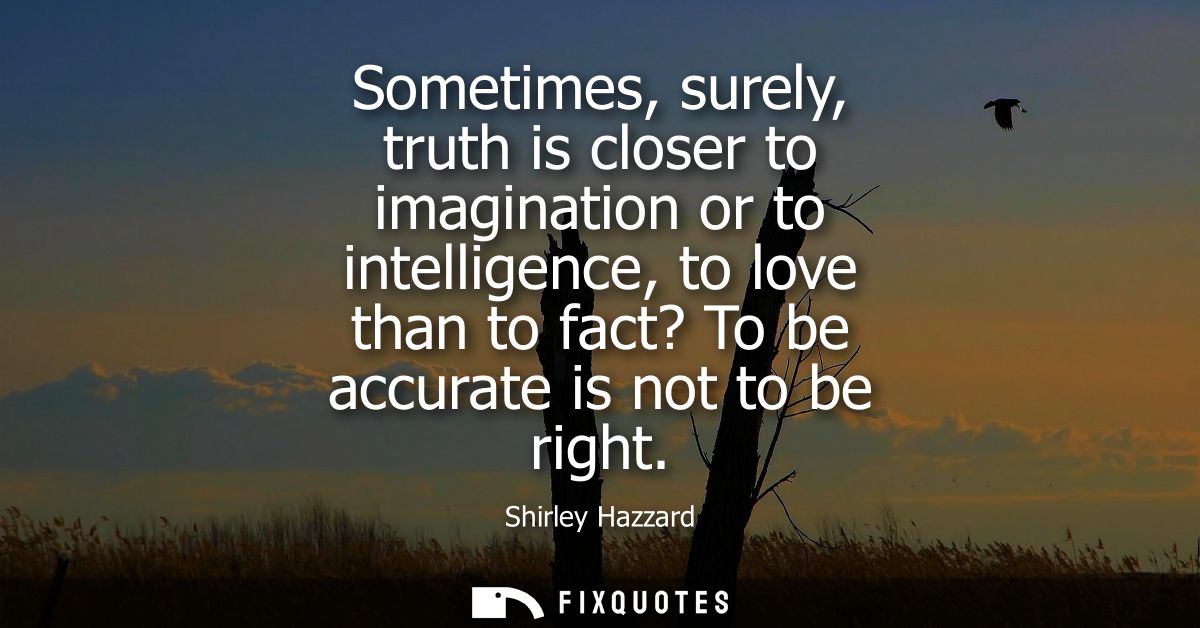
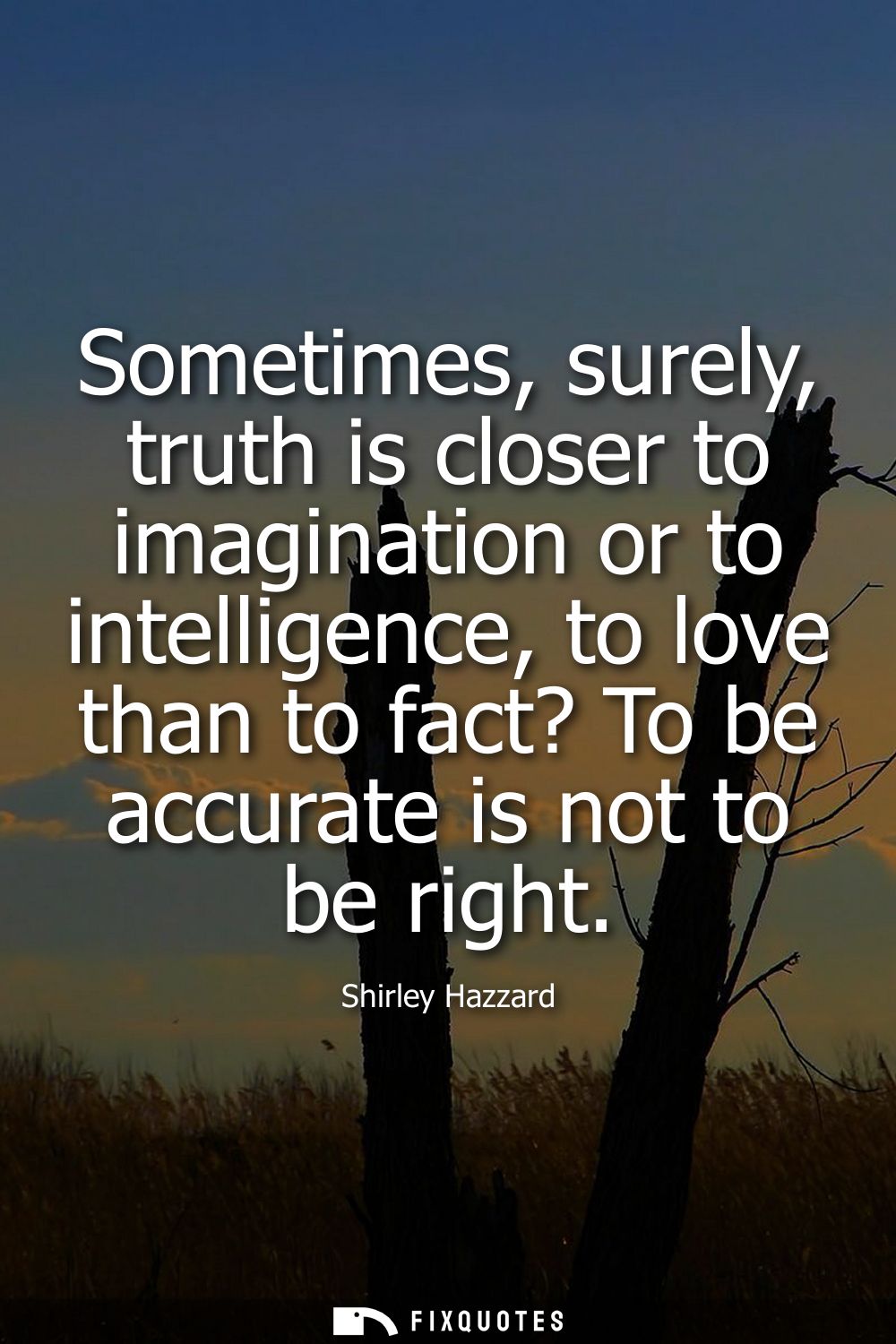
"Sometimes, surely, truth is closer to imagination or to intelligence, to love than to fact, to be accurate is not to be right"
About this Quote
The rhetorical move is sly. "Sometimes, surely" is both modest and impatient: a polite throat-clear that also dares you to disagree without sounding thick. Then comes the hinge: "closer". She’s not claiming imagination is truer than fact; she’s claiming facts can be the wrong neighborhood. A person can report every detail of a scene and still miss the story, the motive, the human weather. Think of how bureaucracy, journalism, and even memory can become fixated on correct particulars while committing larger distortions - the kind that flatten suffering, excuse cruelty, or mistake procedure for justice.
"To be accurate is not to be right" lands like a courtroom warning. Accuracy is a technical virtue; rightness is an ethical and intellectual one. In Hazzard’s world - shaped by war, diplomacy, and the long afterlife of political lies - the danger isn’t fantasy. It’s meticulous, self-satisfied correctness deployed to evade responsibility. The line defends art’s special jurisdiction: not to fabricate, but to reach a truth that facts alone can’t guarantee.
Quote Details
| Topic | Truth |
|---|---|
| Source | Help us find the source |
| Cite |
Citation Formats
APA Style (7th ed.)
Hazzard, Shirley. (2026, February 17). Sometimes, surely, truth is closer to imagination or to intelligence, to love than to fact, to be accurate is not to be right. FixQuotes. https://fixquotes.com/quotes/sometimes-surely-truth-is-closer-to-imagination-109906/
Chicago Style
Hazzard, Shirley. "Sometimes, surely, truth is closer to imagination or to intelligence, to love than to fact, to be accurate is not to be right." FixQuotes. February 17, 2026. https://fixquotes.com/quotes/sometimes-surely-truth-is-closer-to-imagination-109906/.
MLA Style (9th ed.)
"Sometimes, surely, truth is closer to imagination or to intelligence, to love than to fact, to be accurate is not to be right." FixQuotes, 17 Feb. 2026, https://fixquotes.com/quotes/sometimes-surely-truth-is-closer-to-imagination-109906/. Accessed 5 Mar. 2026.