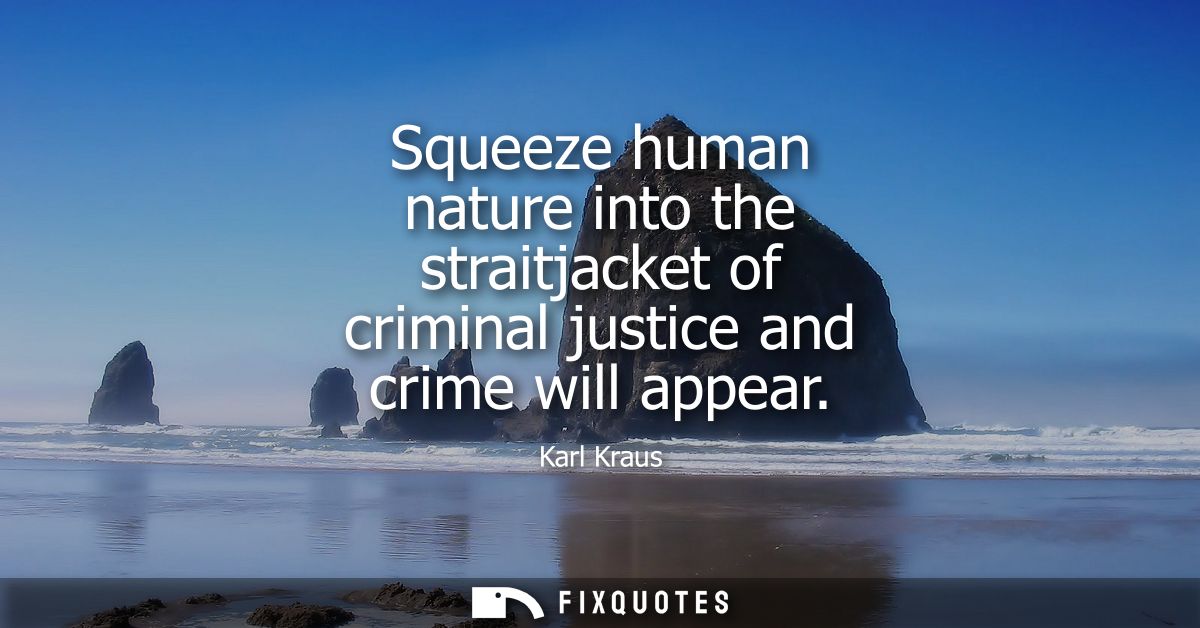
"Squeeze human nature into the straitjacket of criminal justice, and crime will appear"
About this Quote
The subtext is classic Kraus: contempt for bureaucratic language that pretends to be neutral while smuggling in violence. “Human nature” is messy, contradictory, often petty - the kind of chaos that satire loves because institutions can’t stand it. A “straitjacket” is both medical and punitive, implying that criminal justice borrows the authority of care to perform coercion. Once you force complex motives - poverty, desperation, pride, impulse, illness - through a narrow legal funnel, you get “crime” as a tidy product: a label, a record, a social identity.
Context matters. Kraus was writing in fin-de-siecle Vienna and the interwar years, watching a hyper-literate empire collapse into modern propaganda, mass politics, and technocratic policing. His point lands as a warning about administrative overreach: when law insists on being the master story of human conduct, it doesn’t eliminate disorder. It reframes life as pathology and produces offenders to match the diagnosis.
Quote Details
| Topic | Justice |
|---|---|
| Source | Help us find the source |
| Cite |
Citation Formats
APA Style (7th ed.)
Kraus, Karl. (2026, February 18). Squeeze human nature into the straitjacket of criminal justice, and crime will appear. FixQuotes. https://fixquotes.com/quotes/squeeze-human-nature-into-the-straitjacket-of-75432/
Chicago Style
Kraus, Karl. "Squeeze human nature into the straitjacket of criminal justice, and crime will appear." FixQuotes. February 18, 2026. https://fixquotes.com/quotes/squeeze-human-nature-into-the-straitjacket-of-75432/.
MLA Style (9th ed.)
"Squeeze human nature into the straitjacket of criminal justice, and crime will appear." FixQuotes, 18 Feb. 2026, https://fixquotes.com/quotes/squeeze-human-nature-into-the-straitjacket-of-75432/. Accessed 30 Mar. 2026.