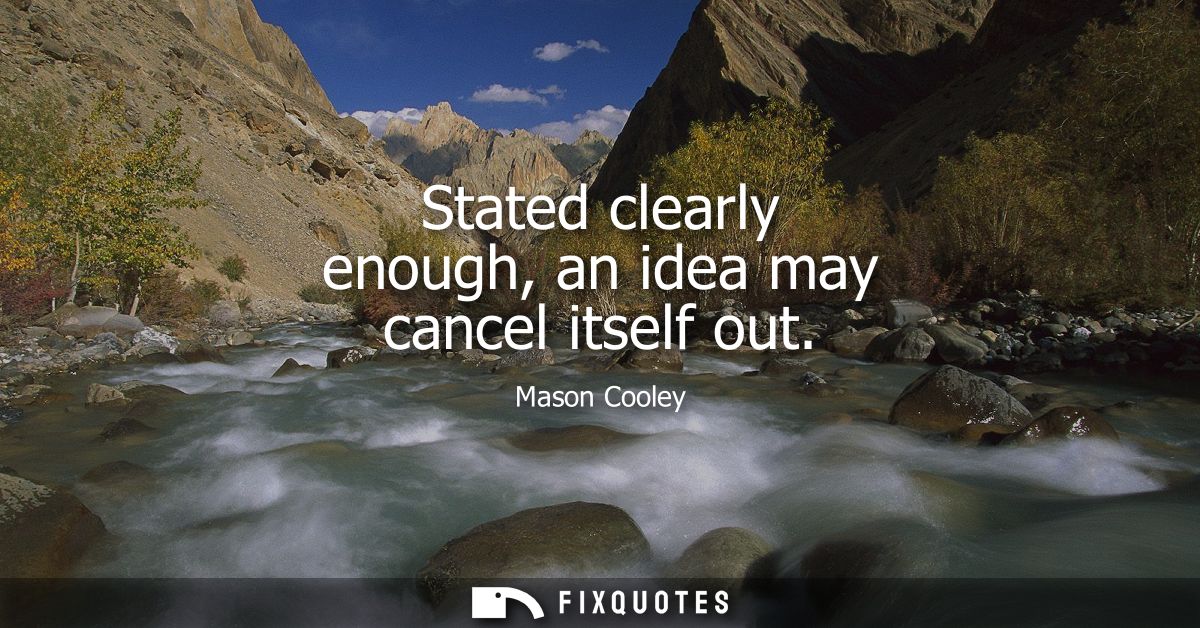
"Stated clearly enough, an idea may cancel itself out"
About this Quote
Clarity is supposed to be the moral good of ideas: strip away the fog and truth stands there, clean and undeniable. Cooley flips that piety with a dry little paradox. If an idea is stated clearly enough, it may cancel itself out not because language is treacherous, but because lucidity can reveal the hidden wiring: the contradictions, the self-serving assumptions, the unearned leap from premise to conclusion.
The line is a warning shot at rhetorical mystique. Plenty of notions survive by being only half-said, protected by vagueness, jargon, or the audience's desire to nod along. Pin the idea down with crisp definitions and a straight chain of logic, and you sometimes watch it collapse like a cheap tent. It is Cooley's way of describing a kind of intellectual solvent: precision. The sharper the phrasing, the harder it is to smuggle in ambiguity as evidence.
There's also a more unsettling implication: language doesn't merely deliver thought; it completes it. Some ideas feel coherent in the head because they're still atmospheric, not yet forced into the yes-or-no architecture of sentences. When you articulate them fully, you discover they were moods, not arguments.
Cooley, an aphorist working in the late-20th-century tradition of compressed skepticism, writes like someone who distrusts grand systems and loves the moment they break under their own weight. The quote isn't anti-clarity; it's pro-accountability. Say it plainly. Let it fail honestly if it deserves to.
The line is a warning shot at rhetorical mystique. Plenty of notions survive by being only half-said, protected by vagueness, jargon, or the audience's desire to nod along. Pin the idea down with crisp definitions and a straight chain of logic, and you sometimes watch it collapse like a cheap tent. It is Cooley's way of describing a kind of intellectual solvent: precision. The sharper the phrasing, the harder it is to smuggle in ambiguity as evidence.
There's also a more unsettling implication: language doesn't merely deliver thought; it completes it. Some ideas feel coherent in the head because they're still atmospheric, not yet forced into the yes-or-no architecture of sentences. When you articulate them fully, you discover they were moods, not arguments.
Cooley, an aphorist working in the late-20th-century tradition of compressed skepticism, writes like someone who distrusts grand systems and loves the moment they break under their own weight. The quote isn't anti-clarity; it's pro-accountability. Say it plainly. Let it fail honestly if it deserves to.
Quote Details
| Topic | Reason & Logic |
|---|---|
| Source | Help us find the source |
| Cite |
Citation Formats
APA Style (7th ed.)
Cooley, Mason. (2026, January 16). Stated clearly enough, an idea may cancel itself out. FixQuotes. https://fixquotes.com/quotes/stated-clearly-enough-an-idea-may-cancel-itself-127823/
Chicago Style
Cooley, Mason. "Stated clearly enough, an idea may cancel itself out." FixQuotes. January 16, 2026. https://fixquotes.com/quotes/stated-clearly-enough-an-idea-may-cancel-itself-127823/.
MLA Style (9th ed.)
"Stated clearly enough, an idea may cancel itself out." FixQuotes, 16 Jan. 2026, https://fixquotes.com/quotes/stated-clearly-enough-an-idea-may-cancel-itself-127823/. Accessed 12 Feb. 2026.
More Quotes by Mason
Add to List