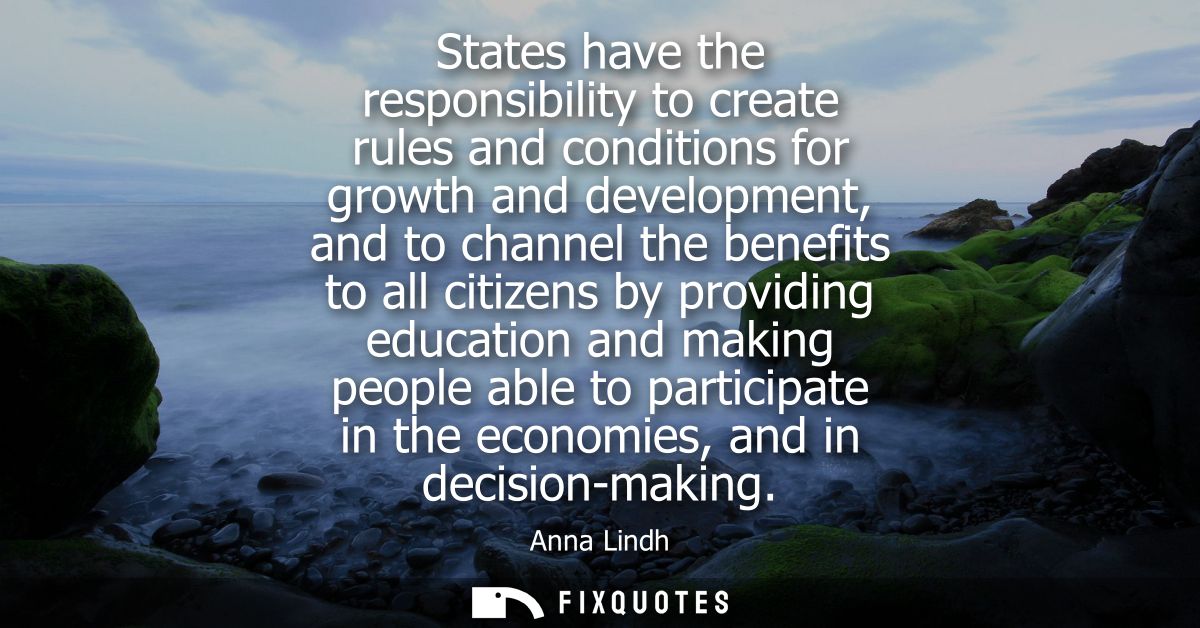
"States have the responsibility to create rules and conditions for growth and development, and to channel the benefits to all citizens by providing education and making people able to participate in the economies, and in decision-making"
About this Quote
The subtext is about risk management and moral accounting. Growth, in this framing, is not an automatic public good; it can concentrate power and wealth unless rules and institutions actively “channel the benefits.” That verb matters: it suggests a strong state not as a bulldozer, but as a set of levers and channels shaping outcomes. She’s arguing for a state that does two things at once: builds capacity (education, skills, access to labor markets) and protects democracy itself by enabling participation “in decision-making.” That last clause quietly ties economic policy to civic stability: if people can’t meaningfully participate in the economy, they eventually stop believing in the political system that governs it.
Context matters because Lindh wasn’t a theorist; she was a Swedish foreign minister navigating EU integration debates, post-Cold War optimism, and the early warning signs of polarization. The rhetoric works because it fuses technocratic language (“rules and conditions”) with a democratic promise: prosperity has to be legible and shared, or it becomes a solvent of trust.
Quote Details
| Topic | Human Rights |
|---|---|
| Source | Help us find the source |
| Cite |
Citation Formats
APA Style (7th ed.)
Lindh, Anna. (2026, January 17). States have the responsibility to create rules and conditions for growth and development, and to channel the benefits to all citizens by providing education and making people able to participate in the economies, and in decision-making. FixQuotes. https://fixquotes.com/quotes/states-have-the-responsibility-to-create-rules-39568/
Chicago Style
Lindh, Anna. "States have the responsibility to create rules and conditions for growth and development, and to channel the benefits to all citizens by providing education and making people able to participate in the economies, and in decision-making." FixQuotes. January 17, 2026. https://fixquotes.com/quotes/states-have-the-responsibility-to-create-rules-39568/.
MLA Style (9th ed.)
"States have the responsibility to create rules and conditions for growth and development, and to channel the benefits to all citizens by providing education and making people able to participate in the economies, and in decision-making." FixQuotes, 17 Jan. 2026, https://fixquotes.com/quotes/states-have-the-responsibility-to-create-rules-39568/. Accessed 27 Mar. 2026.